Remember to star our public account ⭐️ to receive timely updates.
01 News Introduction: A Milestone Event for Domestic GPGPU
On September 15, Loongson Technology announced that its first self-developed GPGPU chip, the 9A1000, has completed tape-out this quarter, marking a key breakthrough for domestic GPUs from “integrated cores” to “independent chips.” As a core component of computing systems, the long-standing reliance on imported GPUs is set to change, and this event holds strategic significance for the autonomy and control of computing power in critical industries such as government and energy..
02 Technical Analysis: Architectural Innovation and Performance Leap
Architecture Upgrade and Core Parameters
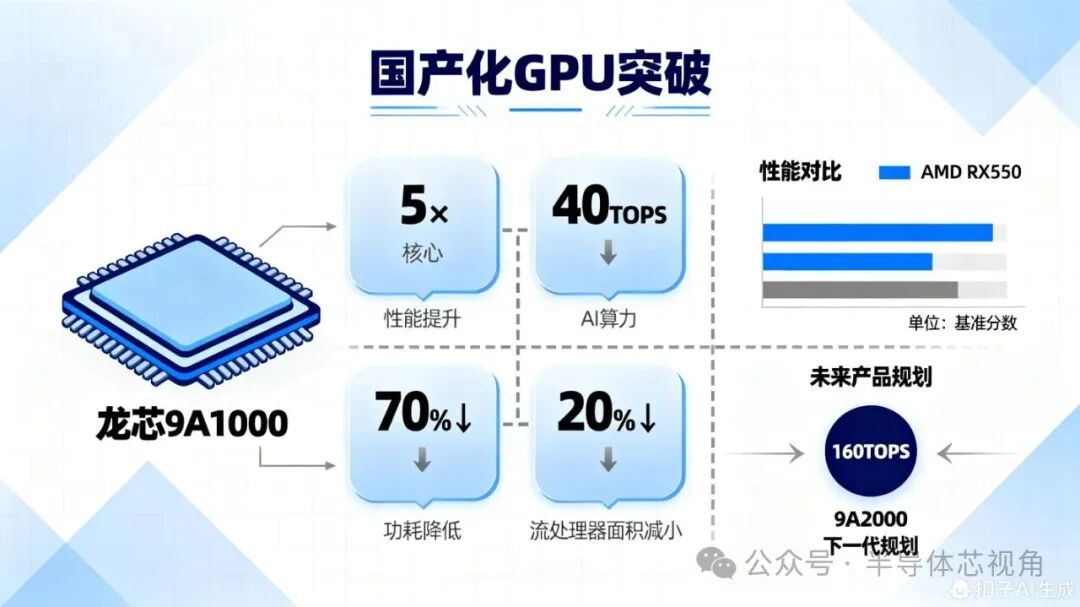
The 9A1000 is positioned for entry-level dedicated computing scenarios, utilizing an advanced architecture to achieve INT8 AI performance greater than 32 TOPS, supporting OpenGL 4.0 graphics standards and H.264/H.265 encoding/decoding. Key optimizations include: a 20% reduction in stream processor area, a 70% decrease in light-load power consumption, and a 25% increase in clock frequency, forming a “low power + high computing power” technical combination..
Generational and International Comparison
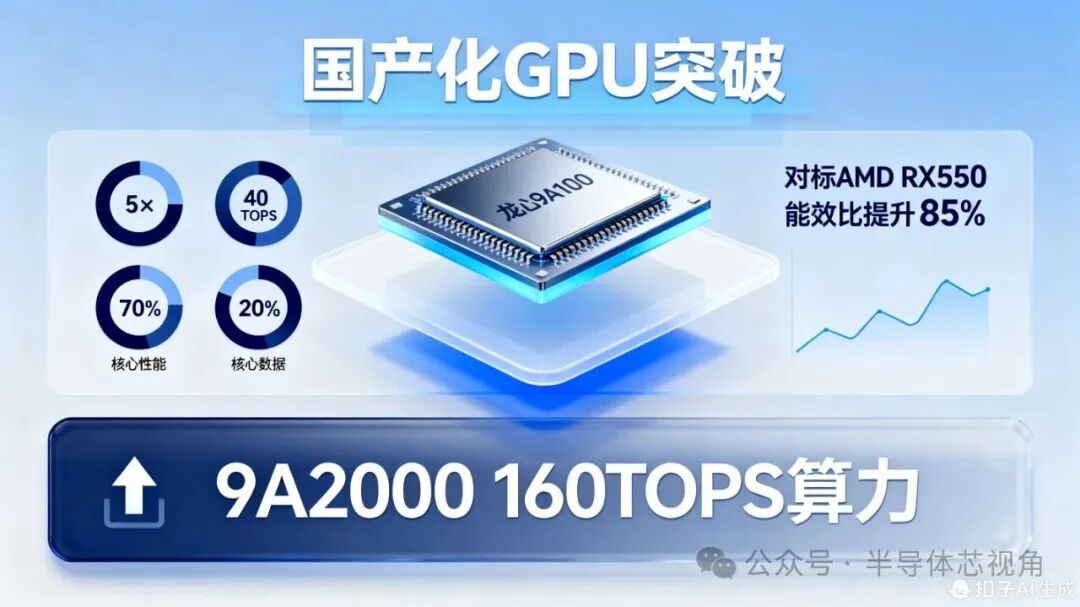
Compared to the previous generation LG200, the 9A1000 achieves a 5-fold increase in core performance, and AI computing power reaches 40 TOPS. Through doubling the graphics pipeline and area optimization technology, it achieves a performance leap in a smaller chip size. Compared to the international competitor AMD RX550, its INT8 computing power advantage (>32 TOPS) and domestic characteristics create differentiated competitiveness, although there is still a gap in graphics API version support..
03 Significance of Domestic Production: Breaking Monopolies and Ensuring Autonomous Control of the Industrial Chain
As a core component of computing power, the GPU market has long been monopolized by foreign manufacturers. The 9A1000, based on Loongson’s self-developed LoongArch instruction set, is fully domestically produced from architectural design to tape-out verification, meeting the “computing power security” needs of critical industries. This breakthrough validates the full-chain capability of domestic GPUs from design to manufacturing, promoting “autonomous controllable replacement” in fields such as government and electricity..
04 Market Positioning: Focusing on AI Inference and Edge Computing
32 TOPS INT8 computing power combined with a 70% reduction in power consumption makes the 9A1000 precisely suitable for edge computing scenarios: industrial IoT terminals, smart security devices, etc., which require “low power + high AI performance.” It complements the Loongson 2K/3A series CPUs, creating a domestic solution that covers general computing and heterogeneous acceleration, filling the gap in the lightweight intelligent acceleration market..
05 Future Plans: 9A Series Technology Roadmap
The 9A2000, set to launch in 2026, will adopt a four-chip integrated architecture to achieve INT8 computing power of 160 TOPS, supporting BF16/FP8 data types and OpenGL 4.6, targeting the mid-to-high-end AI inference market. The subsequent 9A3000 plans to achieve performance leaps through architectural innovation and process upgrades, gradually building a domestic GPU product line covering entry-level to high-end..
06 Expert Opinions and Industry Reactions
Su Menghao, head of Loongson’s general GPU R&D, pointed out that the 9A1000 achieves a breakthrough of “5-fold performance increase + 70% power reduction” through a 20% reduction in stream processor area and architectural optimization. Chairman Hu Weiwu emphasized the strategy of “achieving lower costs, higher performance, and better ecology through self-reliance,” providing a technical benchmark for the construction of the domestic GPU ecosystem..
Industry analysis believes that this breakthrough marks the transition of domestic GPUs from “technical validation” to “scene implementation,” and the subsequent ecological adaptation progress will impact the construction of domestic computing power infrastructure.
We are deep observers penetrating the technical fog with chips as our anchor. Focusing on hardcore analysis of chip technology, tracking global capacity and policy dynamics, and collecting real-world stories from engineers. We deconstruct industries with technical details and connect ecosystems with warmth — understanding the industrial code of each chip, remember to follow us!