The last experiment in class on October 13 was to prove this. I wasn’t very good at manual proofs, but a numerical simulation code solved it in no time. It has been inconvenient to write mathematical formulas on WeChat, so I delayed for more than a month before writing this article. The Fourier transform is often understood as a “tool for viewing the frequency spectrum.” However, from another perspective, it can be seen as a transformation of the signal from the “time coordinate system” to the “frequency coordinate system,” while keeping the energy unchanged. Behind this is the famous Parseval’s theorem and a key concept in linear algebra: the unitary matrix.In linear algebra, a unitary matrix U satisfies: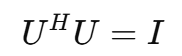
Geometrically, a unitary matrix represents an “orthogonal transformation in complex space” that preserves the length (norm) of vectors, and energy is precisely the square of the vector’s 2-norm. Thus, we can express the DFT as a suitably scaled unitary matrix, leading to Parseval’s theorem, which states that “time domain energy = frequency domain energy.”
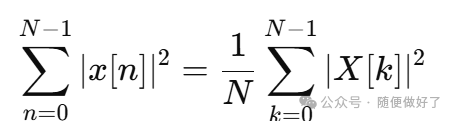
Here we find that there is a coefficient. Without keeping you in suspense, the actual DFT matrix differs from the definition of U, and normalization leads to a coefficient difference of 1/N in the 2-norm.
Matlab simulation results:
===== Using fft to Verify Parseval’s Theorem =====
Time domain energy E_time = 84.118013722769
Frequency domain energy E_freq = 84.118013722769
Difference |E_time-E_freq|= 0.000e+00
The numerical results show that the time domain energy <span>87.142323852243</span> is consistent with the frequency domain energy calculated using Parseval’s formula within the precision range, experimentally verifying that “under the standard DFT definition, the time domain energy equals the frequency domain energy” according to Parseval’s theorem.
===== Unitarization of DFT Matrix and Verification of U^H U = I (N = 8) =====
||U^H U – I||_F = 2.733e-15
After unitarizing the DFT matrix for N=8, the calculation results are close to machine precision, indicating that it is a strict unitary matrix. This supports the view from linear algebra that the discrete Fourier transform, after appropriate normalization, is essentially an energy-preserving “rotation” transformation.
===== Using Unitary DFT to Verify Energy Conservation (N = 128) =====
Time domain energy E_time_u = 80.000000000000
Frequency domain energy E_freq_u = 80.000000000000
Difference |E_time_u-E_freq_u| = 8.527e-14
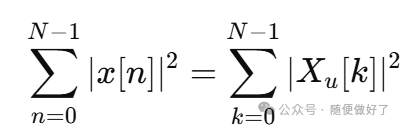
Under the definition of the unitary DFT, the total energy difference between the time and frequency domains is only 8.5×10^−14. At this point, Parseval’s theorem no longer carries an additional 1/N coefficient, but is expressed in the most symmetric form as: