On November 19, 2025, local time, Tesla CEO Elon Musk and NVIDIA CEO Jensen Huang participated in a panel discussion at the U.S.-Saudi Investment Forum held in Washington, focusing on the latest advancements in artificial intelligence and technology, concentrating on future core areas such as AI factories, robotics, and space computing — this is not only a peak dialogue in the tech industry but also a new chapter in the global technological revolution.
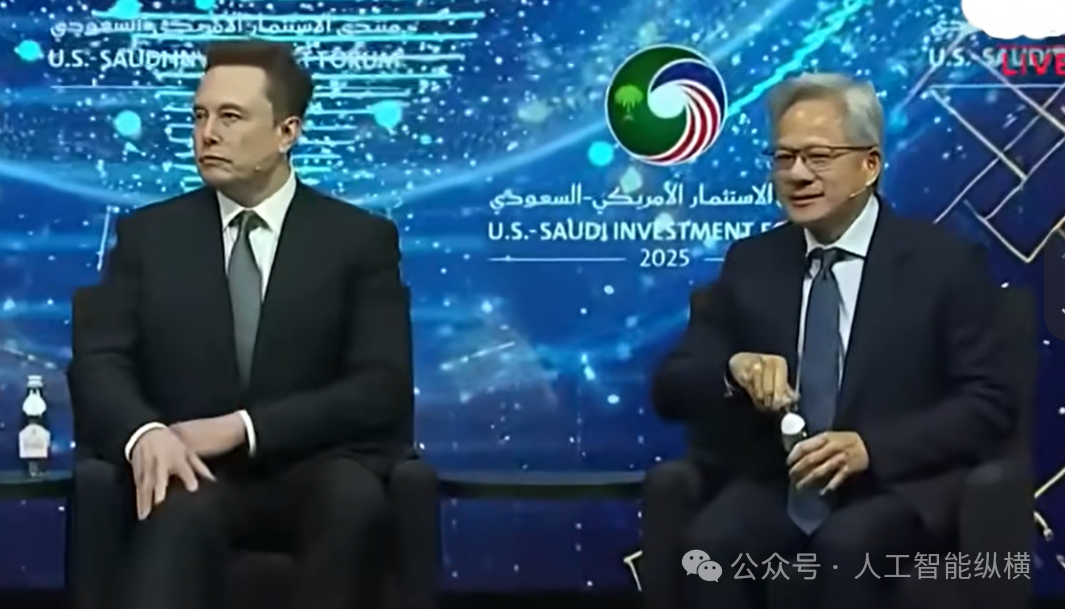
Interestingly, Huang was dressed in a suit that day instead of his usual leather jacket.
1. Insights from Industry Leaders: Reshaping the Underlying Logic of the Industry
Elon Musk: The Essence of First Principles is ‘Creation, Not Disruption’
In response to the question of “how to reshape the industry using first principles,” Musk provided a core answer: “Most of the time, it’s not about disruption, but about creation.”
From SpaceX’s reusable rockets (which had no true counterparts before) to Tesla reducing battery costs from $1000 per kWh to over $100, and now targeting the humanoid robotics field — he has always focused on “filling the gaps”: “Currently, there are no truly useful humanoid robots, only gimmicky products.”
Musk’s ambitions go beyond this: “Tesla will create the first truly useful general-purpose humanoid robots, and this will be a revolution.” In his view, humanoid robots will become “the largest and most important product in history,” far exceeding the scale of smartphones, and the ultimate value of AI and robotics is to “completely eliminate poverty,” allowing all humanity to live prosperous lives.
Jensen Huang: AI is Infrastructure, the Generative Revolution is Just Beginning
“AI is an infrastructure,” Huang’s judgment is clear and firm. In his view, digital intelligence will permeate every industry, company, and country, and the core change of this revolution is the iteration of computing methods: in the past, it was “retrieval-based computing” — systems merely found content created by humans in advance; now it is “generative computing” — software generates unique answers in real-time based on identity and context. To support this real-time generation, AI factories must be built globally, marking a new computing paradigm.
The combination of “AI factories + robots” will lead to explosive growth in productivity. Huang emphasized: “In the future, we will use millions of robots to enhance the workforce, which is the core of the next wave of productivity revolution.”
2. Employment Anxiety? The ‘Calming Pill’ Offered by Industry Leaders
Technological revolutions inevitably come with concerns about employment, and Musk and Huang provided answers from different dimensions.
Long-term: Work Becomes a ‘Voluntary Option’, Currency May Lose Meaning
Musk’s perspective looks 10-20 years ahead: “Work will become optional, just like today you can grow your own vegetables or buy them.” As AI and robots continue to advance and material wealth increases significantly, “currency may gradually lose its meaning.” He recommended the Ian M. Banks “Culture” series of novels, which depict a positive AI future — this is not mere talk, but an inevitable trend of technological iteration.
Short-term: Work Changes ‘Different’, Not Disappearing
Huang dispelled concerns with real-world examples: “Radiologists were once thought to be the first to be replaced by AI, but in reality, the number of radiologists worldwide is actually increasing.” AI has improved reading efficiency by dozens of times, allowing doctors to see more patients and engage in deeper communication, significantly enhancing hospital diagnostic levels.
“Tedious and difficult tasks will become simpler, productivity will increase significantly, but jobs will not disappear,” Huang said with a smile, “Elon and I will actually be busier because AI allows us to realize our ideas faster.”
3. Major Announcement! 500 MW Super AI Data Center, Startups ‘Soaring’
Musk announced first that he will partner to build a 500 MW super AI data center in Humanne (Phase 1: 50 MW), utilizing NVIDIA’s latest technology. Huang quickly added: “AWS has also signed a contract with Humanne for the first phase of 100 MW, with future goals reaching the gigawatt level.”
Notably, Humanne is a “startup with almost zero revenue,” yet it has secured such a significant order right from the start. Additionally, NVIDIA’s collaboration will use the Omniverse platform for digital twin factories, robot training, and advance the construction of supercomputers for simulating quantum computers — a new global AI core node is rising.
4. AI Bubble Theory? Huang Shatters Doubts with Three Realities
In response to market concerns about an “AI bubble,” Huang provided a resounding response, revealing three core realities that demonstrate the inevitability of AI development:
- The end of Moore’s Law, with global computing demand far exceeding traditional CPUs, and the proportion of accelerated computing in the top 500 supercomputers has surged from 10% six years ago to over 90%;
- The recommendation systems driving the internet are fully transitioning to generative AI;
- Hundreds of billions of dollars worth of traditional data processing tasks (SQL, data frames, etc.) are migrating to GPUs.
“The computing power truly used for top-level generative AI is far less than everyone imagines, and every penny is worth it,” Huang emphasized, stating that these three trends are sufficient to support the surge in computing power construction, and the AI revolution is not a bubble, but a reality that is happening.
5. The Next Stop for AI: Space! Computing Costs Will Be Lower Than on Earth in Four to Five Years
When asked whether AI would “go to space,” Musk provided an imaginative answer: “AI going to space is inevitable.”
His logic is simple and robust: Earth only receives one two-billionth of the energy from the sun, to achieve even a small part of Kardashev Type I civilization (utilizing more than one millionth of the sun’s energy), solar-powered AI satellites must be deployed in deep space. More importantly, the space environment is conducive to chip cooling (pure radiative cooling without water), and solar panels are cheaper and “never set,” eliminating the need for energy storage batteries.
“In as little as four to five years, the comprehensive cost of AI computing in space will be far lower than on Earth,” Musk asserted, “Building hundreds of gigawatts on the ground is already difficult, let alone terawatt levels, which can only be achieved in space.”
6. Conclusion: From Intelligence to Space, the Next Journey of Human Civilization
This peak dialogue among tech giants outlines a clear blueprint for the era of AI + robotics, with explosive growth in productivity, reshaping of work forms, the rise of space computing, and gradual elimination of poverty…
As both leaders stated, technological revolutions do not shift according to human will, but they bring not panic, but a better future. When AI becomes infrastructure, when robots become partners, and when space becomes a new computing frontier, human civilization stands at a critical juncture towards a new era of intelligence.
#ComputingPower #Algorithms #Data #Applications #Governance
Welcome to follow! → Click one【Like】and【Little Red Heart】