1. NVIDIA Core Architecture and Technical Features
1. Consumer-grade GPU (GeForce Series)
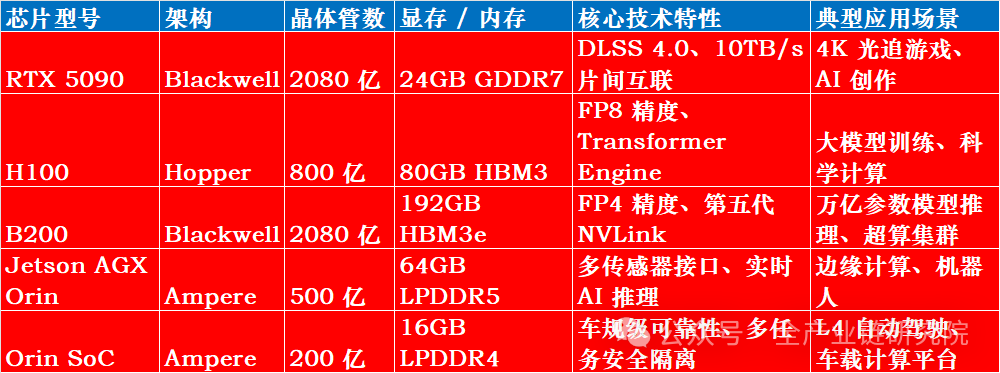
RTX 50 Series (Blackwell Architecture) manufactured using TSMC’s 4NP process, with a transistor density of 208 billionNVIDIA, equipped with the fifth-generation Tensor Core and fourth-generation RT Core, supporting DLSS 4.0 (multi-frame generation technology) and 10TB/s interconnect bandwidthNVIDIA.The flagship model RTX PRO 6000 workstation version features 24,064 CUDA cores, 96GB GDDR7 ECC memory, single-precision floating-point performance of 125TFlops, and a power consumption of 600W, designed for professional rendering and AI inference.RTX 40 Series (Ada Lovelace Architecture) with second-generation RT Core and fourth-generation Tensor Core, supports DLSS 3.5 (ray reconstruction), with memory bandwidth improved by 50% compared to the previous generation, suitable for high-resolution gaming and light AI applicationsNVIDIA.
2. Data Center and AI Acceleration Chips
H100 (Hopper Architecture) with 80 billion transistors, 80GB HBM3 memory, fourth-generation Tensor Core supporting FP8 precision, Transformer Engine accelerating large model training, with single-card AI computing power reaching 60P FLOPS.The China-specific version H800 reduces NVLink bandwidth to 400GB/s to meet domestic compliance requirements.H200 (Hopper Architecture Upgrade) with 141GB HBM3e memory, bandwidth of 4.8TB/s, throughput improved by 15-20% when processing 1T parameter models, suitable for ultra-large-scale pre-training.B200 (Blackwell Architecture) with 208 billion transistors, 192GB HBM3e memory, bandwidth of 8TB/s, supporting FP4 precision, AI computing power reaching 18P FLOPS, utilizing fifth-generation NVLink (1.8TB/s bidirectional bandwidth), scalable to 576 GPU clustersNVIDIA.GB200 Super Chip integrates 2 B200 GPUs and 1 Grace CPU, achieving rack-level liquid cooling design through NVLink, with AI performance 65 times that of the H100 system, designed for trillion-parameter modelsNVIDIA.GB300 Super Chip manufactured using TSMC’s 4NP process, based on a dual-mask large chip design, integrates 208 billion transistors, with 160 SM units, each SM containing 128 CUDA cores, totaling 20,480 CUDA cores and 640 fifth-generation Tensor cores, and equipped with 40MB TMEM.
3. Edge Computing and Embedded Chips (Jetson Series)
Jetson AGX Orin 64GB version provides 275TOPS (INT8) computing power, integrating 2048 CUDA cores, 64 Tensor Cores, and 12 Cortex-A78AE CPU cores, supporting multi-sensor fusion and real-time video processing, with a power consumption of 15-60W, suitable for robotics, drones, and industrial automation.
4. Autonomous Driving Chips (Orin Series)
Orin SoC designed for L4 level autonomous driving, with 254TOPS computing power, supporting multi-camera, LiDAR, and millimeter-wave radar fusion, already applied in models from Xiaopeng and NIO.
2. Key Parameter Comparison
 3. Application Scenarios and Market Positioning
1. Gaming and Creative Design
- RTX 50 Series: Achieves 4K 120FPS + frame rates in games like Cyberpunk 2077 through DLSS 4.0 and ray tracing technology, while supporting GPU-accelerated rendering for Blender and the entire Adobe suiteNVIDIA.
- RTX PRO Series: Optimized for 3D modeling (such as Autodesk Maya) and visual effects (such as NVIDIA Omniverse), with 96GB memory capable of handling ultra-large-scale scenes.
2. AI and Data Centers
- H100/H200: Supports training of hundreds of billions of parameter models like ChatGPT, with single-card training speed improved 3 times compared to A100, and an 8-card cluster capable of handling 200B parameter models.
- B200/GB200: The Transformer engine of the Blackwell architecture accelerates attention layers by 2 times, and confidential computing technology protects sensitive data, suitable for fields with high security requirements such as finance and healthcareNVIDIA.
3. Edge and Embedded Computing
- Jetson AGX Orin: Analyzes 16 channels of 4K video streams in real-time for industrial quality inspection, with a power consumption of only 20W; implements crop health monitoring and path planning in agricultural drones.
- Orin SoC: Supports autonomous driving domain controllers processing data from 20 camera feeds and LiDAR point clouds simultaneously, with latency below 20ms, meeting automotive-grade ASIL-D certification.
4. Future Technology Trends
- GB300 (to be released in 2025): Adopts CPO (Co-Packaged Optics) technology, with inter-chip transmission rates reaching 1.6Tbps, power consumption reduced by 40%, driving optical communication into the high-speed era.
- Fifth-generation NVLink: Supports 576 GPU clusters, with bandwidth reaching 130TB/s, capable of building Exascale supercomputers, accelerating climate simulations and drug developmentNVIDIA.