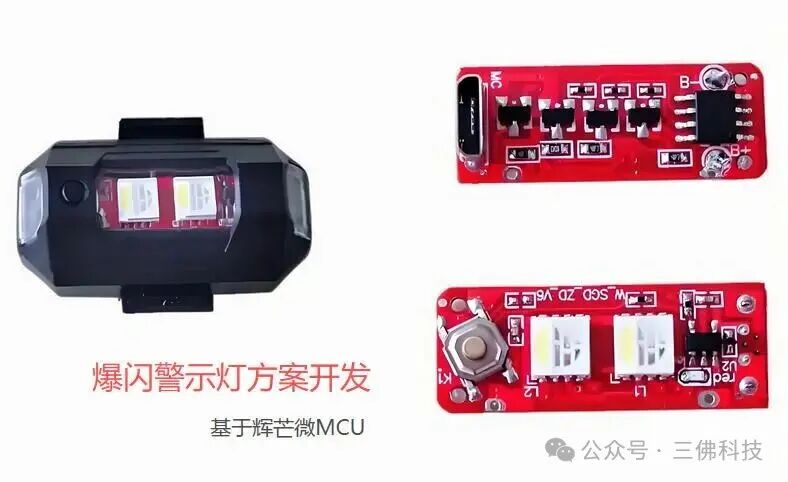
In scenarios such as traffic safety, emergency command, and construction warnings, high-brightness flashing warning lights play a crucial role as a visual warning method. Traditional warning lights often use simple timing circuits or low-performance microcontrollers, leading to issues such as insufficient brightness, high power consumption, and limited functionality. Shenzhen Sanfo Technology has proposed a control solution for flashing warning lights based on the high-performance FMD series MCU, featuring high brightness output, multiple flashing modes, low power operation, and strong scalability, making it suitable for various portable or fixed warning devices.
Solution Overview (Selection for Different Scenarios)
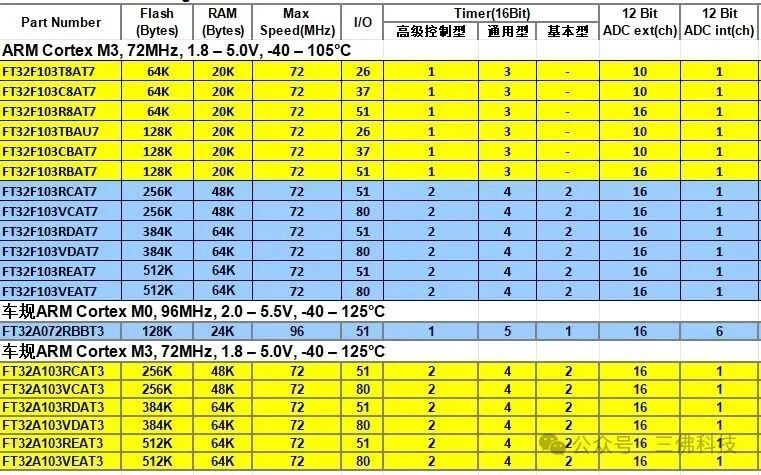
This solution uses the FMD series MCU from Huimangwei as the main control chip to drive a high-brightness LED array to achieve a flashing effect. By utilizing the MCU’s PWM module, timers, GPIO, and other resources, it precisely controls the LED on-off frequency and duty cycle to realize multiple flashing modes. Additionally, it supports external triggering, light-sensitive automatic adjustment, and low battery indication functions.The basic model of the warning light (such as temporary construction lights) primarily uses the 8-bit MCU from Huimangwei: it features 16KB of Flash storage (capable of storing multiple flashing programs) and 256B of RAM (sufficient for real-time data processing). The 8 GPIO interfaces can stably drive 4-6 groups of LED arrays, and the 2.0-5.5V wide voltage design perfectly adapts to AA batteries or small lithium batteries, making it especially suitable for portable devices.For mid-to-high-end models (such as smart emergency lights and tunnel maintenance lights), the FT32F030 32-bit MCU is recommended: with a 72MHz main frequency, it can quickly process data from multiple sensors, and the 12-bit ADC module (accuracy ±1LSB) can accurately collect parameters such as illumination, voltage, and temperature. The industrial-grade wide temperature range of -40~105℃ can handle extreme environments with significant temperature fluctuations in tunnels. Both chips adopt UltraEE technology, with DROM endurance of up to 1 million times, ensuring stable operation for over 5 years even with high-frequency flashing (approximately 100,000 times per day).
Core Function Design
1. Multiple Flashing Modes
Through the internal timer and PWM module of the MCU, the following flashing modes can be achieved:
| Mode Number | Mode Name | Description |
|---|---|---|
| 1 | Single Flash | Single high-brightness flash, interval of 1 second |
| 2 | Double Flash | Fast double flash, interval of 0.5 seconds |
| 3 | Triple Flash | Continuous three flashes, simulating police light effect |
| 4 | Fast Flash | High-frequency flashing, frequency of 10Hz |
| 5 | Custom Mode | Users can customize the frequency via buttons or serial port |
2. Automatic Light Sensitivity Adjustment (Optional)
By connecting an external light-sensitive resistor or digital light sensor, the MCU can real-time collect the ambient light intensity and automatically adjust the LED brightness, achieving high brightness during the day and low brightness at night, thus avoiding light pollution and saving energy.
3. Low Power Design
The MCU supports various low-power modes (Sleep/Stop/Standby), with standby current as low as a few microamps; the non-essential modules are automatically turned off during flashing intervals; it supports battery voltage detection, automatically reducing brightness or extending flashing intervals when the battery is low, thus prolonging battery life.
4. External Triggering and Linkage Control
Reserved external trigger interfaces (such as infrared, vibration, wireless modules) can achieve the following functions: automatically start flashing upon receiving a trigger signal; support linkage of multiple light groups to achieve synchronous or alternating flashing; communicate with the main control system via UART or I2C, integrating into a larger system platform.
Advantages of the Solution
| Feature | Description |
|---|---|
| High Reliability | Huimangwei MCU industrial-grade stability, suitable for harsh environments |
| Strong Flexibility | Supports multiple flashing modes and custom settings, adaptable to different application scenarios |
| Low Power Consumption | Supports various power-saving strategies, suitable for battery-powered portable devices |
| Easy Development | Officially provides complete SDK and reference designs, short development cycle |
| Cost Control | Simple solution, fewer components, suitable for large-scale production |
Application Scenarios
-
Road construction warning lights
-
Auxiliary flashing lights for police cars/ambulances
-
Night warning lights for electric bicycles
-
Emergency command identification lights
-
Warning modules for smart wearable devices
Conclusion
The flashing warning light solution based on the Huimangwei MCU, with its high performance, low power consumption, and flexible control advantages, provides an intelligent upgrade path for traditional warning light products. In the future, it can further integrate wireless communication, remote control, solar power supply, and other functions, expanding into a broader field of smart transportation and security.If you need the schematic, source code, or demo board information for this solution, please contact the primary distributor of Sanfo Technology for technical support. This concludes the flashing warning light solution shared by Shenzhen Sanfo Technology. Shenzhen Sanfo Technology focuses on microcontroller application solution design and development, providing 8-bit and 32-bit microcontrollers.