
As one of the earliest listed chip companies in China, Allwinner Technology’s strength in this field is beyond doubt. However, in the past, when people talked about this veteran chip maker, the first impression was often its prowess in the consumer electronics sector. Indeed, relying on the R&D foundation laid since the tablet era in areas such as smart application processors SoC, high-performance analog devices, and wireless interconnect chips, Allwinner has recently excelled in various product markets including smart hardware, smart robotics, smart home appliances, smart IoT, tablets, network set-top boxes, as well as power analog devices and wireless communication modules.
Especially in many emerging consumer electronics fields, Allwinner chips have significantly outperformed competitors in market share. Over the years, Allwinner has developed into a core supplier for several well-known domestic and international consumer electronics brands. Due to these brands’ high demands for product quality, Allwinner has continuously refined its chip quality, achieving standards comparable to industrial electronics. For example, a leading white goods manufacturer requires a smart refrigerator to have a lifespan exceeding 10 years; a leading robotic vacuum manufacturer has extremely high requirements for motor control and anti-static measures, etc.
Driven by such development
Allwinner naturally extended its chip product line
into the industrial sector
The industrial path, accumulating strength over time
Although less mentioned, Allwinner has been deeply involved in the industrial chip market for a long time.
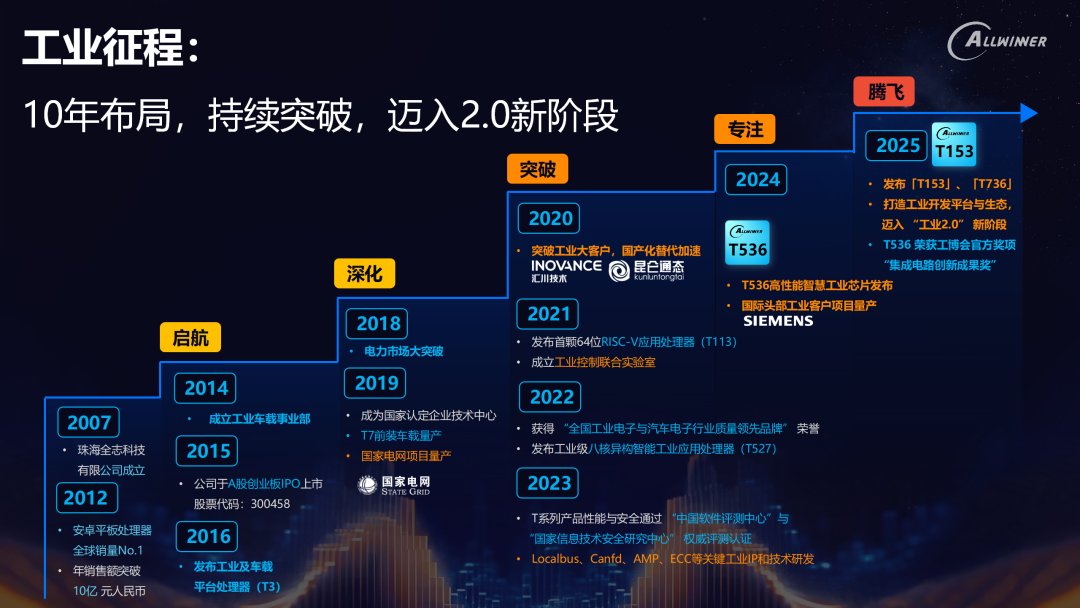
As early as 2014, the year before Allwinner’s A-share listing, the company established an industrial vehicle division focused on the R&D and market application of high-reliability, high-stability industrial-grade chips. Two years later, Allwinner launched its first dedicated processor T3 for the industrial sector. After nearly a decade of market testing, the Allwinner T3 is still widely used in various industrial products, with cumulative shipments exceeding 50 million units.
After making a strong entry into the industrial market with the T3, Allwinner further increased its investment in the industrial sector. By 2018, the company achieved a significant breakthrough in the power market, successfully entering the supply chain of the State Grid. In 2019, the company completed the entire process from R&D to mass production of power products in just one year. In 2020 alone, this product achieved an impressive annual shipment of 1 million units.
Since then
Allwinner has continued to develop rapidly in the industrial and power markets
In terms of commercial cooperation,the company has established strategic partnerships with leading companies in the industrial sector such as Inovance Technology and Kunlun Tongtai; in terms of technological innovation, in 2021, it jointly established an industrial control laboratory with Inovance Technology; in 2022, it successfully launched the industrial-grade octa-core heterogeneous smart application processor T527, which was awarded the title of “National Leading Brand in Industrial Electronics and Automotive Quality”; in 2023, Allwinner’s T series products successfully passed authoritative certification from the China Software Testing Center and the National Information Technology Security Research Center in terms of performance and safety; in the same year, significant progress was made in the R&D of key industrial IPs such as Localbus, CAN FD, AMP, and ECC; in 2024, Allwinner made its debut at the China International Industrial Expo, releasing the T536 chip designed specifically for industrial control, while also successfully achieving mass production of a project in collaboration with global industrial giant Siemens.
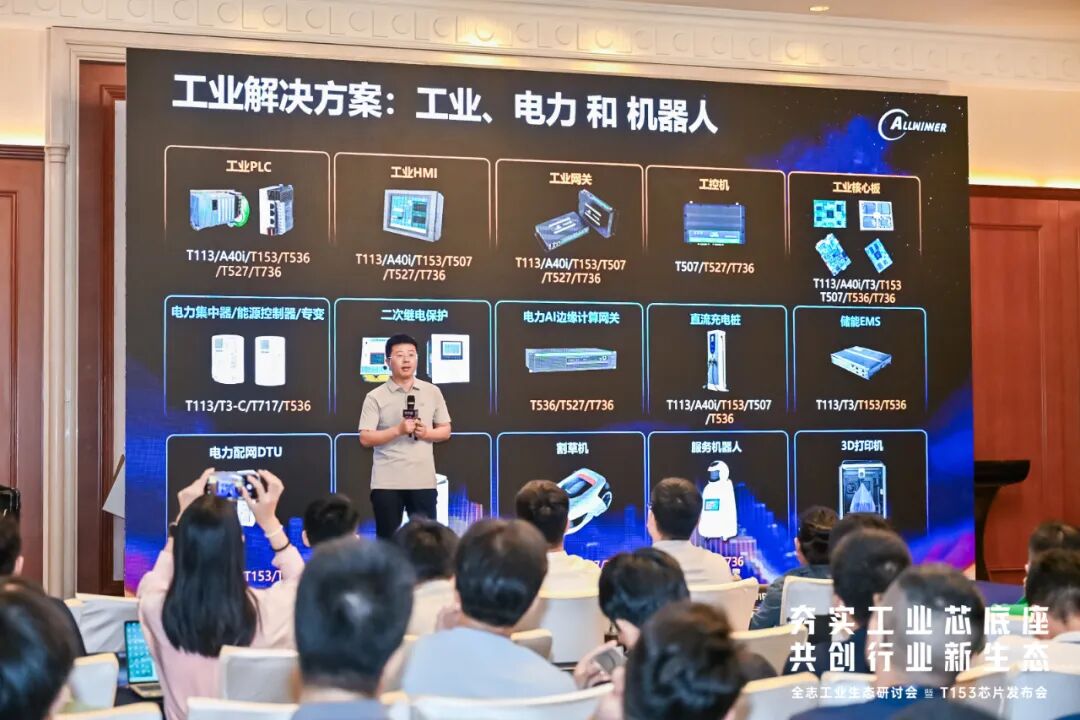
In the product field,Allwinner has continuously enriched its industrial chip lineup over the years. From the early T7, A40i, T507, T517, T113, and T527 to the recently released T536 and T736, Allwinner has created a platform SoC solution that covers all computing power, empowering various industries in the field of industrial intelligence through high-quality processes and advanced IP.
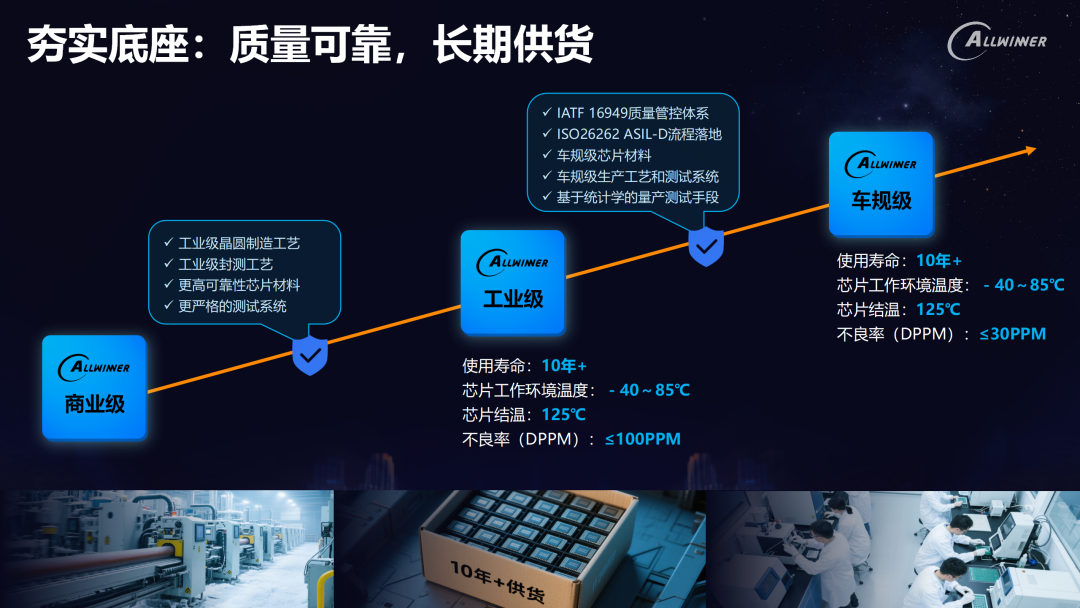
As Pi Jieyong, Deputy General Manager of Allwinner’s Industrial Vehicle Division, stated in a recent speech at the “Allwinner Industrial 2.0 Strategy Release Conference”: “After years of meticulous cultivation, Allwinner has established a ‘comprehensive industrial-grade and partially automotive-grade’ chip quality system, with the defect rate in the product market now fully ‘in the hundreds’, gaining recognition from leading industrial and automotive customers.”
Being able to break through in this highly competitive market with extreme demands for product performance and quality is attributed to Allwinner’s persistent investment over the years. Looking at the company’s recent financial reports, Allwinner’s investment in R&D has always remained high. According to the financial report data for the first half of this year, Allwinner’s R&D investment during this period reached 275.3792 million yuan, accounting for 20.60% of operating income, an increase of 4.28% compared to the same period last year, providing strong support for the company to create more competitive industrial chips.
At the recent Shanghai Industrial Expo’s closed-door session, Allwinner also showcased its high-performance industrial processor T153, which offers exceptional value.

“Chip” product launch, exceptional value
Before detailing the T153, Allwinner’s Vice President of Solution Operations, Zhu Zhenhua, emphasized: “This is a chip that offers exceptional value for industrial applications.”
It is well known that traditional industrial chips are mostly simple MCU-type chips that can only perform basic industrial control functions, but this is no longer sufficient to meet the demands of emerging industrial scenarios under the AI wave. In response to this situation,choosing to use high-performance consumer-grade chips as a transitional solution for AI industrial intelligence upgrades has led to new problems—traditional consumer-grade chips often result in redundant performance and functionality in industrial scenarios, and their reliability is also difficult to meet the stringent requirements of industrial environments.
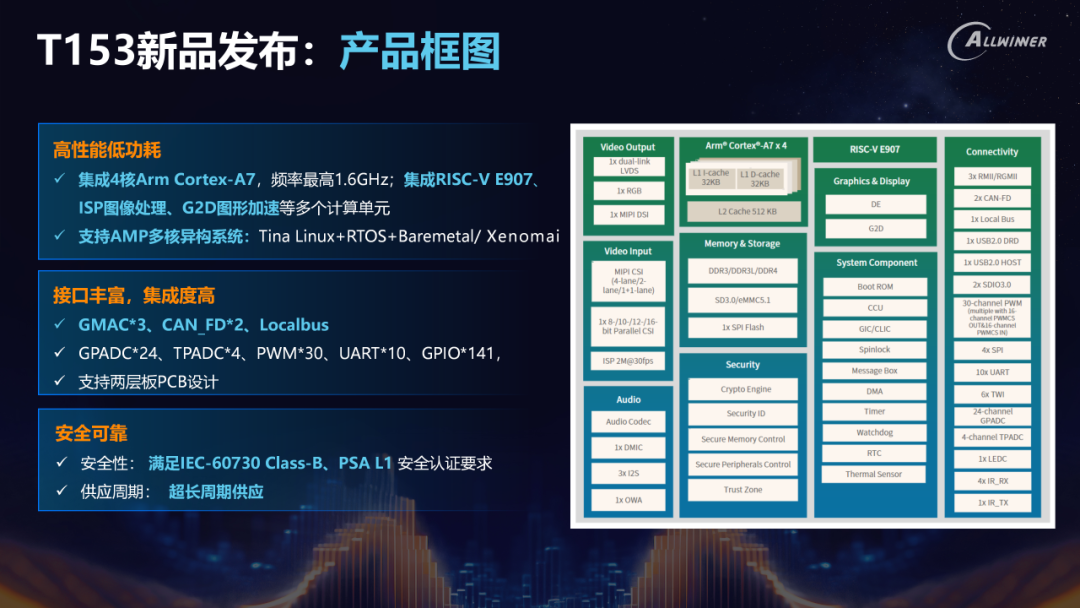
Based on these insights,Allwinner Technology has launched the T153. As a chip designed specifically for industrial scenarios, it can be widely applied in PLC, HMI, industrial gateways, and other industrial applications, the T153 features reliable computing power, high scalability, and an open software ecosystem tailored to smart industrial needs.
Part 01
In terms of computing power
Part 02
In terms of scalability
In terms of scalability, the chip benefits from a rich interface configuration.
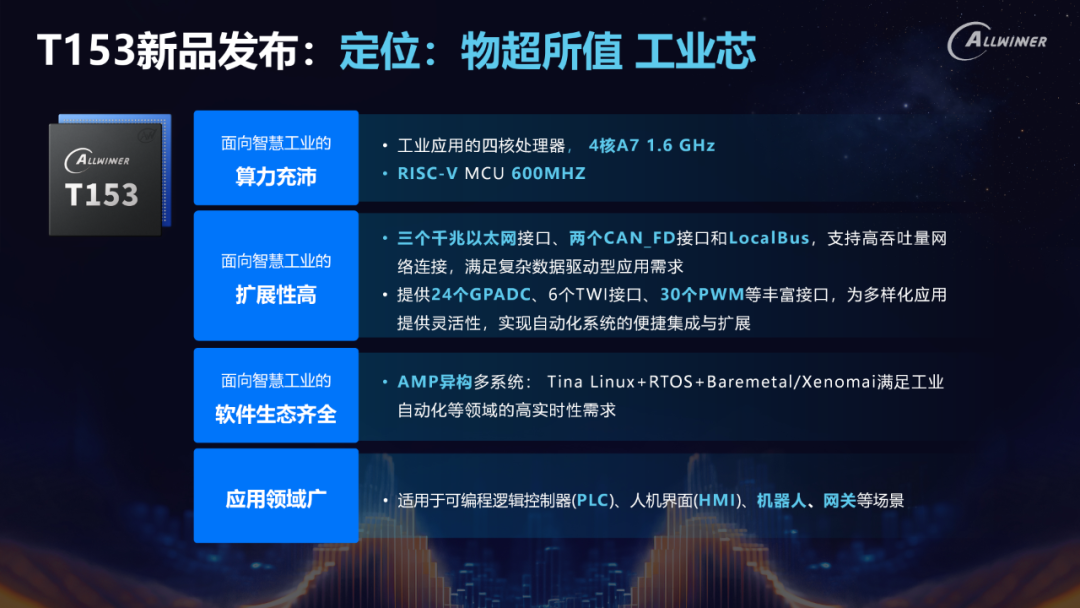
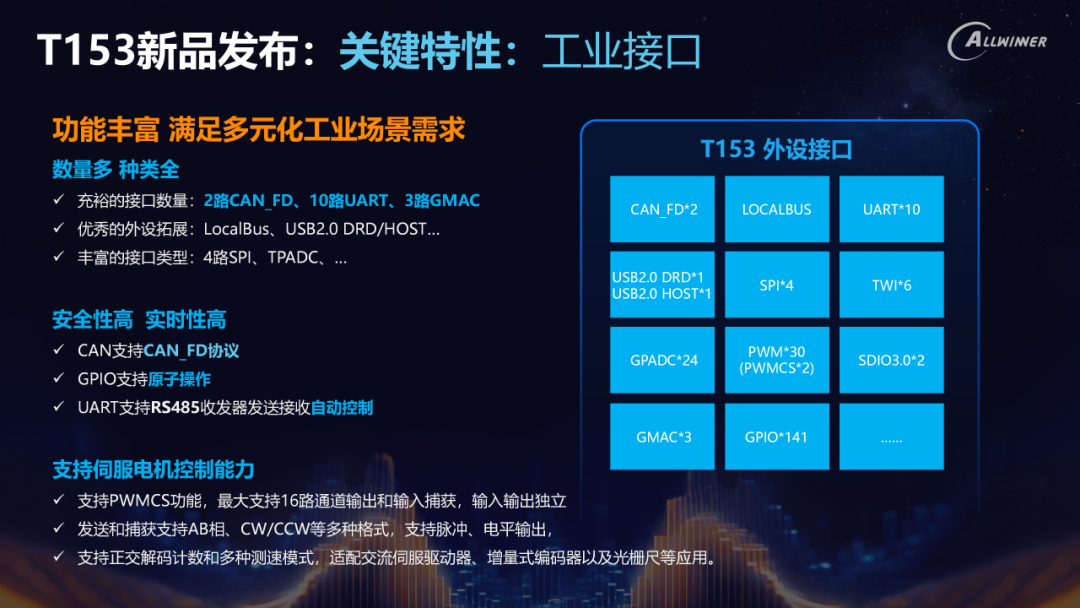
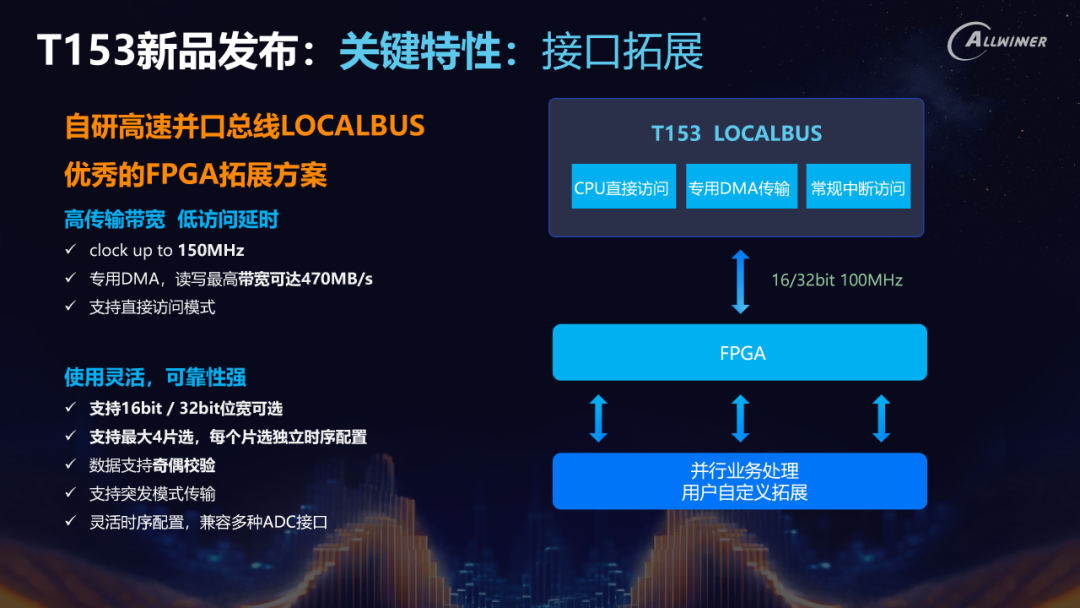
Zhu Zhenhua introduced that the T153 is equipped with three Gigabit Ethernet interfaces, two CAN-FD interfaces, and LocalBus, supporting high-throughput network connections to meet the needs of complex data-driven applications. Its integrated image signal processor and display engine can provide clear real-time visual feedback for precision manufacturing process management. As shown in the figure, the T153 also offers 24 GPADC, 6 TWI interfaces, 30 PWM, and other rich interfaces, providing flexibility for diverse applications and facilitating convenient integration and expansion of automation systems.

In addition, the T153 has another significant advantage, which is its outstanding performance in terms of safety. It is reported that this chip meets industrial safety certification requirements such as IEC-60730 Class-B and PSA L1, ensuring reliable operation in harsh industrial environments. Furthermore, the chip offers an ultra-long supply cycle, providing stable support for long-term projects of industrial customers.
To gain recognition in the industrial market, having a competitive chip is just the foundation; the ability to develop in synergy with software and ecosystem is another challenge posed by the industrial market to chips. This has also been a problem that the Allwinner team has focused on solving over the past few years.

Coordinated Software and Hardware Ecosystem, Empowering Smart Industry
The so-called industrial software ecosystem is a diversified ecosystem that is both traditional and innovative, both closed and open:
On one hand, the traditional industrial market already has a large existing base, and entering this market requires seamless adaptation of software and interface protocols to the existing industrial software ecosystem; on the other hand, the emergence of new industrial product forms, such as robotic arms, dexterous hands, and industrial-grade AI, has raised higher requirements for SoC chip software solutions, prompting continuous iteration and updating of software systems and frameworks to meet new demands.
In terms of software ecosystem, the T153 supports AMP heterogeneous multi-systems (Tina Linux + RTOS + Baremetal), a feature that allows it toflexibly configure multiple different operating systems, meeting the high real-time requirements in fields such as industrial automation, thereby building a complete software ecosystem for smart industry.
“Industrial software requiresstability, real-time performance, safety, and sustainability, supporting more industrial standard interfaces, compatibility, and strong scalability.” In his speech, Su Jiajia, General Manager of Allwinner’s System Software Center, mentioned. “Through continuous innovation in software architecture and ecosystem collaboration, Allwinner injects new vitality into industrial intelligent applications, continuously providing customers with ‘stable, real-time, safe, and sustainable’ solutions.”
From his introduction, we learned that Allwinner is continuously promoting the optimization of software platform operating systems for real-time performance, compatibility with mainstream industrial protocols, security hardening, and AI edge inference, striving to truly achieve ‘reliable hardware, easy-to-use software, and a complete ecosystem.’ Among them, the ‘one master and multiple slaves’ distributed architecture software is an important software achievement launched by the company in response to the needs of the industrial sector.
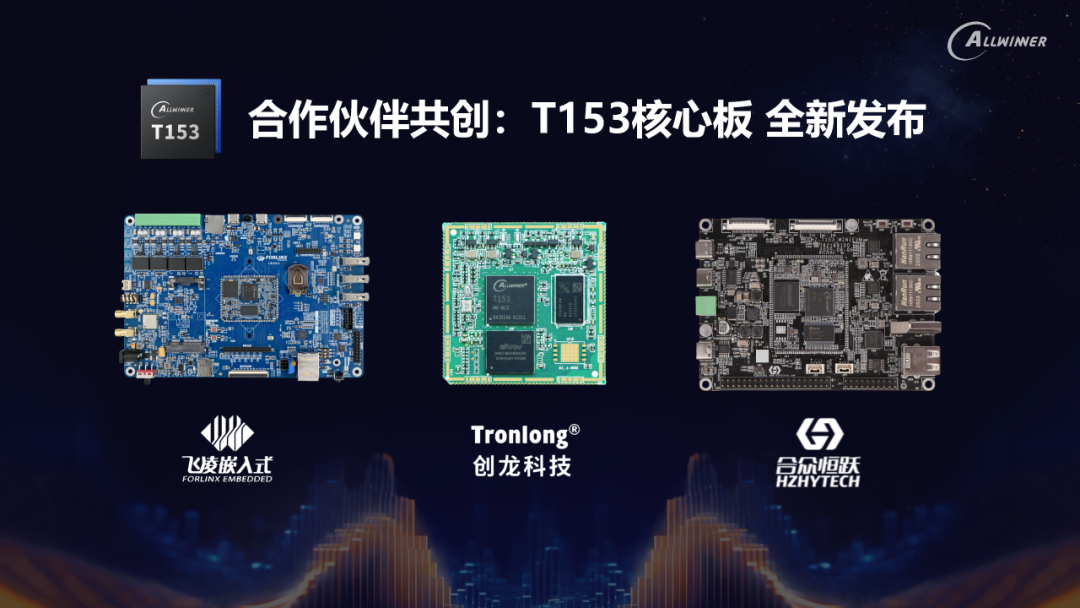
To enable developers to better utilize the company’s industrial chips, Allwinner has actively promoted the integration with mainstream industrial operating systems, protocol stacks, and development tools over the past few years, including collaborations with leading brand customers, solution providers, and software and technology partners, and is committed to building a complete development ecosystem from chips to systems, from hardware to applications, working together to promote the intelligent upgrade of the industry.
As emphasized by Allwinner in the speech, the industrial market is not only characterized by a dispersed customer base and long return cycles, but also has extreme requirements for product quality, with relatively long supply cycles and complex and diverse service demands. In view of this, Allwinner Technology has made a professional, reliable, long-term, and open commitment in the field of industrial chips.
Of course, Allwinner will continue to increase investment in software and ecosystem construction, creating broader and more reliable partnerships to fully empower the industrial transition to intelligence.
In Conclusion
In recent years, with the surge of artificial intelligence, the already budding smart industry has entered a fast track of development, which presents obvious opportunities for industrial chips. Especially in the current global competitive landscape, developing domestic industrial chips is urgent. For Allwinner, which has inherent SoC advantages and has been deeply involved in the high-performance edge computing market for many years, a new opportunity is emerging.
Allwinner has also emphasized that the company will continue to increase investment in the industrial sector, with higher performance, more advanced processes, and more complete and rich chip solution platforms already in the R&D stage. According to Allwinner, the new generation AI platform chip T736 is expected to officially launch in the next quarter.
It is reported that this chip integrates a dual-core Arm Cortex-A76 and a six-core Arm Cortex-A55 CPU, and is equipped with an NPU unit with a computing power of up to 3 Tops, significantly enhancing AI inference and overall performance. At the same time, the T736 achieves a comprehensive upgrade in multimedia processing, supporting more efficient encoding and decoding capabilities, and can be widely applied in various high-performance demand scenarios such as in-vehicle intelligent cockpits, industrial control computers, edge computing nodes, and industrial robots.

“We are at the historical forefront of domestic substitution, a common opportunity bestowed upon us by the times. We invite more partners to join our ecosystem and jointly define the future of industrial intelligence,” said Zhu Zhenhua, Vice President of Allwinner’s Solution Operations, at the end.