The National College Student Embedded Chip and System Design Competition aims to promote creativity, standardized design, self-improvement, and enjoyment of competition. Since its inception, it has nearly covered all electronic information universities across the country, playing a positive role in promoting the growth of innovative talents among college students and enhancing their engineering practical abilities, thus having a wide and positive impact in universities and the industry.
FeiLing Embedded, as one of the co-organizers of this competition, collaborated with Rockchip to set up a special competition topic in the application track, using the ELF 2 development board designed based on the Rockchip RK3588 chip as the competition platform. This attracted over 500 participating teams, and after a rigorous selection process including online preliminary reviews and regional semi-finals, 64 teams successfully advanced to the national finals.
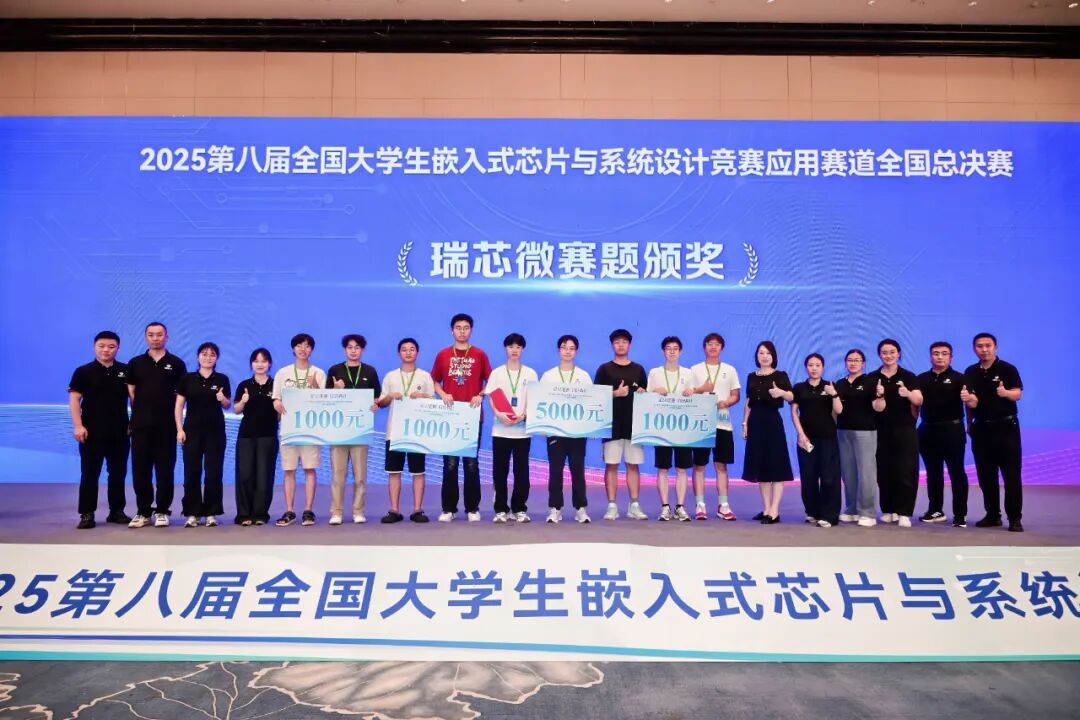 Among them, Wuhan University of Technology‘s “Cooking Team” won the national first prize with their project “Intelligent Learning Assistance System Based on RK3588”. The team consists of three students from the School of Information Engineering: Li Xu, Chen Zihui, and Liao Xinyi, and the project was completed under the guidance of Teacher Wang Yongsheng. Next, let’s take a closer look at the details of this award-winning project.
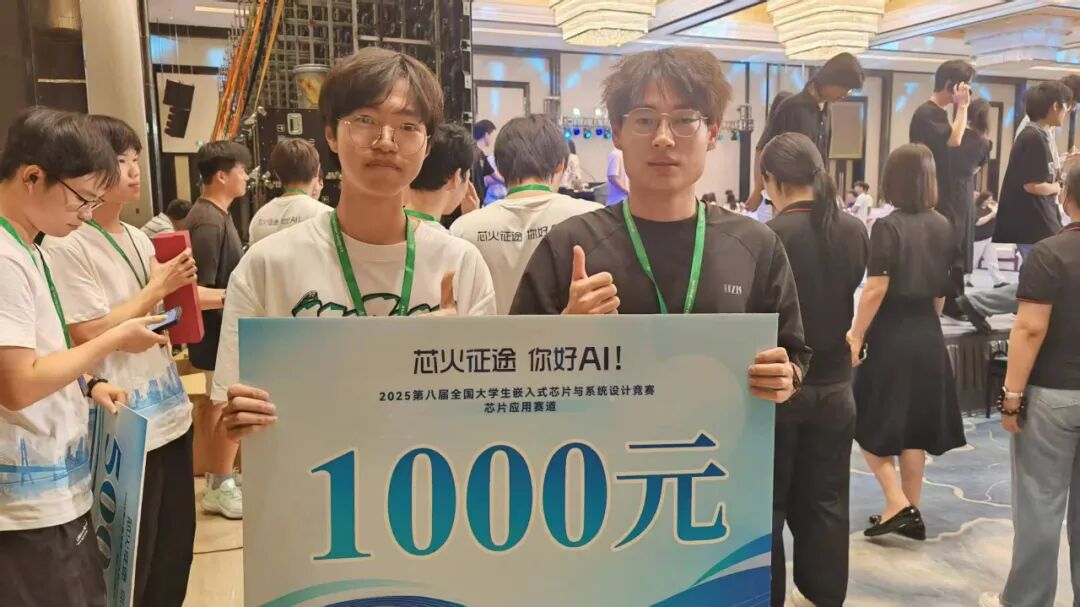 “Cooking Team” presentationProject introduction of “Intelligent Learning Assistance System Based on RK3588”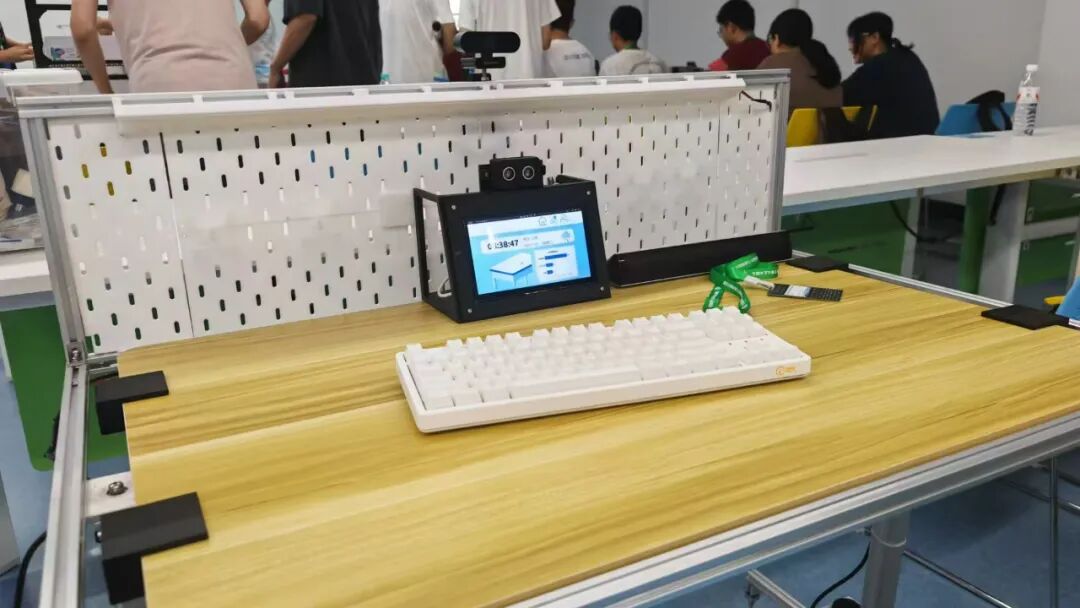
This project is an intelligent learning assistance system designed based on the 【RK3588】 ELF 2 development board, aimed at addressing efficiency and health issues in traditional learning environments through the integration of multiple technologies.
The core functions of the system cover five aspects:
First, it detects behaviors such as blinking frequency, drowsiness, and phone usage based on a micro-expression training set and YOLO model, triggering voice reminders if time exceeds limits;
Second, it achieves adaptive adjustment of desktop height through AI vision and ultrasonic sensors (HC-SR04), monitoring sitting posture in real-time and providing warnings;
Third, it utilizes the TEMT6000 sensor and PWM dimming technology to achieve stepless light adjustment to maintain stable ambient light;
Fourth, it combines the SHTC3 temperature and humidity sensor to control the temperature within a comfortable range (maximum 45°C, accuracy ±0.2°C) using heating wires;
Fifth, it records focus levels, phone usage frequency, and other metrics through a Qt local interface and WeChat mini-program, providing personalized learning suggestions.
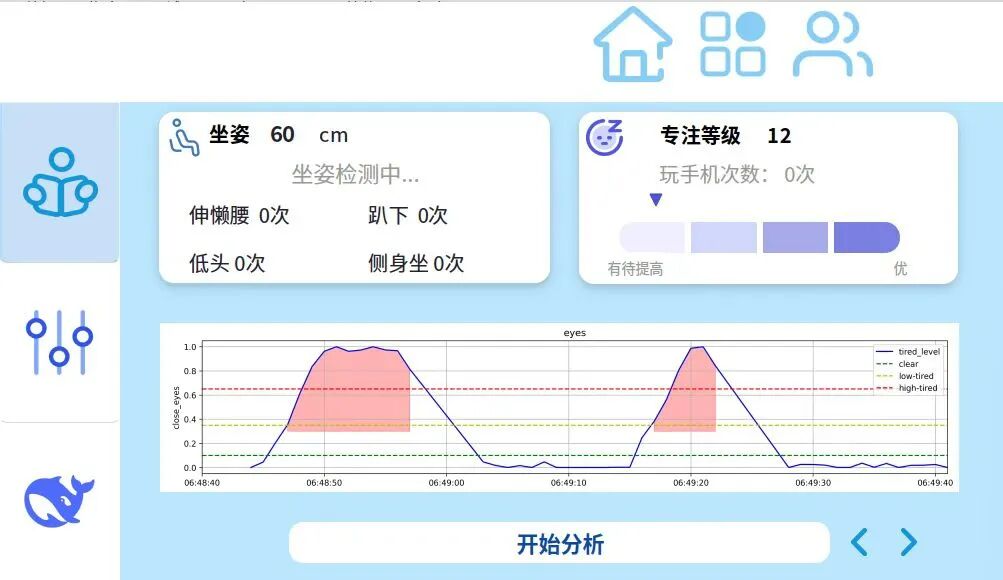
Technically, it employs multimodal perception fusion, deploying a lightweight YOLO model (frame rate ≥30fps) on an NPU with 6 TOPS computing power, collaborating with ultrasonic, temperature, and humidity sensors for multidimensional data collection; embedded optimization supports stepper motor driving for desktop height adjustment (range 75-125cm), and PWM stepless dimming; cross-platform interaction is achieved through a Qt local GUI (real-time data display and control) and MQTT protocol for cloud synchronization, enabling remote monitoring by parents.
The system has a wide range of application scenarios, suitable for K12 education (posture correction, focus management), higher education (improving efficiency in self-study rooms), online education (monitoring home learning), and can assist ADHD groups and visually impaired learners, as well as being adaptable for libraries and other public spaces.
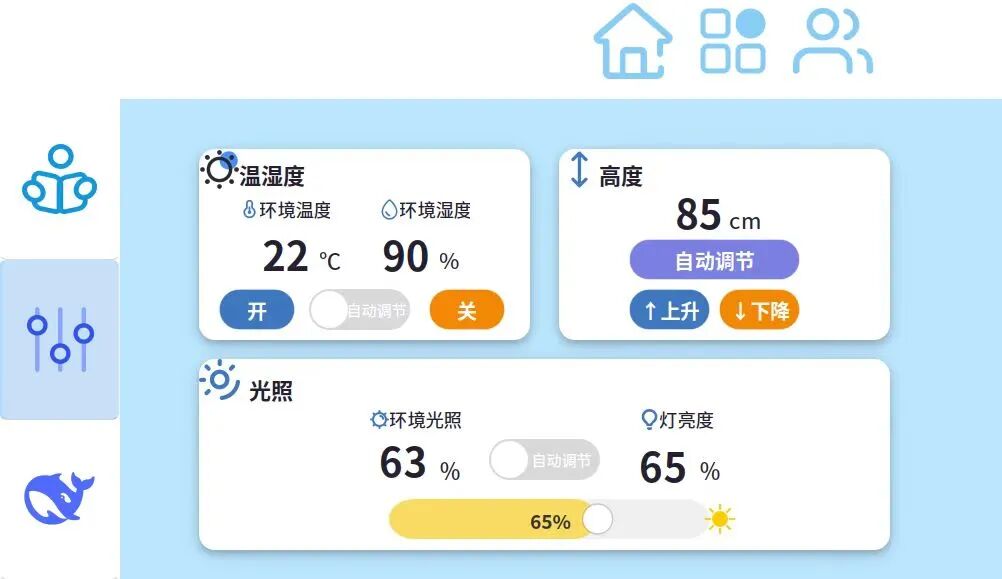
In terms of performance, the desktop height adjustment range is 75-125cm, light adjustment supports 0-100% stepless variation, temperature control accuracy is ±0.2°C, and visual detection relies on NPU acceleration to ensure real-time performance. Its innovation lies in the deep integration of multimodal perception collaboration, embedded real-time control, and cross-platform interaction, promoting the intelligent upgrade of learning scenarios through a “perception-analysis-control-feedback” closed loop. The design process starts from requirements, through hardware selection, algorithm development, joint debugging testing, to deployment iteration, forming a complete technical implementation path.
*Disclaimer: All project introductions in this article are derived from the submissions of students participating in the application track of the 2025 Eighth National College Student Embedded Chip and System Design Competition, created by the students themselves. FeiLing Embedded presents the content of the award-winning projects solely to showcase the participants’ works, providing more creative inspiration for developers, and has obtained consent from the organizers and participating teams. FeiLing Embedded does not bear any legal responsibility for the content or video fonts of the project display.