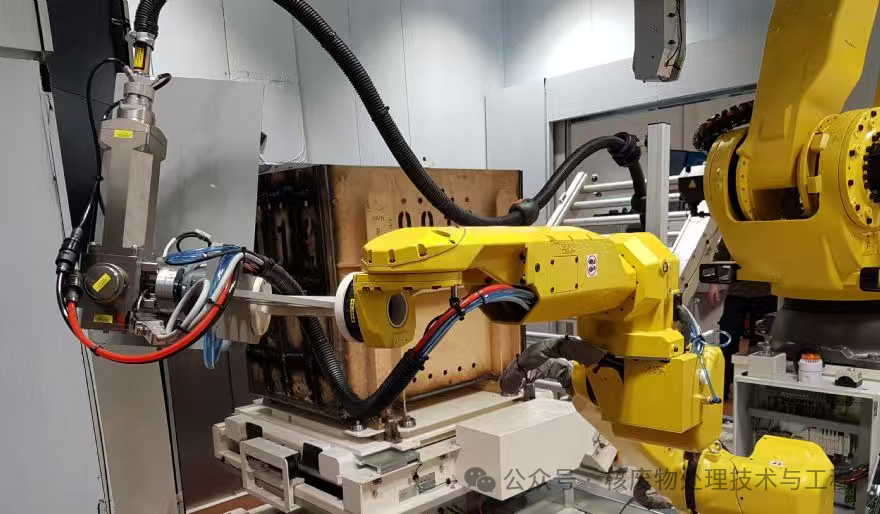
 According to a report from the Machinery Market website on August 25, the Sellafield site has recently successfully deployed the UK’s first commercial off-the-shelf (COTS) robotic system, achieving a significant breakthrough in radioactive waste processing technology. This system utilizes commercial robots from Fanuc, designed and supplied by the integrator Cyan Tec, significantly enhancing the efficiency of nuclear waste processing while completely eliminating the radiation exposure risks associated with manual operations. The project background stems from the decommissioning needs of the first-generation Magnox Fuel Storage Ponds (FGMSP) at the Sellafield site. These storage ponds have become high-risk pollution sources due to the long-term accumulation of radioactive sludge, fuel residues, and corrosion materials. To advance the cleaning of the fuel storage ponds, it is necessary to remove the fuel boxes containing waste from the ponds. However, due to limited storage space, the fuel boxes need to be cut to reduce their volume after removal. In traditional manual operations, operators must wear protective suits and use angle grinders to cut the fuel boxes, which, due to radiation safety restrictions, takes nearly a month to process each fuel box. In contrast, the newly deployed automated laser cutting unit can complete the same task in just 60 minutes, achieving an efficiency increase of up to 720 times and enabling fully unmanned operations throughout the process. The core of the system consists of two Fanuc six-axis industrial robots: the ARC Mate 120iC is responsible for high-precision laser cutting, while the M-900iB/360 handles the transportation and disassembly of containers weighing up to 360 kilograms. The robotic system operates entirely remotely, capable of identifying different fuel box shapes through 3D scanning, automatically planning the optimal cutting path, and reducing the waste volume to one-third of its original size, greatly alleviating storage pressure. Tony Jones, Managing Director of Cyan Tec, emphasized, “The absolute reliability of the system is the top priority; we cannot afford the risks associated with downtime due to failures. The extreme durability of Fanuc robots in the automotive manufacturing industry was a key reason for choosing them.” Currently, the unit has exceeded its original target of processing 50 fuel boxes and continues to operate efficiently. This project has validated the applicability of commercial off-the-shelf (COTS) equipment in nuclear radiation environments for the first time, breaking the industry’s traditional reliance on “customized specialized equipment” and providing a new paradigm for global nuclear waste management that is more cost-effective and has greater promotional value.Reprint with source indicated
Translation | Xie Yuchen
Proofreading | Ren Yong

Scan to follow us!