✅ Author Profile: A passionate researcher and Matlab simulation developer, skilled in data processing, modeling simulation, program design, complete code acquisition, paper reproduction, and scientific simulation.
🍎 Previous reviews, follow my personal homepage:Matlab Research Studio
🍊 Personal motto: Investigate things to gain knowledge, complete Matlab code and simulation consultation available via private message.
🔥 Content Introduction
Geological faults are products of crustal movement, characterized by the rupture of rocks in the crust and significant displacement along the rupture surface. They not only directly reflect the processes of geodynamics but also serve as important triggers for natural disasters such as earthquakes and volcanoes, while playing a crucial role in the distribution of mineral resources and groundwater movement. Therefore, precise and efficient detection of geological faults is of utmost theoretical and practical significance for the prevention of geological disasters, resource exploration, and fundamental geological research.
Traditional fault detection methods, such as field geological surveys, drilling sampling, and shallow seismic exploration, each have their advantages, but often face numerous limitations when dealing with complex terrains, deep fractures, and concealed faults, resulting in issues such as low detection accuracy, high workload, and expensive costs. With the rapid development of technology, modern crack detection techniques, especially geophysical detection technologies, have brought revolutionary changes to the detection of geological faults.
Geophysical methods infer the properties and structures of underground geological bodies by measuring changes in geophysical fields, and their non-destructive, efficient, and wide coverage characteristics give them unique advantages in fault detection. Among them, seismic exploration is one of the most widely used and effective methods. The differences in the propagation speed and attenuation characteristics of seismic waves in different lithologies and structural media cause distortions, dislocations, or attenuations in the seismic reflection or refraction waveforms near faults. By identifying and analyzing these anomalies, the position, trend, dip, dip angle, and throw of the fault can be accurately delineated. For example, reflection seismic methods can provide high-resolution images of underground structures, clearly revealing the attitude of the fault plane; while refraction seismic methods are more suitable for detecting deeper or concealed faults.
In addition to seismic exploration, gravity and magnetic exploration are also commonly used to assist in fault detection. The differences in rock density and magnetic properties on both sides of a fault can lead to local gravity and magnetic anomalies. By finely measuring and inverting these anomalies, the existence of faults can be inferred. Especially for concealed faults that do not have obvious surface exposures, subtle changes in the gravitational and magnetic fields are often key clues to their discovery. Furthermore, electrical exploration, particularly resistivity and electromagnetic methods, detects faults by measuring differences in the conductivity of underground media. Since fracture zones are often rich in groundwater or broken rocks, their resistivity is significantly lower than that of surrounding intact rock masses, making electrical exploration effective in identifying and tracing fracture zones.
In recent years, with the rise of multi-source information fusion technology, combining various geophysical detection methods with remote sensing technology and drilling data has become an important development trend in geological fault detection. For instance, using satellite remote sensing images to identify surface linear structures and geomorphological anomalies provides preliminary clues for geophysical exploration; combining this with high-precision geophysical data for detailed interpretation and validating through drilling data can greatly enhance the accuracy and reliability of fault detection. At the same time, the development of three-dimensional visualization and numerical simulation technologies allows geologists to more intuitively and comprehensively understand the three-dimensional morphology and spatial distribution of faults, providing a solid data foundation for fault mechanical behavior and earthquake risk assessment.
However, geological fault detection still faces many challenges. Complex geological environments, such as intense structural deformation, magmatic intrusion, and steep faults, can complicate the collection and interpretation of geophysical signals. Detecting deep faults is particularly challenging and requires geophysical technologies with deeper penetration capabilities and higher resolution. Additionally, accurately extracting fault information from vast amounts of geophysical data and effectively distinguishing faults from anomalies caused by other geological structures also places higher demands on the expertise and experience of data processing and interpretation personnel.
Looking ahead, geological fault detection technology will continue to develop towards high precision, deep penetration, multi-parameter, and intelligent directions. Emerging distributed optical fiber sensing technology and microseismic imaging technology are expected to play a greater role in fault detection. The introduction of artificial intelligence and machine learning algorithms will significantly enhance the efficiency of processing and interpreting geophysical data, achieving automatic identification and fine characterization of faults. Furthermore, interdisciplinary collaborative research will deepen, with experts from geology, geophysics, computer science, and other fields working together to tackle challenges in the field of fault detection.
In summary, geological faults are an indispensable component of the Earth’s evolutionary process. Their detection is not only an important aspect of geological scientific research but also a fundamental task for ensuring human societal safety and promoting sustainable development. Through continuous innovation and improvement of crack detection technologies, we hope to gain a deeper understanding of geological faults, thereby better predicting and preventing geological disasters, more effectively developing and utilizing Earth’s resources, and ultimately achieving harmonious coexistence between humans and nature.
⛳️ Operation Results
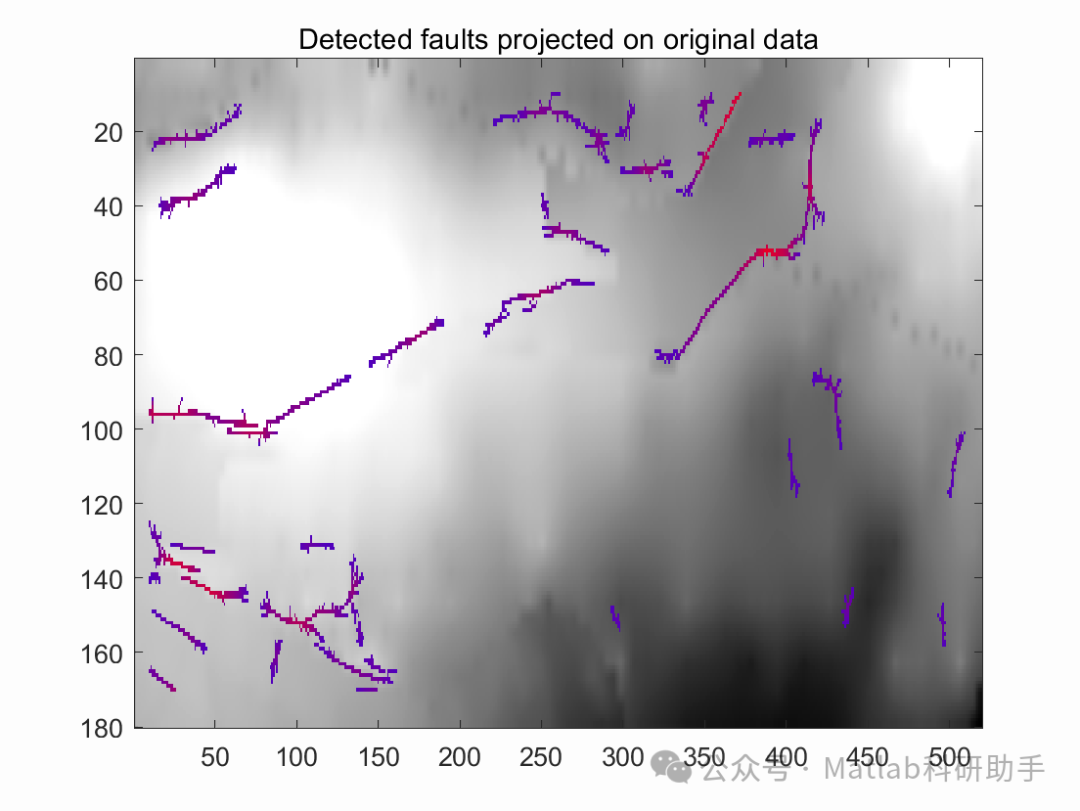
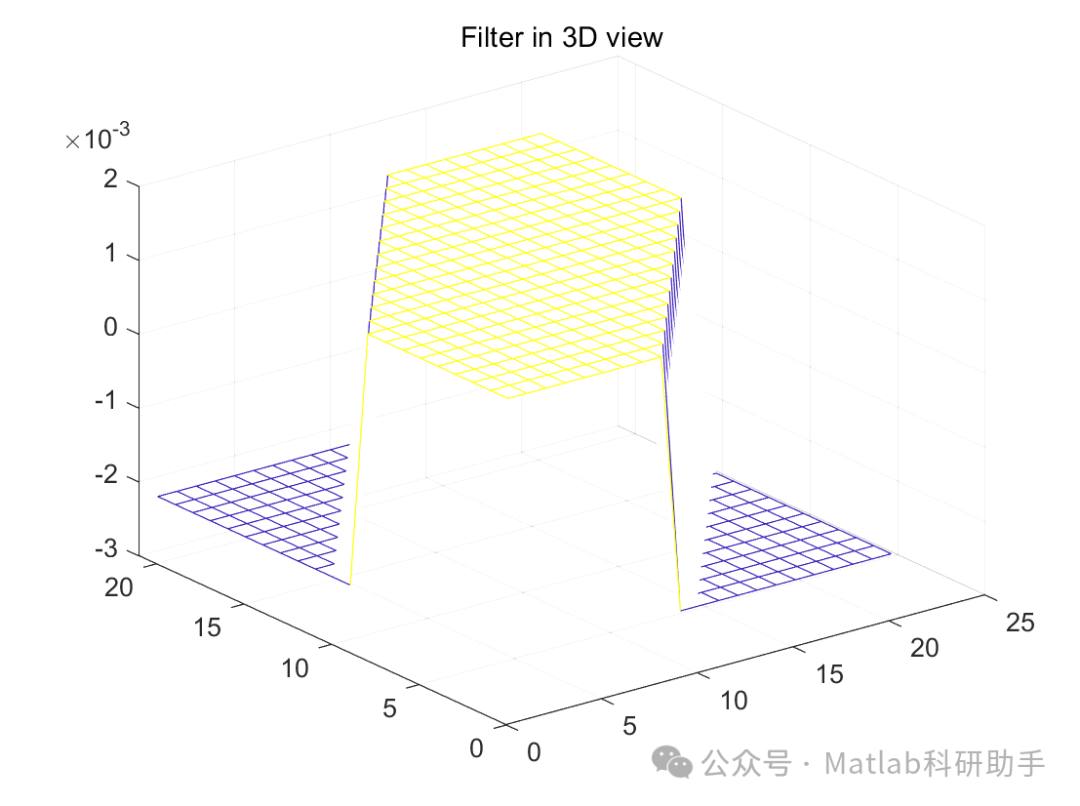
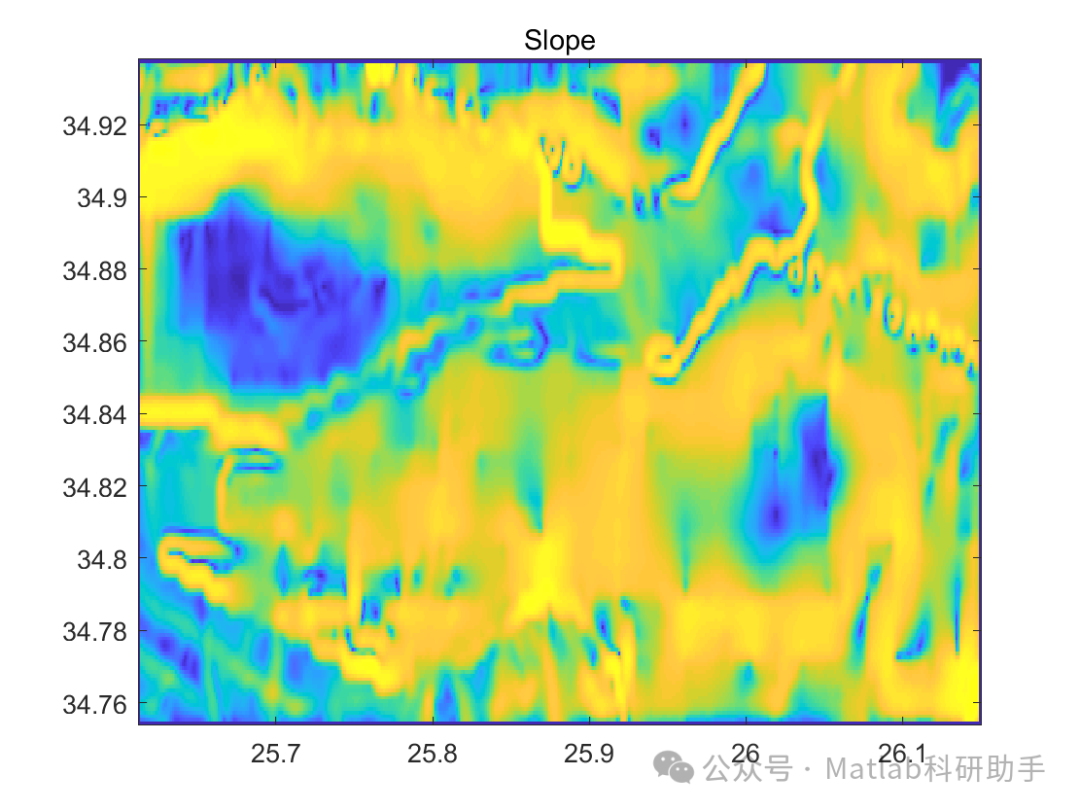
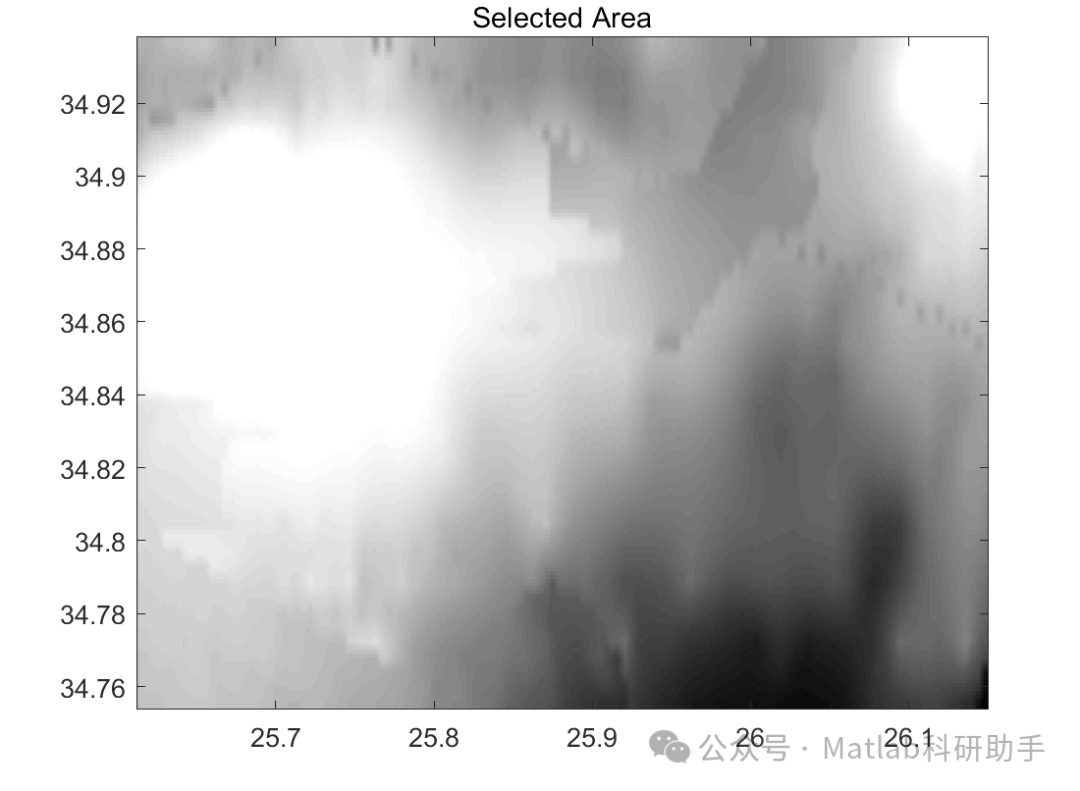
🔗 References
[1] Liu Zhenzhen. Design of Emission Signals for Elastic Wave Detection of Coal Seam Based on Continuous Seismic Sources [D]. Shandong University of Science and Technology, 2018.
[2] Zeng Zheng, Dong Fanghua, Chen Xiao, et al. Implementation of 3D Reconstruction of CT Tomographic Images Using MATLAB [J]. CT Theory and Application Research, 2004, 13(2):24-29. DOI:10.3969/j.issn.1004-4140.2004.02.006.
[3] Su Xiuyun, Pei Guoxian, Yu Bin, et al. Automatic Registration of Continuous Tomographic Images of China Using Photoshop and Matlab Software Based on Mark Points [J]. Journal of Southern Medical University, 2007, 27(12):5. DOI:10.3321/j.issn:1673-4254.2007.12.017.
📣 Sample Code
🎈 Some theoretical references are from online literature; if there is any infringement, please contact the author for deletion.
👇 Follow me to receive a wealth of Matlab e-books and mathematical modeling materials
🏆 Our team specializes in guiding customized MATLAB simulations in various research fields to support your research dreams:
🌈 Various intelligent optimization algorithm improvements and applications
Production scheduling, economic scheduling, assembly line scheduling, charging optimization, workshop scheduling, departure optimization, reservoir scheduling, three-dimensional packing, logistics site selection, cargo location optimization, bus scheduling optimization, charging pile layout optimization, workshop layout optimization, container ship loading optimization, pump combination optimization, medical resource allocation optimization, facility layout optimization, visual domain base station and drone site selection optimization, knapsack problem, wind farm layout, time slot allocation optimization, optimal distributed generation unit allocation, multi-stage pipeline maintenance, factory-center-demand point three-level site selection problem, emergency supply distribution center site selection, base station site selection, road lamp post arrangement, hub node deployment, transmission line typhoon monitoring devices, container scheduling, unit optimization, investment portfolio optimization, cloud server combination optimization, antenna linear array distribution optimization, CVRP problem, VRPPD problem, multi-center VRP problem, multi-center multi-vehicle VRP problem, dynamic VRP problem, two-layer vehicle routing planning (2E-VRP), electric vehicle routing planning (EVRP), hybrid vehicle routing planning, mixed flow shop problem, order splitting scheduling problem, bus scheduling optimization problem, flight shuttle vehicle scheduling problem, site selection path planning problem, port scheduling, port bridge scheduling, parking space allocation, airport flight scheduling, leak source localization.
🌈 Time series, regression, classification, clustering, and dimensionality reduction in machine learning and deep learning
2.1 BP time series, regression prediction, and classification
2.2 ENS sound neural network time series, regression prediction, and classification
2.3 SVM/CNN-SVM/LSSVM/RVM support vector machine series time series, regression prediction, and classification
2.4 CNN|TCN|GCN convolutional neural network series time series, regression prediction, and classification
2.5 ELM/KELM/RELM/DELM extreme learning machine series time series, regression prediction, and classification
2.6 GRU/Bi-GRU/CNN-GRU/CNN-BiGRU gated neural network time series, regression prediction, and classification
2.7 Elman recurrent neural network time series, regression prediction, and classification
2.8 LSTM/BiLSTM/CNN-LSTM/CNN-BiLSTM long short-term memory neural network series time series, regression prediction, and classification
2.9 RBF radial basis function neural network time series, regression prediction, and classification
2.10 DBN deep belief network time series, regression prediction, and classification
2.11 FNN fuzzy neural network time series, regression prediction
2.12 RF random forest time series, regression prediction, and classification
2.13 BLS broad learning system time series, regression prediction, and classification
2.14 PNN pulse neural network classification
2.15 Fuzzy wavelet neural network prediction and classification
2.16 Time series, regression prediction, and classification
2.17 Time series, regression prediction, and classification
2.18 XGBOOST ensemble learning time series, regression prediction, and classification
2.19 Transform various combinations of time series, regression prediction, and classification
Directions cover wind power prediction, photovoltaic prediction, battery life prediction, radiation source identification, traffic flow prediction, load forecasting, stock price prediction, PM2.5 concentration prediction, battery health status prediction, electricity consumption prediction, water body optical parameter inversion, NLOS signal identification, precise prediction of subway stops, transformer fault diagnosis.
🌈 In image processing
Image recognition, image segmentation, image detection, image hiding, image registration, image stitching, image fusion, image enhancement, image compressed sensing.
🌈 In path planning
Traveling salesman problem (TSP), vehicle routing problem (VRP, MVRP, CVRP, VRPTW, etc.), three-dimensional path planning for drones, drone collaboration, drone formation, robot path planning, grid map path planning, multimodal transport problems, electric vehicle routing planning (EVRP), two-layer vehicle routing planning (2E-VRP), hybrid vehicle routing planning, ship trajectory planning, full path planning, warehouse patrol.
🌈 In drone applications
Drone path planning, drone control, drone formation, drone collaboration, drone task allocation, online optimization of safe communication trajectories for drones, vehicle collaborative drone path planning.
🌈 In communication
Sensor deployment optimization, communication protocol optimization, routing optimization, target localization optimization, Dv-Hop localization optimization, Leach protocol optimization, WSN coverage optimization, multicast optimization, RSSI localization optimization, underwater acoustic communication, communication upload and download allocation.
🌈 In signal processing
Signal recognition, signal encryption, signal denoising, signal enhancement, radar signal processing, signal watermark embedding and extraction, electromyography signals, electroencephalography signals, signal timing optimization, electrocardiogram signals, DOA estimation, encoding and decoding, variational mode decomposition, pipeline leakage, filters, digital signal processing + transmission + analysis + denoising, digital signal modulation, bit error rate, signal estimation, DTMF, signal detection.
🌈 In power systems
Microgrid optimization, reactive power optimization, distribution network reconstruction, energy storage configuration, orderly charging, MPPT optimization, household electricity.
🌈 In cellular automata
Traffic flow, crowd evacuation, virus spread, crystal growth, metal corrosion.
🌈 In radar
Kalman filter tracking, trajectory association, trajectory fusion, SOC estimation, array optimization, NLOS identification.
🌈 In workshop scheduling
Zero-wait flow shop scheduling problem (NWFSP), permutation flow shop scheduling problem (PFSP), hybrid flow shop scheduling problem (HFSP), zero idle flow shop scheduling problem (NIFSP), distributed permutation flow shop scheduling problem (DPFSP), blocking flow shop scheduling problem (BFSP).
👇