Helicobacter pylori (H. pylori) has been officially classified as a Group 1 carcinogen by the World Health Organization (WHO). Current diagnostic methods, including invasive endoscopy, fecal antigen tests, and serological tests, have limitations in sensitivity, specificity, or patient compliance. Saliva, as a non-invasive and easily obtainable biological fluid, has emerged as a promising alternative for detecting H. pylori. However, the low abundance of nucleic acids derived from H. pylori in saliva necessitates high-sensitivity and high-selectivity detection strategies, highlighting the urgency of developing advanced analytical platforms.Current nucleic acid-based detection methods, such as polymerase chain reaction (PCR), rely on expensive equipment and specialized personnel, and lack sufficient sensitivity for trace targets in complex matrices, limiting their field applications. There is an urgent need to develop miniaturized and user-friendly analytical devices.Microfluidic chips, due to their miniaturization, automation, and integration features, have been widely explored as potential platforms for biosensing applications, combining various detection methods such as electrochemical or fluorescence analysis. However, these microfluidic sensors have critical limitations, including a single signal output mode and susceptibility to environmental interference, which collectively affect the reliability and sensitivity of detection results.To address these issues, a dual-mode biosensing platform has emerged, providing self-validated and more reliable results. The electrochemical mode offers high sensitivity, excellent quantification capability, and is suitable for miniaturization, while the colorimetric mode provides simple, intuitive, and instrument-free readings, making it ideal for on-site screening. This synergistic combination makes electrochemical/colorimetric dual-mode sensors highly promising for point-of-care testing (POCT). The construction of a high-reliability, high-sensitivity dual-mode microfluidic sensor for in situ nucleic acid detection using nanoenzyme-based materials is a very promising alternative. However, the issue of false-negative results due to low nucleic acid concentrations in samples remains to be solved.Catalytic hairpin assembly (CHA) stands out due to its high amplification efficiency, excellent biocompatibility, ease of operation, and cost-effectiveness. To date, integrated CHA-based nanomaterials have been applied in the fields of bioanalysis and diagnostics. Combining CHA with microfluidic biosensors to simplify workflows for quantitative nucleic acid detection using automated fluid control is a very promising strategy.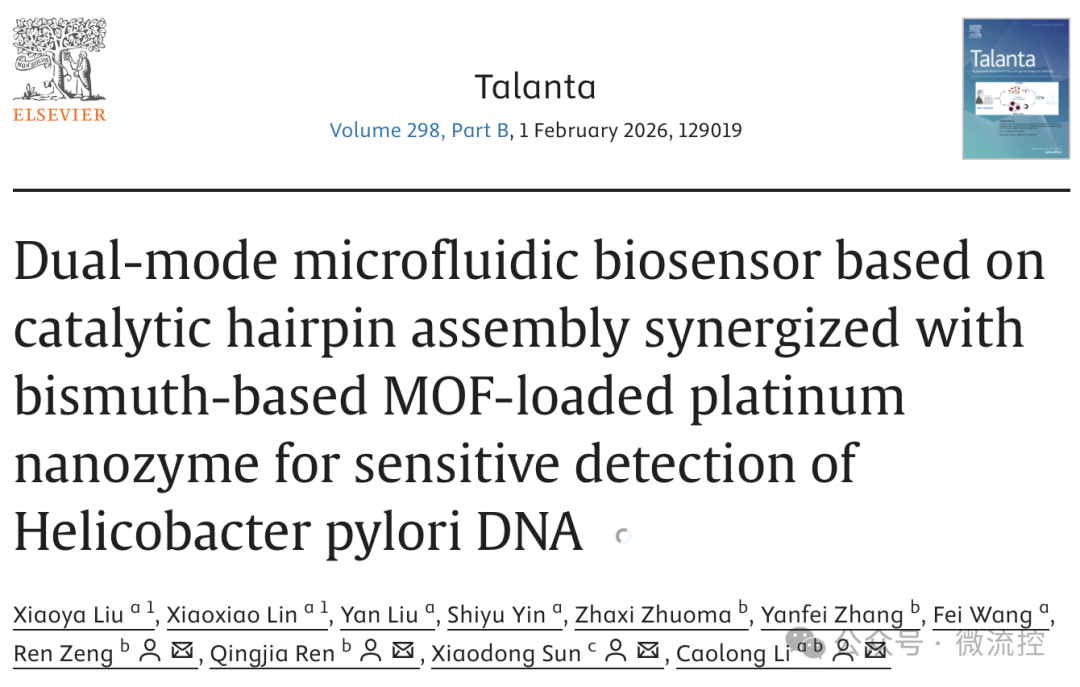 According to Meimins Consulting, in this context, researchers from China Pharmaceutical University, Tibet University of Traditional Medicine, and Shanghai University have proposed a CHA-based microfluidic biosensor for electrochemical/colorimetric dual-mode detection of H. pylori DNA in saliva. The sensing mechanism involves Fe₃O₄@SiO₂ functionalized H1 as a capture probe for the specific recognition of H. pylori nucleic acids, while Bi-MOF@Pt-H₂ serves as a signal probe that catalyzes the oxidation of 3,3′,5,5′-tetramethylbenzidine (TMB) substrate in the presence of H₂O₂, thereby converting the molecular recognition event into electrochemical and colorimetric dual signals.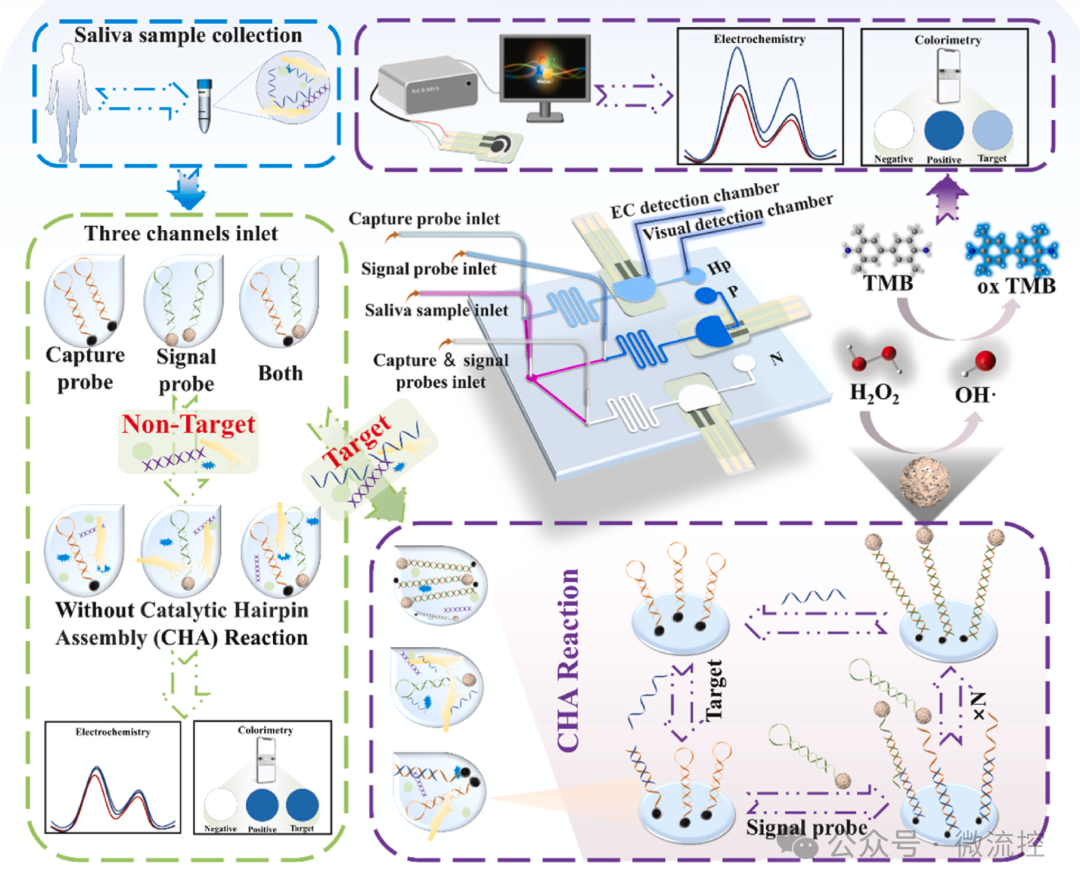
Schematic diagram of the dual-mode microfluidic biosensor based on catalytic hairpin assembly
This microfluidic chip integrates a sample loading unit, a probe loading/mixing unit, an electrochemical detection unit with screen-printed electrodes, and a colorimetric observation unit equipped with an optical window, capable of identifying the infection status of H. pylori. The signal probe, which exhibits excellent peroxidase-like activity, catalyzes the oxidation of TMB, resulting in a sequential increase in peak current for the experimental group and a gradual decrease in colorimetric intensity.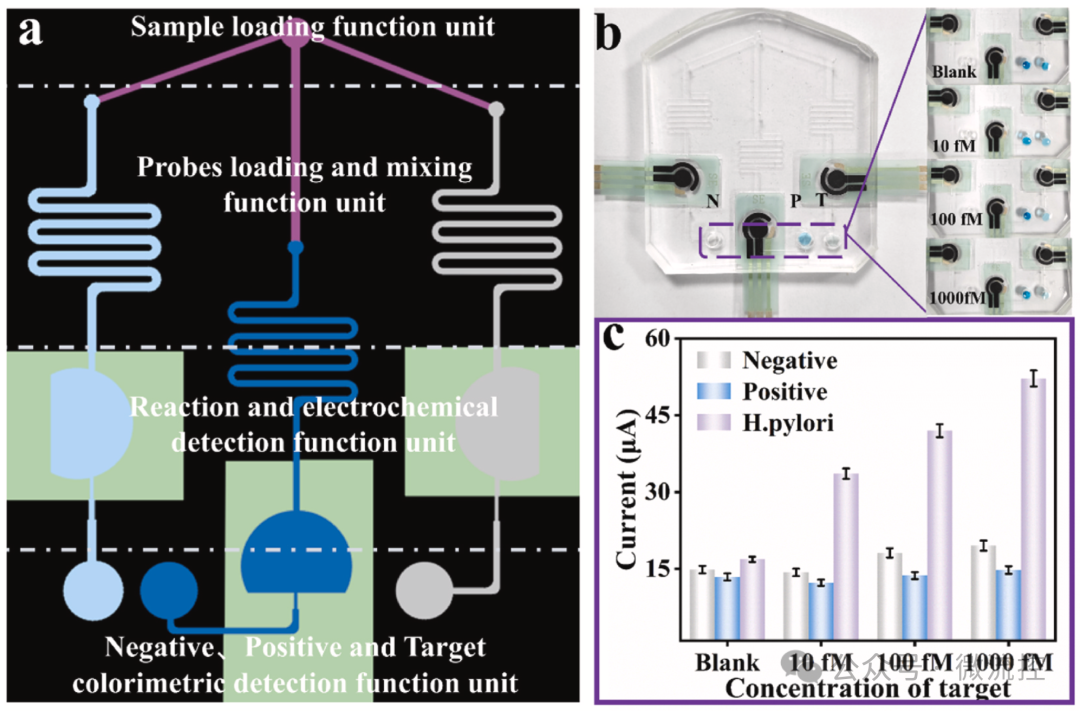 Electrochemical/colorimetricdual-mode microfluidic chip
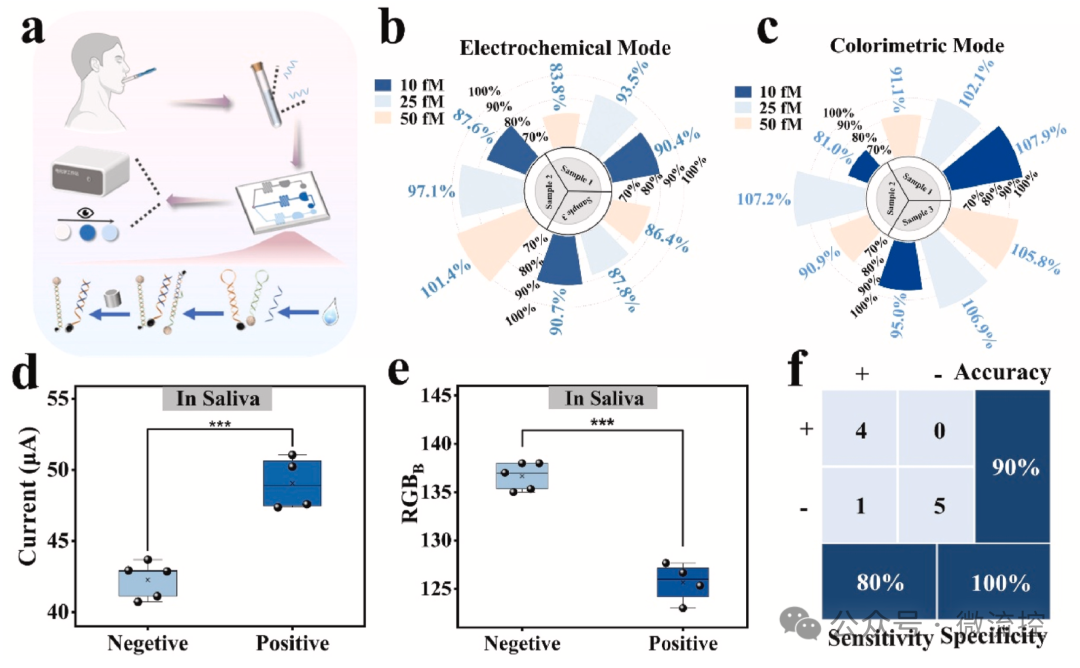 Dual-mode detectionSchematic diagram of H. pylori infectionAs expected, this microfluidic chip achieved consistent results in saliva samples, demonstrating good reproducibility, stability, and anti-interference capability. Therefore, the developed sensor can facilitate on-site nucleic acid detection and has potential application value in assisting the diagnosis of H. pylori infection. The related research findings have been published in the recent journal Talanta under the title “Dual-mode microfluidic biosensor based on catalytic hairpin assembly synergized with bismuth-based MOF-loaded platinum nanozyme for sensitive detection of Helicobacter pylori DNA.” Paper link: https://doi.org/10.1016/j.talanta.2025.129019
Further Reading:
“Microfluidic Technology and Market – 2024 Edition”
“Biosensor Technology and Market for Point-of-Care Applications – 2022 Edition”