

Article Information
High Sensitivity Lithium Plating Detection Based on Time-Domain DRT Analysis of High Energy Lithium-Ion Batteries
First Author: Wang Yu
Corresponding Authors: Liu Yajie*, Zhou Xing*, Xiao Peitao*
Affiliation: College of System Engineering, National University of Defense Technology, School of Frontier Interdisciplinary Sciences, College of Aerospace Science and Engineering
Research Background
High-energy lithium-ion batteries are prone to lithium plating side reactions during fast charging at room temperature and low-temperature charging, severely affecting the battery’s health and safety. The online lithium plating detection method accurately detects lithium plating reactions by extracting the in-situ measurement characteristics of lithium-ion batteries, thus avoiding lithium plating reactions during subsequent charging processes and effectively ensuring the long-term safe operation of lithium-ion batteries. However, existing online lithium plating detection methods mostly suffer from insufficient detection sensitivity and reliance on human experience, making it difficult to apply directly in battery management systems. Achieving high-sensitivity online automatic lithium plating detection remains a significant challenge.
Article Summary
Recently, the team of Professor Zhang Tao from the National University of Defense Technology published a research paper titled “High sensitivity detection of lithium plating in high-energy lithium-ion batteries based on time-domain distribution relaxation times analysis” in the internationally renowned journal Energy Storage Materials. The paper proposes using time-domain relaxation time distribution to model the relaxation voltage curve after charging lithium-ion batteries with high precision, and sets the lithium plating detection threshold based on the modeling error, thus achieving online lithium plating detection. The method achieves a lithium plating detection accuracy rate of up to 99% in fast charging at room temperature and low-temperature charging experimental scenarios, demonstrating high detection accuracy and sensitivity. The lithium plating detection method proposed in the paper does not require additional measurement hardware and can achieve online automatic lithium plating detection relying solely on the voltage curve monitored by the battery management system, showing excellent application prospects.
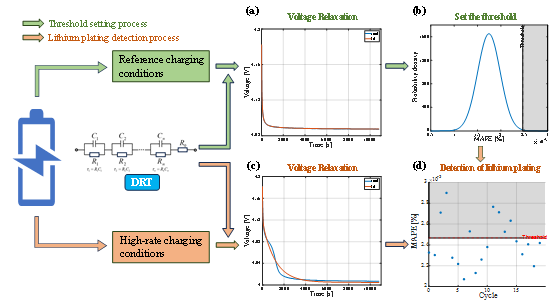
Figure 1. Schematic diagram of the lithium plating detection method based on time-domain DRT analysis.
Main Points of the Article
Point 1: Relaxation Voltage Curve Modeling Based on Time-Domain DRT
The relaxation phase after charging lithium-ion batteries is a typical depolarization process. When lithium plating reactions do not occur, the relaxation process includes Ohmic polarization, interfacial polarization, and diffusion polarization. The article combines formula derivation and sample demonstrations to prove that the time-domain DRT model can achieve high-precision modeling of the relaxation voltage curve when lithium plating reactions do not occur, with a modeling error not exceeding 0.01% (the evaluation metric used is the Mean Absolute Percentage Error, MAPE).
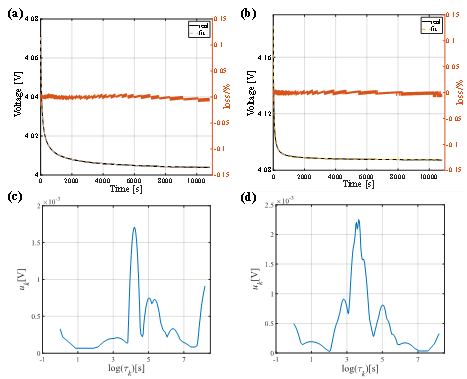
Figure 2. Modeling effects of time-domain DRT on (a) relaxation voltage curves under standard charging conditions at 25°C and (b) 0°C; (c) and (d) are the corresponding polarization voltage distribution curves.
Point 2: Setting Lithium Plating Detection Threshold Based on Time-Domain DRT Modeling Error
When lithium plating reactions occur during the previous charging process, some deposited lithium metal will reinsert into the graphite particles during the relaxation process, which will change the original relaxation voltage variation pattern, making it impossible for the time-domain DRT model to achieve accurate modeling. Based on this phenomenon, the paper uses the time-domain DRT model to model the relaxation voltage curves under 80 standard charging condition cycles, using the Ks test to determine that the obtained modeling errors follow a normal distribution N(μ,σ). Therefore, the 3σ rule is used to set the lithium plating detection threshold, meaning that cycles with time-domain DRT modeling errors exceeding μ+3σ have a very high probability of having undergone lithium plating reactions.
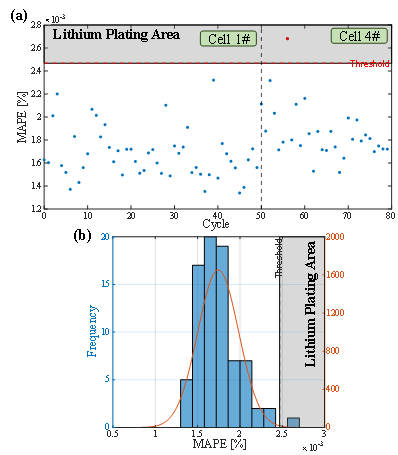
Figure 3. Modeling error diagram of relaxation voltage curves under standard charging condition cycles. (a) Error scatter plot; (b) Error distribution plot.
Point 3: Verification of Lithium Plating Detection in Multiple Charging Scenarios Based on Detection Threshold
The paper conducts lithium plating detection on a total of 240 cycles of relaxation voltage curve modeling errors under various charging scenarios, including fast charging at room temperature and low-temperature charging, based on the established lithium plating detection threshold. Meanwhile, the lithium plating conditions of lithium-ion batteries in each charging scenario were determined by disassembling the batteries and observing the lithium deposition on the anode surface. The detection results showed that all 160 cycles that underwent lithium plating reactions were accurately identified, while only one of the remaining 80 cycles that did not undergo lithium plating reactions was misjudged as having undergone lithium plating reactions, achieving a detection accuracy rate of 99.6% for lithium plating reactions.
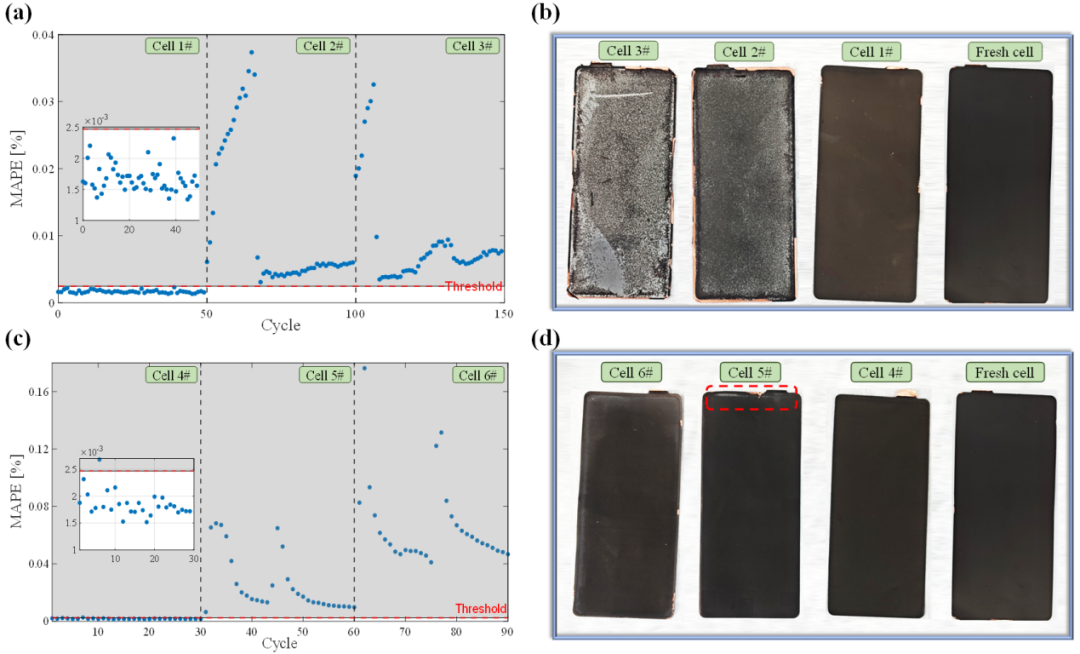
Figure 5 (a) Scatter plot of time-domain DRT modeling errors for Cell 1#, Cell 2#, and Cell 3# (room temperature charging scenario); (b) Optical photos of the anodes for Cell 1#, Cell 2#, and Cell 3#; (c) Scatter plot of time-domain DRT modeling errors for Cell 4#, Cell 5#, and Cell 6# (low temperature charging scenario); (d) Optical photos of the anodes for Cell 4#, Cell 5#, and Cell 6#.
Article Link
High sensitivity detection of lithium plating in high-energy lithium-ion batteries based on time-domain distribution relaxation times analysis
https://doi.org/10.1016/j.ensm.2024.103369
Corresponding Author Introductions
Liu Yajie Researcher Introduction: Currently a researcher and doctoral supervisor at the College of System Engineering, National University of Defense Technology, mainly engaged in research on health assessment and fault diagnosis of lithium-ion batteries, optimization design of hybrid energy storage systems, and energy management of microgrids. He has hosted over 20 projects including the National Natural Science Foundation project. He has published over 30 papers in top journals such as Applied Energy, authorized 25 national invention patents, and received three provincial and ministerial-level scientific and technological progress first and second prizes, as well as two first and second prizes from national first-level academic societies in natural sciences.
Zhou Xing Assistant Researcher Introduction: He obtained his Bachelor’s degree, Master’s degree, and Doctorate from the National University of Defense Technology in 2013, 2015, and 2019, respectively, and was a visiting scholar at Tsinghua University’s Battery Safety Laboratory. He is currently an assistant researcher at the School of Frontier Interdisciplinary Sciences, National University of Defense Technology. His research focuses on wide temperature range high power battery energy storage systems and their safety diagnosis, optimization design, and control of hybrid energy storage systems.
Xiao Peitao Lecturer Introduction: He obtained his Bachelor’s degree in Science and Master’s degree in Science from Tianjin University in 2010 and 2013, respectively, and received his Doctorate from Fudan University in 2019. He previously worked as an engineer at Envision AESC and was a postdoctoral researcher at Tsinghua University. He is currently a lecturer at the College of Aerospace Science and Engineering, National University of Defense Technology. His research focuses on the design of secondary batteries with high energy density, wide temperature range, and high safety.
Research Team Introduction
The Smart Energy System Engineering Innovation Team at the College of System Engineering, National University of Defense Technology, was proposed for establishment in 2012 by former university president Academician Yang Xuejun. The team mainly relies on multiple national first-class disciplines, including Management Science and Engineering (A+), Computer Science and Technology (A+), and Control Science and Engineering (A), dedicated to exploring the forefront of energy technology in the military field and building an excellent innovation team with innovative spirit, efficient collaboration, and continuous nurturing of talents. The team currently includes six members with military teaching titles, leading talents in Hunan Province, national outstanding youth, and provincial outstanding youth/young talents, and has established a key laboratory for smart interconnection technology of multi-energy systems in Hunan Province, an energy management collaborative innovation center, and a graduate innovation practice base for smart energy management in Hunan Province.
Research Group Introduction
The Military Power Supply Optimization Design and State Assessment Research Group under this team mainly focuses on the application needs of optimization design and health state assessment of lithium batteries/hybrid storage systems under special environments and extreme conditions, conducting basic theoretical methods and applied innovative research in system modeling and parameter identification, SOH/SOC assessment, remaining life prediction, and fault diagnosis. The research group currently has more than ten full-time teachers, postdoctoral researchers, and graduate students, and has a relatively complete battery comprehensive evaluation laboratory with over ten specialized testing equipment including temperature chambers, battery charge and discharge testers, and electrochemical workstations.
Research Group Recruitment
The research group is continuously recruiting postdoctoral researchers. The specific treatment is a pre-tax annual salary of 160,000 to 200,000 yuan, with a settlement allowance of 20,000 yuan. During the research period, the children’s schooling and other matters will be treated equally to those of active military officers at the National University of Defense Technology. During the research period, one can apply for the “德雅青年学者博士后” program, enjoying a pre-tax annual salary of 400,000 yuan and a settlement allowance of 50,000 yuan. Contact: Teacher Liu Yajie, 18613956066, [email protected].


Add Official WeChat to Join Group Communication
SCI Carbon Dioxide Mutual Aid Group
SCI Catalytic Materials Exchange Group
SCI Sodium-Ion Battery Exchange Group
SCI Ion Exchange Membrane Experience Exchange Group
SCI Fuel Cell Exchange Group
SCI Supercapacitor Exchange Group
SCI Aqueous Zinc Battery Exchange Group
SCI Water Electrolysis Mutual Aid Group
SCI Gas Diffusion Layer Experience Exchange Group
Note: [Name – Institution – Research Direction]
Note
🔹If there are copyright issues with this article, please contact us for timely processing.
🔹Readers are welcome to forward and promote this article.
🔹“Science Materials Station” will continuously improve its level to share better material consultations with readers. Welcome to follow us.
For submissions, please contact [email protected]
Acknowledgments
Thanks to the authors of this article for their strong support for this report.

Share the Article
Support with a Like
Click to See