Total Word Count: 2145 Reading Time: 13 Minutes
By Anson
Proofread by Kelven
Image Source: Internet
According to reports, this year Huawei’s Kirin 980 chip is the first commercial 7nm processor based on the ARM Cortex-A76 architecture. Its excellent performance not only wins accolades but also enhances its reputation. So, what outstanding performance does the Cortex-A76 used in the Kirin 980 exhibit? What impact does the emergence of this new architecture have on the mobile processor market? This article will explore these questions.
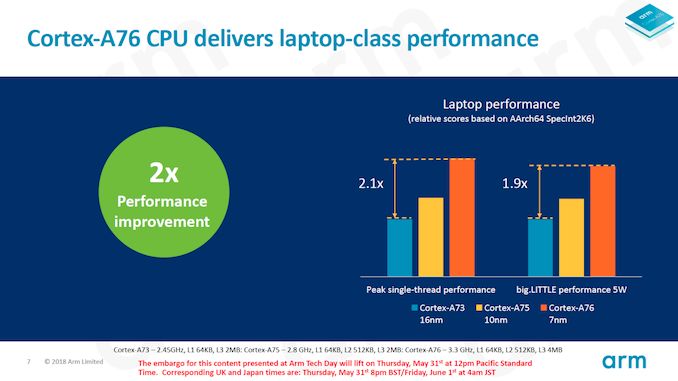

Can Cortex A76 Achieve ARM’s Performance Predictions?
ARM has stated that the Cortex-A76 architecture can reach a clock frequency of up to 3GHz. However, according to Anandtech, achieving 3GHz in practice is challenging, and testing at a frequency of 2.5GHz would be more realistic, so the Kirin 980’s clock frequency is in the range of 2.6GHz, which meets expectations.
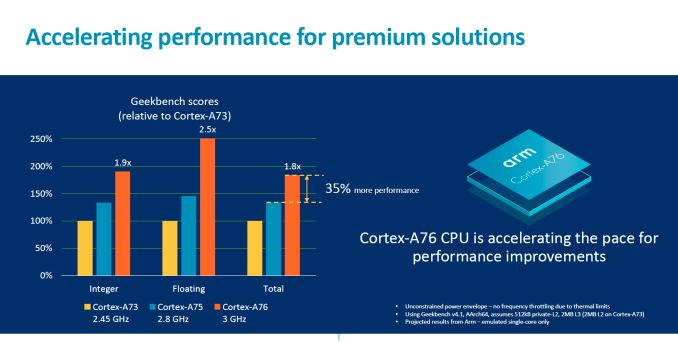
A 3GHz Cortex A76 would outperform a 2.4GHz Cortex A73 (equivalent to Qualcomm’s Snapdragon 835) by 1.9 times in integer performance and 2.5 times in floating-point calculations. If tested at a clock frequency of 2.6GHz, the performance gains would be 1.65 times and about 2.15 times, respectively.
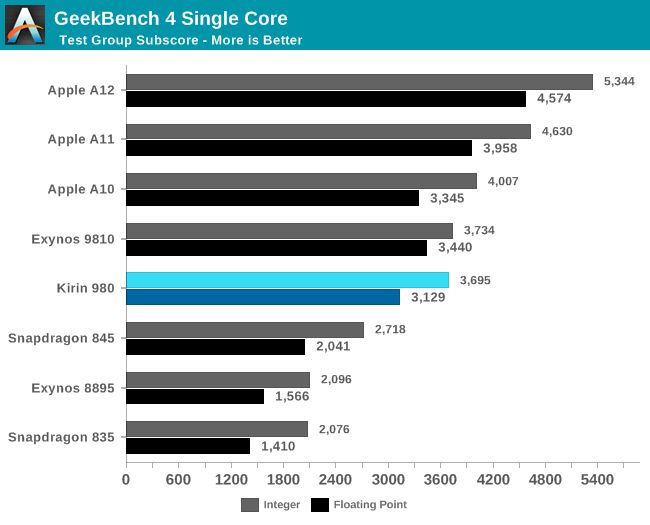
In GeekBench 4 single-core performance, the Kirin 980 with Cortex A76 architecture achieved a 1.77 times improvement in integer calculations and a 2.21 times improvement in floating-point calculations, exceeding performance expectations, likely due to the 4MB L3 cache configuration of the Kirin 980.
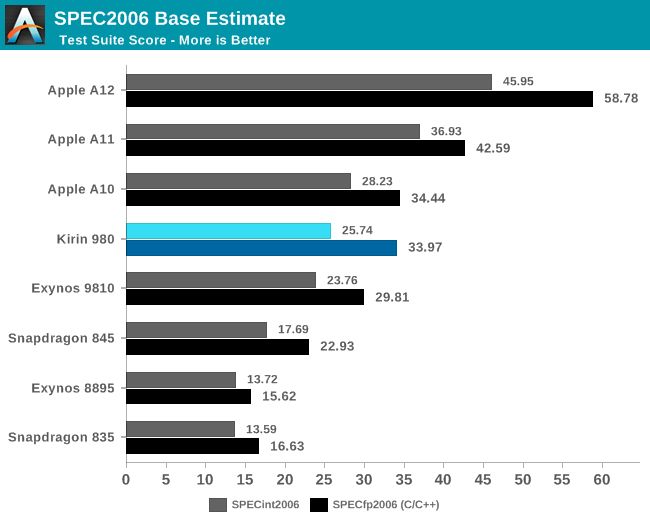
In IPC comparisons, Cortex A76 shows improvements of 1.58 times and 1.79 times over Cortex A73 in integer and floating-point performance, respectively.
The Kirin 980’s Cortex A76 improved integer and floating-point scores by 1.89 times and 2.04 times, respectively. In terms of IPC, the Kirin 970 based on Cortex A73 and Snapdragon 835 showed even more significant improvements, with increases of 1.78 times and 1.92 times, respectively.
Because the Kirin 980’s performance exceeded expectations, it achieved performance equivalent to the predicted 3GHz clock frequency while only operating at 2.6GHz.
The Importance of Memory Subsystem Performance
One aspect of CPU performance that has often been misunderstood is the performance of the memory subsystem. In fact, a CPU can have a very wide bandwidth and any number of execution resources, but no matter how large the microarchitecture is, if the memory subsystem (caches, memory controllers) cannot keep the device adequately supplied with data, its role becomes insignificant.
On the other hand, the workload on modern mobile devices is increasing, and speeds are accelerating. Apps are becoming larger and more complex, and the amount of data they process is also significantly increasing.
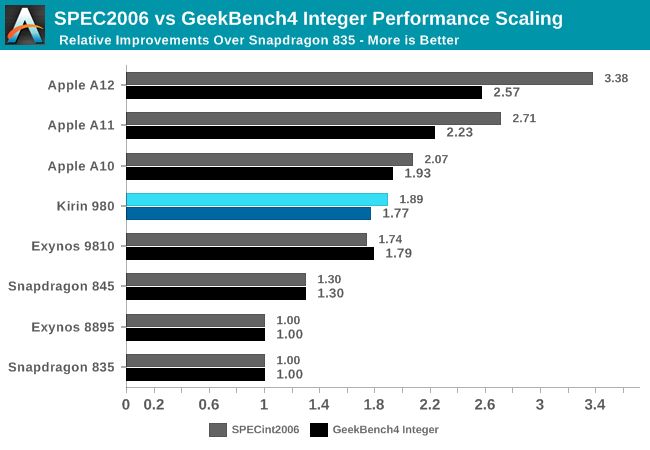
In SPECint2006, the scores of most chips were not significantly different from those predicted in GeekBench4, with the only notable difference being Apple’s A11 and A12 chips, which displayed stronger SPEC workload performance than GeekBench4.
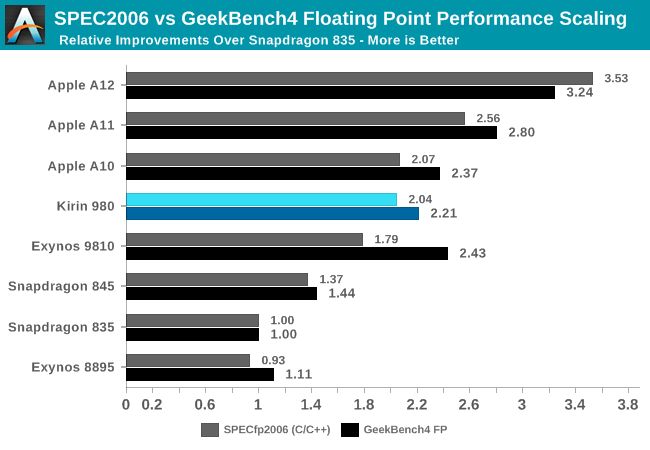
In SPECfp2006, the Apple A12 was able to demonstrate a larger workload in SPECfp than in GB4 FP, indicating that Apple’s new generation of processors introduced significant improvements in memory subsystem performance. Conversely, the Exynos 9810 performed much worse in SPEC than in GeekBench4, indicating that its CPU memory and cache subsystem lag significantly behind competitors.
The Kirin 980, which adopts the Cortex A76 architecture, achieves a relatively good balance in this regard, with performance differences between SPEC and GeekBench4 being minimal.
Top-Level Energy Efficiency, But Absolute Performance Still Lags Behind Apple
ARM claims that under the same power usage, the performance of Cortex A76 is 40% higher than that of Cortex A75; while at the same performance level, Cortex A76 uses only half the power of Cortex A75.
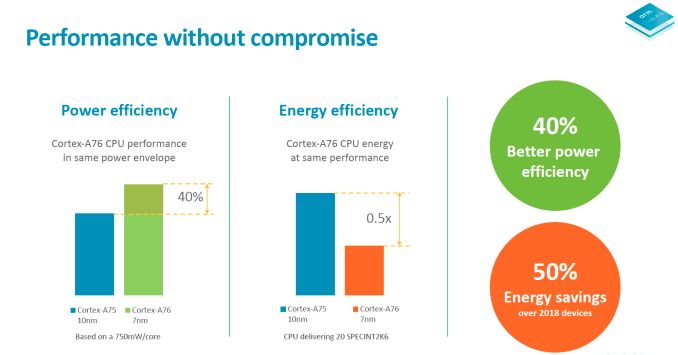
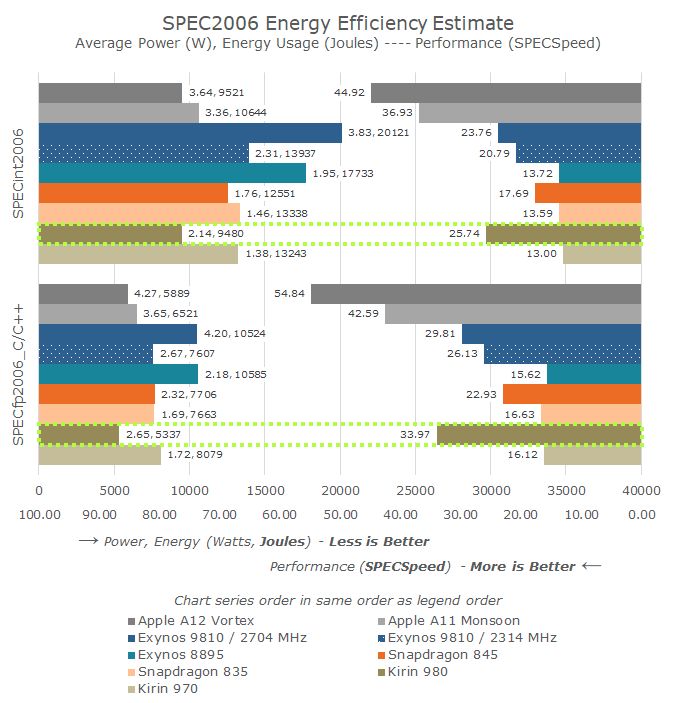
In actual results, Cortex A76 exceeded expectations, validating ARM’s claims. Moreover, since Cortex A76 surpasses IPC predictions, it can achieve target performance at frequency points more efficient than 3GHz.
Results show that the performance of the Kirin 980 is 45-48% higher than that of Snapdragon 845, while the energy consumption at the same performance level is 25-30% lower than that of Snapdragon 845. If the clock frequency of the Kirin 980 were to be reduced, or if a 1.9GHz A76 energy efficiency were to match the performance point of Snapdragon 845, it would be evident that the Kirin 980 consumes less energy than usual.
At the same power level, the performance of Cortex A76 increases by 40%. ARM chose an arbitrary comparison at 750mW. In fact, the CPU of Cortex A76 is more power-consuming, with single-core active platform power consumption rising by 14-21%.
The energy efficiency of the Kirin 980 is slightly higher than that of A12, meaning that the performance per watt of the two chips is almost identical. The difference is that Apple can achieve a 61-74% performance advantage with a linear increase in power consumption of 60-70%.
Conclusion
Last week, Samsung officially released the Exynos 9820, but its benchmark performance was slightly inferior, not only due to scheduling issues but also due to microarchitecture imbalances. The Kirin 980 can exceed the peak performance of Exynos 9810 while consuming only half the energy of Exynos 9810.
Samsung officially claims that the performance of Exynos 9820 is improved by 20% or power consumption increased by 40%, with “or” being the key point. When compared at a baseline of 2.7GHz, its performance can basically compete with Cortex A76, but its poor energy efficiency remains unaddressed. If using a more efficient 2.3GHz result as the baseline performance, while a 40% efficiency improvement can match the Kirin 980, it would still lead to performance deficiencies.
ARM promises a 15-20% performance increase for the next generation of CPUs. ARM’s advantage in this regard lies in its ability to offer better chip performance across a wide power range.
On the other hand, ARM’s new server core—Ares—should serve as the infrastructure for Enyo/A76, and is part of the recently announced Neoverse series CPU cores, which can set up 32 or 64 cores on a single chip. Therefore, we have reason to expect more new products in the mobile field in the coming months.
Note: The test data and compilation sources for this article are from AnandTech
More Major News:
1.Beijing Junzheng Acquires ISSI, Securing Two-Thirds of Board Appointment Rights, Stock Resumes Trading Tomorrow
2. Communication Technology Still Strong with Huawei Mate 20 Special Comparison to iPhone XR Experience
3. China Mobile Completes Bidding for 5 Million NB-IoT Modules: Scale is 10 Times That of Telecom
4. Tianjin and Five Other Provinces and Cities Initiate Number Portability, No Number Change Required to Switch Operators
5. Microsoft’s Cloud Computing Business Grows, May Become the Most Valuable Public Company Globally
6. Domestic Ransomware Outbreak, Tencent Releases Decryption Tool Overnight
7. Guangdong Province’s First Batch of Artificial Intelligence Industrial Parks Announced, Zhuhai High-tech Zone on the List
8. Apple Battery Replacement Prices Restored to Starting at 369 Yuan: January Next Year
9. 45,000 People Vote for 2018 Android Flagship: Samsung Galaxy Note 9 Wins
10. Where is the Next Windfall for AI, IoT, and 4K TV Industries?
Please download Ai Jiwei APP to read