
Click the aboveblue text to follow us
This article will analyze the core concepts, technical details, and practical applications of the Modbus protocol from the interviewer’s perspective, providing a comprehensive interview preparation guide for technical personnel.
1
What are the differences between Modbus RTU, Modbus ASCII, and Modbus TCP? Interviewers often assess candidates’ technical depth by comparing different Modbus variants.
- Modbus RTU: Uses binary encoding, is efficient, and is suitable for serial communication.
- Modbus ASCII: Uses ASCII character encoding, is easier to debug, but less efficient.
- Modbus TCP: Based on Ethernet, adds an MBAP header, and removes CRC checks.
2
How to implement a Modbus slave on a microcontroller?
Implementing a Modbus slave requires the following steps:
- Configure the serial interface: Set up the microcontroller’s UART module, matching the baud rate, parity, and stop bits.
- Parse the request: Receive the Modbus message sent by the master device, parsing the address, function code, and data fields.
- Validate CRC: For Modbus RTU, calculate and validate the message’s CRC.
- Process the function code: Execute the corresponding operation based on the function code (e.g., 03 to read holding registers).
- Generate a response: Construct a response message containing the requested data or error code and send it back to the master device.
Many microcontroller platforms provide Modbus libraries (such as Arduino’s ArduinoModbus library or STM32’s FreeModbus) that can simplify the implementation process.
3
What are the key components of a Modbus message?
Understanding the data frame structure is key to mastering the Modbus protocol, which is also a core focus in interviews.
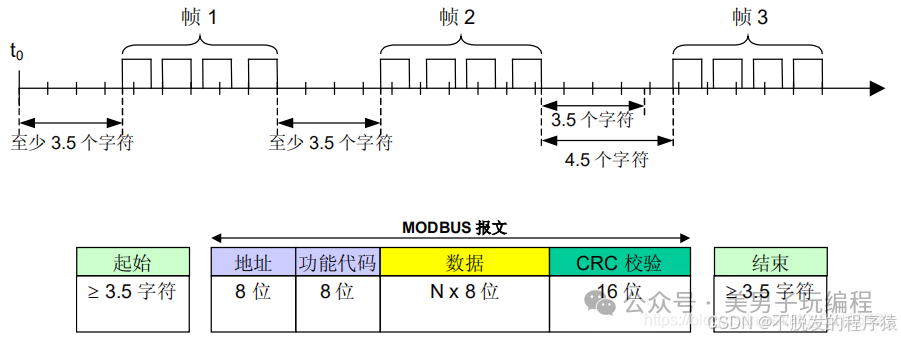
A Modbus message (using RTU as an example) includes the following parts:
- Address field (1 byte): Specifies the slave device address (1-247, 0 for broadcast).
- Function code (1 byte): Indicates the type of operation (e.g., 03 to read holding registers).
- Data field (variable length): Contains specific information required by the function code, such as register address or value.
- Error check (2 bytes): RTU uses CRC, ASCII uses LRC, to ensure data integrity.
- Frame start/end: RTU marks the message boundary with a silence interval of at least 3.5 character times.
4
How to handle CRC calculation in Modbus RTU?
CRC checking is an important part of the Modbus RTU protocol, and interviewers often ask candidates to explain how it works or to implement the algorithm.
Modbus RTU uses a 16-bit CRC for error detection. The sender calculates the CRC for the entire message (address + function code + data) and appends it to the end of the message. The receiver recalculates the CRC and compares it with the received CRC to verify message integrity.
Implementation methods:
- Software implementation: Calculate CRC using a lookup table or polynomial (0xA001).
- Hardware support: Some microcontrollers (like STM32) provide hardware CRC modules to accelerate calculations.
Here is a simple CRC calculation function.
uint16_t modbus_crc16(uint8_t *data, uint16_t length) { uint16_t crc = 0xFFFF; for (int i = 0; i < length; i++) { crc ^= data[i]; for (int j = 0; j < 8; j++) { if (crc & 0x0001) { crc = (crc >> 1) ^ 0xA001; } else { crc = crc >> 1; } } } return crc;}5
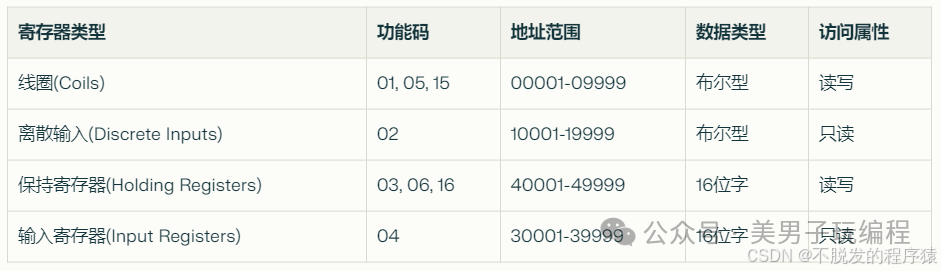
Data types and register classifications in the Modbus protocol
The Modbus protocol defines four basic data types, which are high-frequency topics in interviews.
6
What challenges are faced when implementing Modbus on resource-constrained microcontrollers?
Implementing Modbus on resource-constrained microcontrollers may face the following challenges:
- Memory limitations: Registers and message buffers occupy RAM, requiring storage optimization.
- Timing requirements: Timely responses to master device requests are necessary, especially in real-time systems.
- Serial communication: Correctly configure baud rate, parity, and stop bits to avoid communication errors.
- Error handling: Implement robust error detection and recovery mechanisms, such as handling invalid function codes or CRC errors.
Solutions:
- Use lightweight Modbus libraries to reduce code footprint.
- Utilize interrupt-driven serial communication to improve response speed.
- Optimize data structures to reduce memory usage.
7
How to ensure real-time performance in a Modbus communication system?
To ensure real-time performance, the following measures can be taken:
- Interrupt-driven communication: Use serial port interrupts to handle receiving and sending data.
- Task prioritization: In multi-task systems, prioritize processing Modbus messages.
- Code optimization: Reduce processing delays, such as using efficient CRC algorithms.
- RTOS support: In complex applications, use a real-time operating system (like FreeRTOS) to manage task scheduling.
8
How to debug Modbus communication issues in embedded systems?
Methods for debugging Modbus communication issues include:
- Using protocol analyzers: Such as serial port monitors or Modbus debugging tools to monitor message content.
- Validating message format: Check if the slave address, function code, and data fields are correct.
- Checking CRC: Ensure CRC calculations are correct to rule out transmission errors.
- Configuring serial port parameters: Confirm that baud rate, parity, and stop bits are consistent.
- Logging: Record messages and errors in firmware for analysis.
9
Common function codes and their application scenarios
Function codes frequently tested in interviews include:

10
Common Modbus exception codes
Error handling is an important focus in interviews, reflecting the candidate’s depth of understanding of the protocol.

11
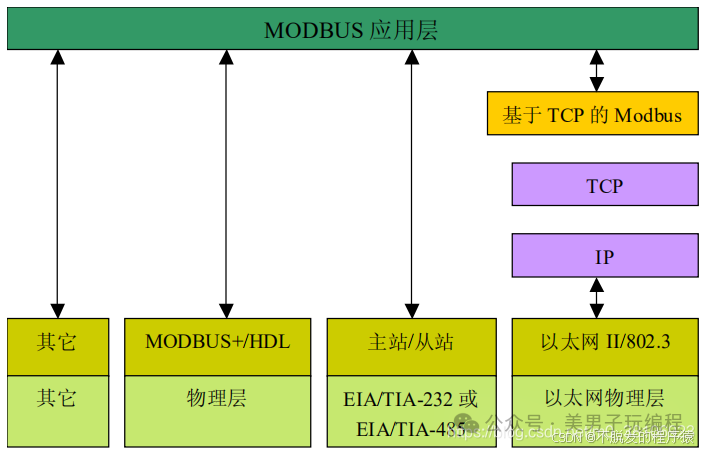
Is Modbus an application layer protocol or a transport layer protocol?
Modbus is a typical application layer protocol (OSI Layer 7), and its design essence lies in device independence.

 Click Read the original text for more exciting content~