On the testing track of Xiaopeng’s R&D center in Guangzhou, a G7 is simulating an automatic emergency lane change in heavy rain. Raindrops are densely hitting the windshield, with visibility below 50 meters. The system suddenly detects an obstacle ahead and completes a deceleration lane change in 0.3 seconds—this reaction time is 1.2 seconds faster than a human. The engineer sitting in the passenger seat glanced at the data stream: “The parallel processing capability of the three Turing chips finally allows us to challenge such extreme scenarios.”
01 Chip Breakthrough: From Computing Power Competition to Pragmatism
At the test drive event in Chengdu in July 2025, several media representatives got to experience the G7 Ultra version equipped with three Turing chips. As the vehicle entered the ramp at 120 km/h, the 87-inch AR-HUD accurately projected a navigation light carpet onto the real road, as if an invisible hand was controlling the steering wheel. Behind this system is2250 TOPS of computing power, equivalent to the performance of 8.6 NVIDIA Orin-X chips.
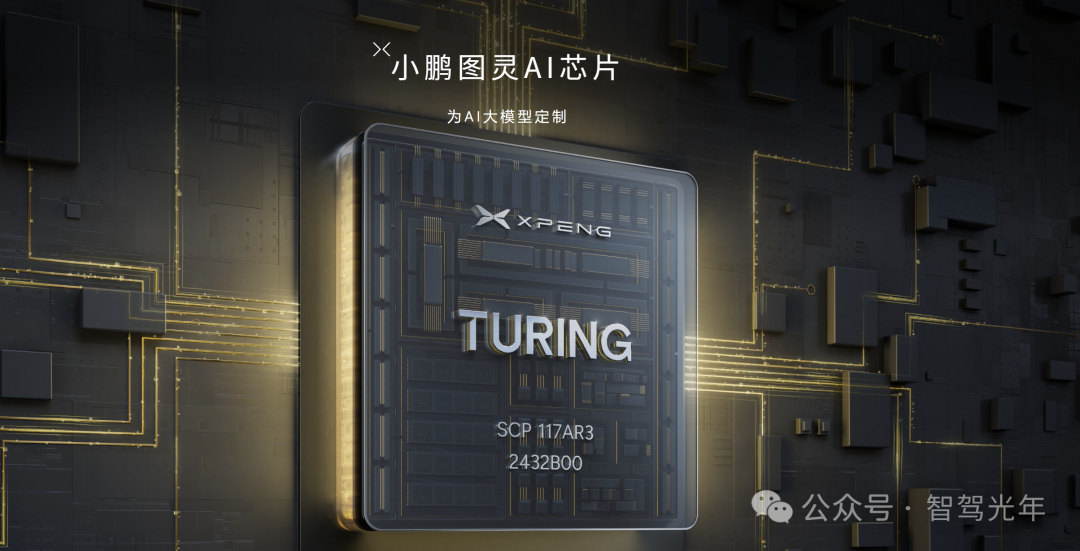
However, the computing power number itself is not astonishing; what is truly critical iscomputing power utilization. Traditional NVIDIA chips have a utilization rate of about 70%-80%, while Turing chips, through an AI-designed architecture, have increased utilization to nearly 100%. This means that every 1 TOPS of computing power is actively participating in decision-making rather than idling away.
02 Real-World Testing: Chip Performance in the Eyes of the Media
Urban Congestion Scenarios During the morning rush hour test on Lushan Avenue in Chengdu, the G7 demonstrated astonishing game-theoretic capabilities. When a nearby vehicle attempted to cut in, the system did not mechanically slam on the brakes but instead slightly adjusted the steering to maintain a safe distance. A fellow photographer remarked: “This feels more like defensive driving by a human driver rather than binary thinking by a machine.”
Extreme Weather Challenges During a test drive, CCTV’s Zhu Guangquan encountered sudden rainfall, yet the AR-HUD still clearly displayed lane boundaries in the downpour. What surprised him even more was that when the system detected a flooded area, it proactively reduced speed to 30 km/h to avoid splashing pedestrians. This attention to detail stems from the dual independent ISP processors’ adaptability to poor lighting conditions.
Complex Road Condition Decisions During a test in Chongqing, a typical “8D magical interchange” was encountered, and the G7 correctly chose the right lane at five consecutive intersections. The key lies in the VLA-OL model’schain reasoning capability: the system performs multi-step deductions like a human (“If I take the far-right lane, I won’t be able to merge onto the Huhong Expressway after 200 meters”), rather than relying on preset rules.
03 The Technological Revolution Behind the Chips
The true breakthrough of the Turing chip lies in itsend-to-end architecture. Traditional intelligent driving systems require three modules: perception, planning, and control, which introduces delays in information transmission. In contrast, the G7’s three chips directly run a large model with 30 billion parameters, requiring only 50 milliseconds from image input to steering control.
This architecture brings two practical advantages:
- Sudden Response: When detecting an electric vehicle suddenly cutting in from 200 meters away, the system can smoothly complete the avoidance maneuver in 0.3 seconds.
- Energy Consumption Control: With an ultra-low energy consumption of 12.9 kWh/100 km, partly due to the chip’s precise control over the power system.
However, testing also revealed flaws: some car owners reported that the system would suddenly downgrade on unmarked rural roads. This indicates that even with 2200 TOPS of computing power, a purely visual solution still has physical limitations.
04 L3/L4: The Gap from Computing Power to Capability
He Xiaopeng claimed that the Turing chip has passed15 years of performance degradation testing, but this does not mean that L4 is immediately achievable. The practical constraints are very clear:
Data Bottleneck: Xiaopeng has accumulated 4 billion kilometers of test data, which, while leading domestically, still falls short of Tesla’s 30 billion kilometers. Especially in scenarios like “Chinese-style cutting in,” the system still needs to learn more game strategies.
Cost Constraints: The three-chip solution brings the G7’s price down to 195,800 yuan, but it is still relatively high compared to the 150,000 yuan mainstream market. To achieve widespread L4 adoption, further reductions in chip costs are necessary.
Regulatory Lag: Current policies still require drivers to be ready to take over at any time, which means that even the strongest computing power cannot be fully unleashed. Mercedes-Benz’s L3 system, which is limited to 60 km/h in Shenzhen, is a typical example.
05 Consumer Guide: Is It Worth Paying for the Chips?
After three months of practical testing, the value of the G7’s chips has gradually become clear:
Recommended User Groups
- Tech-Savvy Users: The three chips provide hardware redundancy for the next 3-5 years, and the experience will significantly improve after the VLA large model OTA in September.
- Frequent Long-Distance Users: The 87-inch AR-HUD + 702 km range + 5C ultra-fast charging is suitable for intercity commuting.
- Families with Multiple Children: The 6D anti-motion sickness feature effectively reduces discomfort for passengers by adjusting power output and chassis feedback.
Cautious User Groups
- Budget-Sensitive Users: The basic version of intelligent driving meets 90% of daily needs, so there is no need to insist on the three chips.
- Rural Users: The system experience is compromised in unmarked road scenarios.
- Conservative Drivers: L2+ assisted driving is sufficient, and there is no need to prepay for unimplemented L3 features.
In Conclusion: The Ongoing Chip Revolution
When a car owner on a certain automotive forum shared a video of the G7 automatically avoiding a child crossing the road, the most upvoted comment was: “This is not a technological miracle, but a safety baseline that should be in place.”
The value of the three Turing chips lies not in allowing users to completely let go of the steering wheel, but in building a more reliable safety barrier with 2200 TOPS of computing power. From the Chengdu test drive event to the Chongqing 8D road test, from navigating through heavy rain to strategic maneuvers on ramps, these fragmented advancements are converging into a qualitative change.
Perhaps, as the engineer wrote in the testing log: “The best chip is not the one with the most impressive parameters, but the one that makes users forget the existence of the chip.”
If you found this article insightful, please give me a follow and a like.