Recently, Huawei released its new generation mobile chip, the Kirin 960, at the autumn media communication conference. Prior to the conference, media outlets leaked the invitation to the Huawei Kirin autumn media communication meeting. According to public information, the Kirin 960 features six major characteristics: performance, battery life, photography, audio, signal, and security. So, do these six features of the Kirin 960 live up to the hype? How does it compare to Qualcomm’s Snapdragon 830, Samsung’s Exynos 8895, and MediaTek’s Helio X30?
● ● ●
Improvements and Features of Huawei Kirin 960
In terms of performance, the Kirin 960 features a quad-core 1.8G ARM Cortex A53 and a quad-core 2.4G ARM Cortex A73, with a GPU of Mali G71 MP8. Huawei has integrated the ARM Cortex-A73 CPU core into the Kirin 960, making it the world’s first mobile chip to incorporate Cortex A73. In terms of GPU, Huawei has shifted from its previous conservative strategy and purchased ARM’s latest Mali G71 to replace the Mali T880 used in the Kirin 950, increasing the core count from 4 to 8. According to Huawei’s presentation, the GPU performance of the Kirin 960 surpasses that of Qualcomm’s Snapdragon 821.
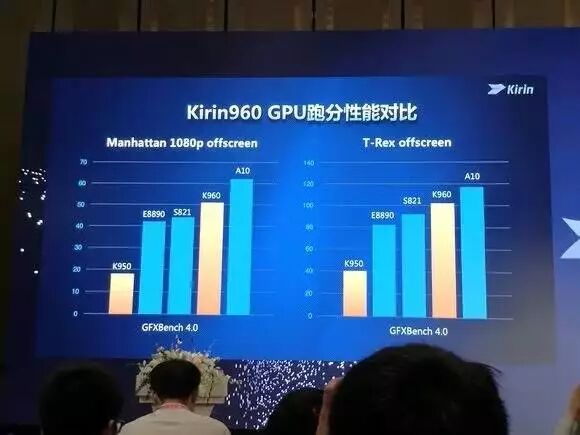
(Huawei’s presentation shows that the GPU performance exceeds that of Snapdragon 821)
In terms of battery life, photography, signal, audio, and security, the Kirin 960 has also made significant improvements.
For example, Huawei claims that the Micro Intelligence Core I6 can reduce power consumption by 40% in certain scenarios. In AR gaming scenarios, the phone’s battery life can be doubled. Additionally, Huawei has adopted a more powerful ISP to achieve better photography results. Furthermore, Huawei’s self-developed baseband supports four-carrier aggregation, with a peak download rate of up to 600Mbps, and it also supports CDMA networks.
Moreover, in terms of audio, Huawei’s Hi6403 can significantly improve call quality in noisy environments. To combat the increasing issue of telecom fraud, the Kirin 960’s anti-counterfeiting base station technology aims to cut off potential scam calls and spam messages at the source.
● ● ●
Qualcomm Snapdragon 830 Leads in Manufacturing Process
According to foreign media reports, a chip named MSM8998 is expected to debut in the first quarter of 2017. Whether MSM8998 will be named Snapdragon 830 is still pending confirmation from Qualcomm.
Current information suggests that MSM8998 will use a 10nm FinFET process, with 4GB DDR4X memory and 64GB UFS storage. Given that Samsung recently announced its mastery of 10nm manufacturing technology, it is likely that the Snapdragon 830 will not be available to consumers for another six months. According to rumors (note: not the same “rumor” as mentioned by the famous teacher), MSM8998 will still use Qualcomm’s Kyro core. Although there are rumors that Snapdragon 830 will be an 8-core SoC, information from Qualcomm’s partners suggests that Snapdragon 830 will still be a quad-core processor like Snapdragon 835 and Snapdragon 820.
Since Qualcomm has not yet disclosed the specific parameters of Snapdragon 830, we will not compare the CPU and GPU performance at this time. However, it is clear that Snapdragon 830, using Samsung’s 10nm manufacturing process, has an advantage over the Kirin 960’s 16nm process. Although Samsung’s manufacturing process has more discrepancies than TSMC’s, such as Samsung’s 14nm being inferior to TSMC’s 16nm, Samsung’s 10nm process is still superior to TSMC’s 16nm process.
On the downside, Snapdragon 830’s release will be about 1-2 quarters later than Kirin 960, allowing Huawei to gain a first-mover advantage. However, Snapdragon 830’s market share will still be larger than that of the Kirin 960, which is only produced and sold by Huawei. Major Android flagship phones from Samsung, LG, ZTE, Vivo, Xiaomi, HTC, Sony, Lenovo, etc., are likely to adopt this chip.
● ● ●
How Does It Compare to Samsung Exynos 8895 and MediaTek Helio X30?
MediaTek’s Helio X30 will continue to use the deca-core architecture of Helio X20, but will add low-power A35 cores, resulting in a configuration of 2*A72 + 4*A53 + 4*A35. The two A72 cores will run at 2.8GHz, while the A53 and A35 cores will be boosted to 2.2GHz and 2.0GHz, respectively. Helio X30 will support up to 8GB of LPDDR4 memory and the UFS 2.1 standard. Based on the performance of X20, the deca-core architecture may not necessarily save power, but with two A72 cores running at 2.8GHz, the X30’s performance is clearly sufficient. Additionally, by switching from ARM’s Mali to Imagination’s PowerVR for the GPU, the X30 gains some prestige, enhancing its competitiveness in the mid-to-high-end mobile chip market.
Samsung’s Exynos 8895 will continue the design of Exynos 8890 for the CPU, but with an increased clock speed of up to 3GHz, and in extreme cases, it can reach 4GHz. The GPU will feature ARM’s Mali-G71.
In terms of CPU, according to Huawei’s presentation, the improvement of Kirin 960 over Kirin 950 is limited. Therefore, the performance improvement of Cortex A73 over Cortex A72 is relatively modest, and it is likely that the A73’s improvement lies in a better performance-to-power ratio. Thus, in terms of single-threaded performance, the 2.4G A73 of Kirin 960 may not outperform the 2.8G A72. Meanwhile, Samsung’s increase of the CPU clock speed to 3-4GHz will yield better performance—dominating single-threaded performance over Kirin 960 and Helio X30—but it may also lead to higher power consumption, depending on whether Samsung’s 10nm process can handle it. Overall, for most scenarios, all three mobile SoCs offer surplus performance.
Regarding GPU performance, according to Huawei’s presentation, the GPU performance of Kirin 960 has already surpassed that of Snapdragon 821. As for whether it can outperform Exynos 8895 and Helio X30, we will refrain from comparison until official GPU performance data for Exynos 8895 and Helio X30 is available.
In terms of manufacturing process, Helio X30 uses TSMC’s 10nm process, while Exynos 8895 uses Samsung’s 10nm process. In terms of manufacturing process, Helio X30 is superior to Exynos 8895, which in turn is superior to Kirin 960.
Overall, due to its disadvantage in manufacturing process, Kirin 960 is inherently at a disadvantage compared to Helio X30 and Exynos 8895. However, based on the performance of X20, the deca-core architecture may not necessarily save power, and Samsung’s aggressive increase of CPU clock speeds to 3-4GHz may lead to excessive power consumption. Given Samsung’s history of over-specifying GPU performance, it is speculated that while Kirin 960 may inherently suffer from power consumption due to its manufacturing process, its power consumption may not be significantly higher than that of Helio X30 and Exynos 8895.
● ● ●
Conclusion
Compared to the significant upgrade from Kirin 930 to Kirin 950—where A72 replaced A53 and 16nm manufacturing process replaced 28nm—Kirin 960 offers limited improvements over Kirin 950, aside from a substantial increase in GPU performance and support for CDMA networks.
The significance of Kirin 960 lies more in addressing the existing shortcomings of Kirin 950, serving Huawei’s development strategy for terminal products. Based on the historical performance of HiSilicon’s Kirin chips, while the Kirin series may not be the top performer at any given time, they tend to achieve a good balance between performance and power consumption. It is believed that devices like the Huawei Mate 9, equipped with Kirin 960, will provide a good user experience.
|
Click on keywords to view related historical articles ● ● ● Loongson 3A3000 | Samsung Note 7 Dajiang “Yun” Mavic | Google Home Domestic Multi-line Laser Radar | Google Daydream VR Headset Xiaomi 5s | Movidius | lightning | Prisma | Live Broadcast Xiaomi Robot Vacuum | Xiaomi Yi M1 Mirrorless Camera | Xiaomi Laptop Application Number | Huawei Drone | Amazon Echo |