Have you ever imagined that the seemingly ordinary smartwatch on your wrist could one day become an “invisible guardian” of your heart health? Recently, a significant study published in the Journal of the American College of Cardiology: Advances (JACC: Advances) has provided new answers for everyone concerned about cardiovascular health.
By analyzing data from 26 studies involving over 17,000 patients, scientists have confirmed that mainstream smartwatches have an overall sensitivity of 95% and specificity of 97% in detecting atrial fibrillation (AF), with some brands achieving accuracy comparable to professional medical devices.
This conclusion not only overturns many people’s perception that “wearable devices are just toys” but also brings new possibilities for the early screening of AF, a “silent killer”.
Why is AF screening so important?
Before discussing smartwatches, we must confront a harsh reality: atrial fibrillation, a heart issue that sounds “non-urgent”, is actually the “number one accomplice” of strokes.
Research shows that AF is the most common arrhythmia globally, with over 52.5 million patients worldwide as of 2021, a 137% increase since 1990.
Even more alarming is that the risk of stroke for AF patients is five times that of the general population, and strokes caused by AF have a high mortality and disability rate, with one in four stroke patients being related to AF.
However, more challenging than the disease itself is the “insidiousness” of AF.
About 30% of AF patients show no obvious symptoms; they do not experience palpitations or dizziness and often only discover that AF is the culprit after a stroke occurs.
This “asymptomatic AF” is considered the most dangerous “invisible killer” by cardiovascular doctors.
Traditionally, the gold standard for diagnosing AF is a 12-lead electrocardiogram (ECG), but it can only capture the heart rhythm at the moment of examination, leading to a misdiagnosis rate of up to 60% for occasional “paroxysmal AF”.
While Holter monitors can track heart activity for 24-48 hours, they require carrying a device, making them inconvenient for daily use; implantable cardiac monitors, though accurate, are invasive and only suitable for high-risk populations.
At this point, the emergence of smartwatches fills the gap between “convenience” and “accuracy”.
How strong is the “heart detection capability” of smartwatches?
This systematic review and meta-analysis conducted by scholars from the United States, Brazil, and other countries is considered a “milestone study in the field of smartwatch AF detection”.
The research team searched global literature up to January 2025 and ultimately selected 26 high-quality studies that met the criteria, covering 17,349 patients and involving major smartwatch brands such as Apple, Samsung, Withings, and Huami.
1. Overall performance: Accuracy far exceeds expectations, comparable to professional devices
Data shows that all smartwatches included in the study have an overall sensitivity of 95% (95% confidence interval: 92%-97%) and specificity of 97% (95% confidence interval: 94%-98%), with a combined area under the curve (AUC) of 0.97—indicating that smartwatches can not only accurately identify patients with AF (high sensitivity) but also effectively exclude healthy individuals without AF (high specificity), achieving an “excellent” level of diagnostic capability.
It is worth noting that even commonly used Holter monitors have a sensitivity and specificity of about 90%-95%.
This means that in AF detection, smartwatches have the capability to “compete on the same stage” as professional medical devices.
2. Brand comparison: Samsung and Huami perform outstandingly, Apple is the most trusted
The study also detailed the performance of different smartwatch brands, revealing significant differences:
Samsung: Overall performance is the best, with a sensitivity of 97%, specificity of 96%, and AUC of 0.98, particularly excelling in identifying “paroxysmal AF”.
Huami: A dark horse, with a sensitivity of 98.68% (almost no missed diagnoses) and specificity of 98.87%, but due to a smaller sample size in related studies, results still require more data validation.
Apple Watch: The most “reliable” all-rounder, with a sensitivity of 94% and specificity of 97%. Although its individual metrics are not the highest, it has the most studies and the broadest patient coverage (involving 12 studies and over 8,000 patients), providing the most clinical evidence and is currently the only smartwatch AF detection feature fully certified by the FDA.
Withings Scan Watch: Average performance, with a sensitivity of 89% and specificity of 95%, suitable for price-sensitive users.
Fitbit: Relatively weak performance, with a sensitivity of 65.57% and specificity of 79.29%. If AF screening is the primary need, it is not recommended as a first choice.
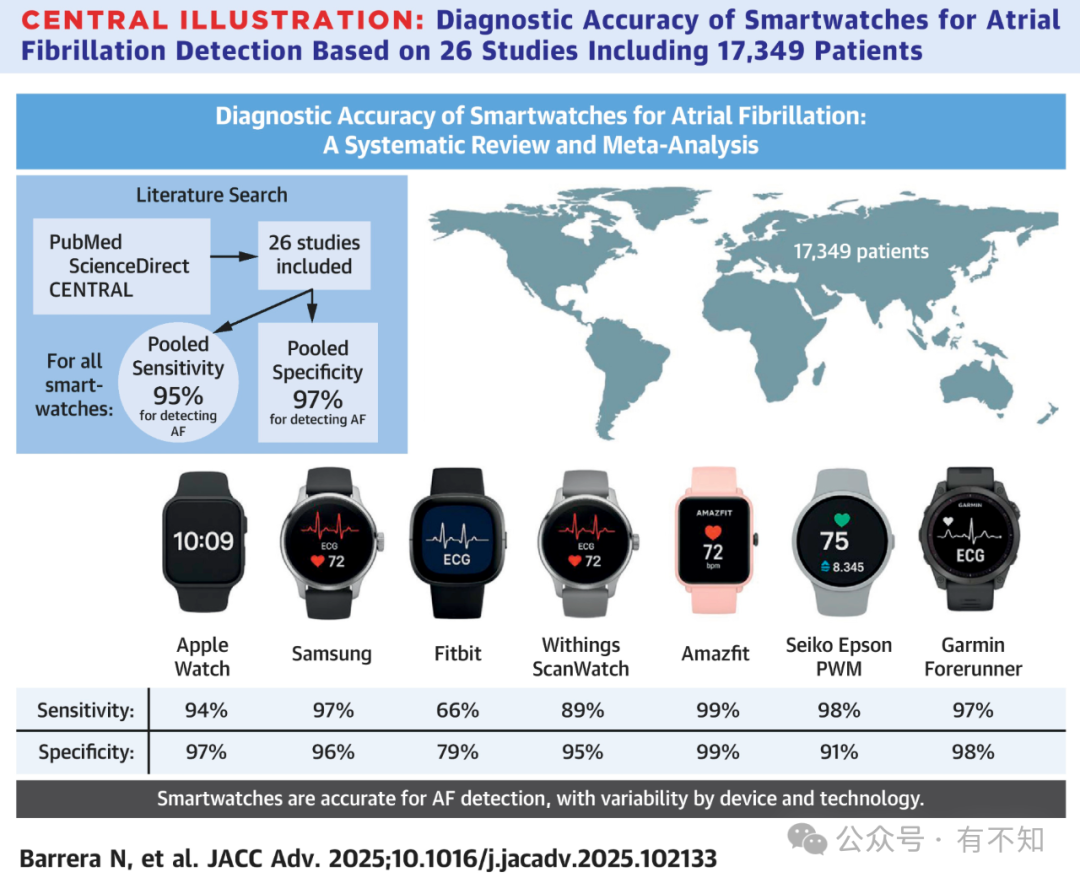
Image source: Paper screenshot
It is worth mentioning that the study also dispelled a common misconception: many people believe that “only smartwatches with ECG functions are accurate”, but the data shows that smartwatches based on PPG photoplethysmography (which monitors blood flow changes through optical sensors) have diagnostic accuracy almost on par with ECG models (AUCs of 0.98 and 0.97, respectively).
In other words, even if your smartwatch does not have ECG functionality, as long as it supports PPG heart rate monitoring, it can still serve as an “entry-level tool” for AF screening.
Who should use smartwatches to screen for AF?
Although the AF detection capabilities of smartwatches are impressive, not everyone needs to “monitor daily”.
Based on research conclusions and clinical guidelines, the following four high-risk groups are especially recommended to use smartwatches as daily screening tools:
1. Individuals over 50 years old: Age is the “number one risk factor” for AF
Data shows that the incidence of AF significantly increases after age 50, with a prevalence of over 10% in those over 65 and as high as 20% in those over 80.
For this group, even without any symptoms, it is recommended to conduct AF detection with a smartwatch 1-2 times a week (some smartwatches support “passive monitoring”, which can automatically identify irregular heart rhythms and alert users).
2. Individuals with a family history of AF or previous medical history
If your parents or siblings have AF, or if you have been diagnosed with “paroxysmal AF”, you belong to a high-risk group for AF.
The advantage of smartwatches lies in “long-term monitoring”, which can capture “short episodes of AF” (lasting less than 24 hours) that are easily missed during routine check-ups, helping doctors determine whether anticoagulation therapy is needed.
3. Patients with hypertension, diabetes, or obesity
Patients with hypertension have a 2.5 times higher risk of developing AF, and diabetes and obesity (BMI≥28) also significantly increase the likelihood of AF.
This group should not only control their underlying conditions but also regularly monitor their heart rhythm with a smartwatch, especially when blood pressure and blood sugar control are poor, increasing monitoring frequency.
4. Patients with stroke or transient ischemic attack (TIA)
About 20% of stroke patients have no clear cause (referred to as “cryptogenic stroke”), with nearly half related to “asymptomatic AF”.
The study specifically mentioned a smartwatch designed for stroke patients (Pulse Watch) that has an accuracy of 92.9% in detecting AF, meaning that stroke patients monitoring with a smartwatch may find the cause and receive targeted treatment to reduce the risk of recurrence.
Three Correct Approaches to AF Screening with Smartwatches
Many people buy smartwatches with AF detection features but end up with inaccurate results due to “incorrect usage”.
According to the recommendations from the research team, correctly using smartwatches to screen for AF requires attention to these three points:
1. Remain “still” during detection; avoid monitoring immediately after exercise
PPG and ECG sensors are very sensitive to motion interference; monitoring while walking or doing housework can easily lead to “false positives” (misdiagnosed as AF).
The correct approach is to sit in a chair, keep your arm still and relaxed, avoid talking or looking down at your phone, and monitor continuously for 30 seconds to 1 minute (some smartwatches support automatic extension of monitoring time) to ensure stable data.
2. Do not rely on “single results”; seek medical attention for continuous abnormalities
An occasional “AF alert” does not necessarily indicate true AF; emotional stress, caffeine consumption, or staying up late can all lead to temporary arrhythmias.
Research shows that the false positive rate for a single abnormal result is about 5%-8%, but if irregular heart rhythms are indicated for three consecutive days or if symptoms such as palpitations, chest tightness, or dizziness occur, it is essential to seek medical attention for further confirmation through a 12-lead ECG or Holter monitor.
3. Regularly update the smartwatch system to ensure algorithms are “up to date”
The AF detection function of smartwatches relies on algorithm upgrades; research has found that brands like Apple and Samsung can improve diagnostic accuracy by 5%-10% through software updates.
It is recommended to check for system updates once a month to ensure that the smartwatch’s detection algorithms are the latest version.
Smartwatches are not a “cure-all”
Despite the encouraging research results, we must recognize that smartwatches are “screening tools”, not “diagnostic tools”, and cannot replace professional medical judgment.
When using them, it is crucial to avoid these three misconceptions:
Misconception 1: “If the detection is normal, there is no need for a check-up”
The advantage of smartwatches is “convenient screening”, but they cannot detect other heart problems (such as coronary artery disease or myocardial ischemia) and cannot replace ECGs or echocardiograms in routine check-ups.
Even if the smartwatch consistently indicates “normal heart rhythm”, individuals over 50 should still have a specialized cardiac examination annually.
Misconception 2: “False positives can be ignored”
Research shows that the false positive rate for AF detection with smartwatches is about 3%-5%, especially higher among younger populations (as AF prevalence is low in younger individuals, occasional arrhythmias are easily misdiagnosed).
However, “false positives” are not “insignificant”—repeated false positive alerts can cause anxiety and even lead to unnecessary tests (such as CT scans or angiography).
If you frequently receive “AF alerts” but are not diagnosed after medical consultation, it is advisable to consult a doctor to adjust the smartwatch’s monitoring parameters or switch to more professional equipment.
Misconception 3: “After being diagnosed with AF, monitoring with a smartwatch is sufficient”
The core of AF treatment is “stroke prevention”; after diagnosis, doctors need to decide whether to initiate anticoagulation therapy based on the CHA₂DS₂-VASc score (a scale for assessing stroke risk) and which medication to choose.
Smartwatches can only monitor heart rhythm changes and cannot determine “the duration of AF episodes” or “whether medication adjustments are needed”, nor can they replace anticoagulation therapy.
Diagnosed patients must follow medical advice for medication, undergo regular check-ups, and smartwatch monitoring should only serve as an “auxiliary tool”.