DOI: <span><span>10.1021</span></span><span><span>/</span></span><span><span>acsami</span></span><span><span>.</span></span><span><span>9b1972</span></span> Published on: <span><span>2020</span></span><span><span>-</span></span><span><span>01</span></span><span><span>-</span></span><span><span>14</span></span> Journal: <span><span>ACS</span></span><span><span> Applied</span></span><span><span> Materials</span></span><span><span>&</span></span><span><span> Interfaces</span></span>
Abstract Translation
Soft robots can surpass traditional rigid robots in terms of structural compliance, safety, and motion efficiency. However, designing and efficiently manufacturing soft robots with multimodal motion capabilities and multifunctionality to navigate dynamic environments and perform diverse tasks remains a significant challenge. This study presents a 3D printed soft robot that features spatially varying material compositions (0-50% particle-polymer weight ratio), multi-scale hierarchical surface structures (10 nm, 1 µm, and 70 µm features on a 5 mm wide robot footpad), and includes multifunctional components. An innovative new additive manufacturing process—magnetic field-assisted projection lithography (M-SL)—was developed to fabricate robots with preset material heterogeneity and structural hierarchy, enabling localized engineering of flexibility and pre-programmed functionalities. The robot employs wireless magnetic drive, exhibiting exceptional multimodal motion capabilities, capable of performing tasks in harsh environments, including effective loading (up to ~30 times its own weight) and obstacle removal (up to 6.5 times its own weight) in confined spaces (such as a 5 mm diameter glass tube and the folds of a pig’s stomach), by grasping or pushing objects (ranging from 0.3 to 8 times its own weight, with speeds up to 31 mm/s). Furthermore, the robot’s footpad is covered with multi-scale hierarchical spike structures, featuring dimensions from nanometers (e.g., 10 nm) to millimeters. This high structural hierarchy enables various superior functions, including transforming naturally hydrophilic surfaces into hydrophobic ones, hair-like adhesion, and excellent cell attachment and growth performance. The study found that hair-like adhesion and engineered hydrophobicity allow the robot to navigate robustly in slippery environments. The multi-material, multi-scale robot design and direct digital manufacturing methods enable the robot to exhibit complex and diverse behaviors in complex environments, promoting a wide range of practical applications.
Figure Caption List
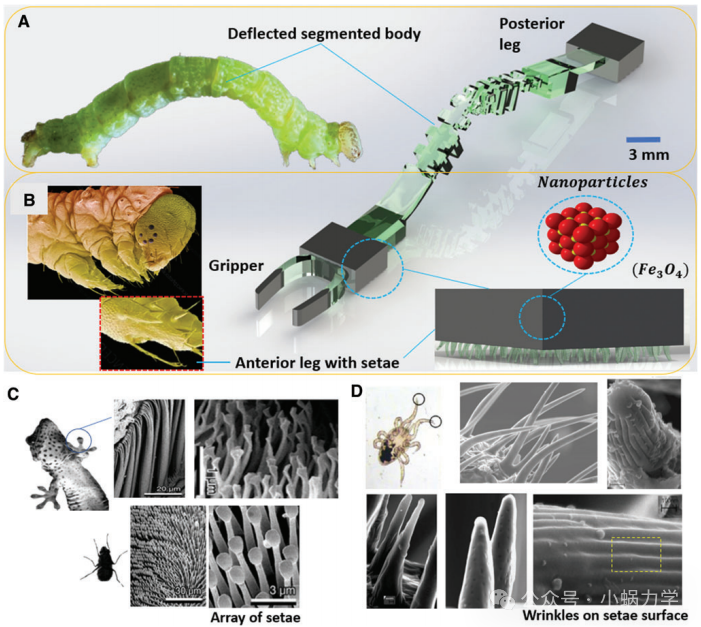
- Figure 1: Overview of Soft Robot Design(A, B) Digital models of multi-material soft robots, with gray representing magnetic particle-polymer composites and green representing flexible polymers.(C) Scanning electron microscope images of adhesion systems from flies (wet fibers) and geckos (dry fibers).(D) Scanning electron microscope images of chicken mite (Dermanyssus gallinae) bristles and different morphologies (grooved and porous).
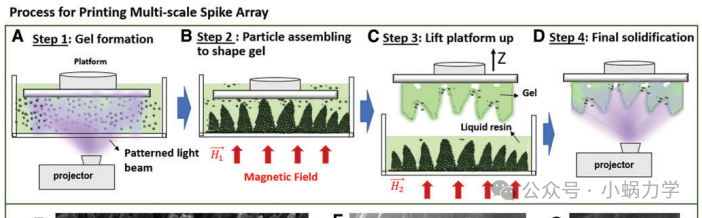
- Figure 3: Manufacturing of Unique Multi-Scale Surface Structures(A-D) Schematic of the printing process for multi-scale surface features on the robot footpad (~70 µm long spikes, tip diameter 5 µm; ~1 µm deep wide wrinkles; 10-20 nm diameter pores):(A) Step 1: The M-SL process begins with light projection onto a particle resin suspension.(B) Step 2: An external magnetic field gradient attracts magnetic particles, forming spikes and inducing tension on the gel spike surface.(C) Step 3: The lifting platform is removed from the resin tank, and permanent magnets are used to remove footpad particles; wrinkles and porous surfaces are generated during particle removal.(D) Step 4: Light projection curing.(E) Scanning electron microscope image of the footpad from a top view.(F) Side view of a single spike.(G) Pores around the spike.(H) Wrinkles with consistent surface density around the spike.(I) Wrinkles with uniform width and depth.
- Figure 4: Drug Delivery and Obstacle Removal Applications(C1, C2) CAD models and printed robots with grippers.(D) Real-world grasping experiments.(E, F) Drug carrying reservoir and release mechanism.(G, H) Demonstration of obstacle pushing in a glass tube.
- Figure 5: Robot Motion and Drug Transport DemonstrationIn an ex vivo gastric model covered with chicken skin tissue, the robot moved 93 mm in 70 seconds (from start to target), completing transport in a slippery harsh environment.
- Figure 6: Measurement of Robot Leg Wettability(A, C) Water droplet contact angles of ~78° (left) and 81° (right) on smooth footpads (without spike surface structure).(B, D) Contact angles of ~132.89° (left) and 132° (right) on footpads with spike surface structures.
- Figure 7: Biocompatibility Testing(B) Cell attachment on spike footpads after 6 hours of seeding.(C) 3D reconstruction of cell growth distribution after 72 hours of seeding.