First Author: Sixing Zheng (Zhejiang University), Junyi Han (Institute of Materials Technology and Engineering, Chinese Academy of Sciences, Ningbo), Zhenhui Kou (Zhejiang University)Corresponding Authors: Tao Zhang (Institute of Materials Technology and Engineering, Chinese Academy of Sciences, Ningbo), Yang Hou (Zhejiang University)
Research BackgroundElectrochemical CO₂ reduction (CO₂ER) to produce multi-carbon fuels is one of the most promising technologies for achieving a “carbon closed loop”. However, the production of ethanol with high selectivity and large current is still limited by insufficient proton supply at the interface:
-
Traditional electrolyte regulation (adding alkali metals, surfactants) fails in membrane electrode assemblies (MEAs) due to the lack of electrolyte at the cathode, leading to spatial inhomogeneity;
-
The buffering capacity of the interfacial water network is depleted under ampere-level currents, making the *CO→*CHO protonation step the rate-limiting step, resulting in the dominance of by-products such as ethylene;
-
Organic molecular interfacial engineering is still in the “trial and error” stage, lacking molecular design principles and without verification in ampere-level MEAs.
Research ObjectiveTo propose a new paradigm of “bidentate nitrogen-centered organic interfacial layers” that reconstructs the hydrogen bond network of interfacial water at the atomic scale, achieving efficient, highly selective, and long-term stable operation of ampere-level CO₂ electrolysis for ethanol production.
Experimental MethodUsing Cu₂O as a precursor, a self-assembled monolayer of bidentate piperazine (PZ, bidentate-N) is formed on its surface, and the PZ-Cu catalyst is obtained through in situ electro-reduction; combined with flow cell/MEA electrolyzers, operando ATR-SEIRAS/SERS, AIMD, and DFT, the orientation of interfacial water, hydrogen bond distribution, key intermediate coverage, and reaction energy barriers are systematically analyzed.
Main Findings
-
Interfacial water “turns” to release protonsAIMD+SEIRAS confirms: PZ disrupts the strong hydrogen bond network, increasing the proportion of free water by three times, with more O−H orientations downward, and the water dissociation energy barrier decreases from 1.12 eV to 0.87 eV, continuously supplying *H.
-
Reaction pathway “bends” towards ethanolDFT free energy diagrams show: the rate-limiting step of PZ-Cu switches from *CO→COCO (ethylene pathway) toCO→*CHO (ethanol pathway); the asymmetric coupling energy barrier of *CHO−*CO is lower, increasing the ethanol/ethylene ratio by 2.3 times.
-
Flow cell performance reaches new heightsFaradaic efficiency for C₂⁺ products exceeds 85% in the range of 400–1000 mA cm⁻², with a peak ethanol FE of 50.5% (at 600 mA cm⁻²), outperforming monodentate piperazine PD-Cu and bare Cu.
-
MEA electrolyzer achieves “ampere-level ethanol” for the first timeAt a total current of 2.0 A (4 cm²), ethanol FE is 40.1%, with total C₂⁺ FE exceeding 70%, and continuous operation for over 30 hours shows almost zero decay in voltage and selectivity, setting a new record for Cu-based catalysts.
Figure Interpretation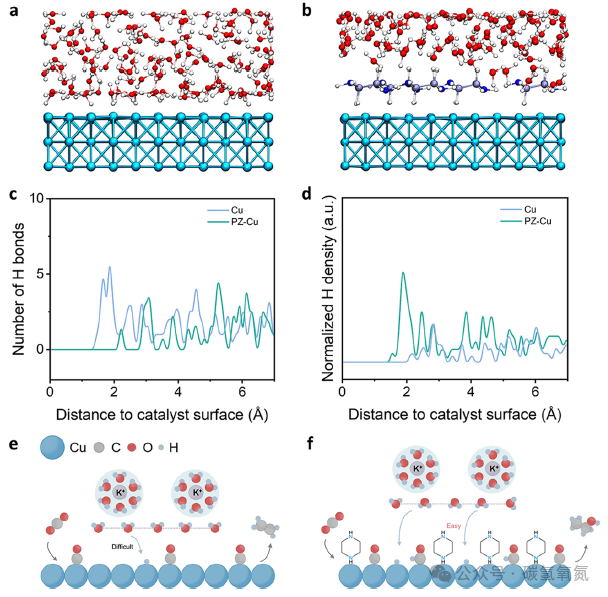
Figure 1 Molecular dynamics reveal interfacial water reconstructiona) Bare Cu surface: water molecules lie flat, hydrogen bond network is denseb) PZ-Cu surface: water molecules stand upright, hydrogen bonds are disruptedc) Hydrogen bond count distribution along the z-direction: PZ-Cu shows a significant decrease in hydrogen bond count within 4 Åd) H atom density: H density peak within 4 Å of the PZ-Cu surface is significantly enhanced, confirming the reorientation of watere-f) Mechanism cartoon: PZ induces water dissociation to generateH, promotingthe protonation of CO→*CHO
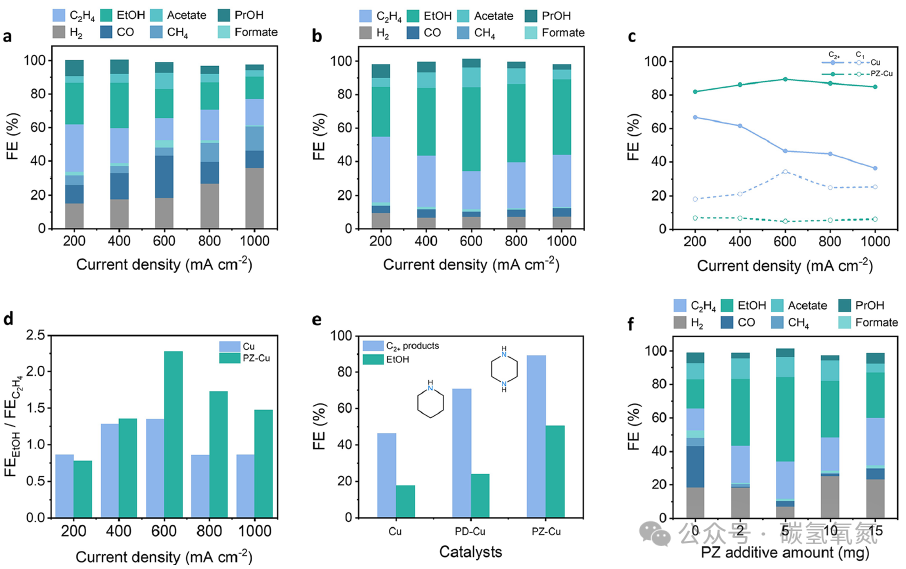
Figure 2 Flow cell CO₂ER performancea-b) Bare Cu vs PZ-Cu product FE-current curves: PZ-Cu ethanol FE is consistently higher than bare Cu, with suppressed by-products CH₄ and H₂c) Comparison of C₂⁺ and C₁ FE: PZ-Cu peaks at 89.4% for C₂⁺ FE, while C₁ is <15%d) Ethanol/ethylene ratio: PZ-Cu reaches 2.3 at 600 mA cm⁻², while bare Cu is only 1.4e) Comparison of C₂⁺ and ethanol FE for three catalysts: bidentate PZ significantly outperforms monodentate PD and bare Cuf) Optimization of PZ addition: maximum C₂⁺ FE at 5 mg, excess leads to a decrease, showing a volcano relationship
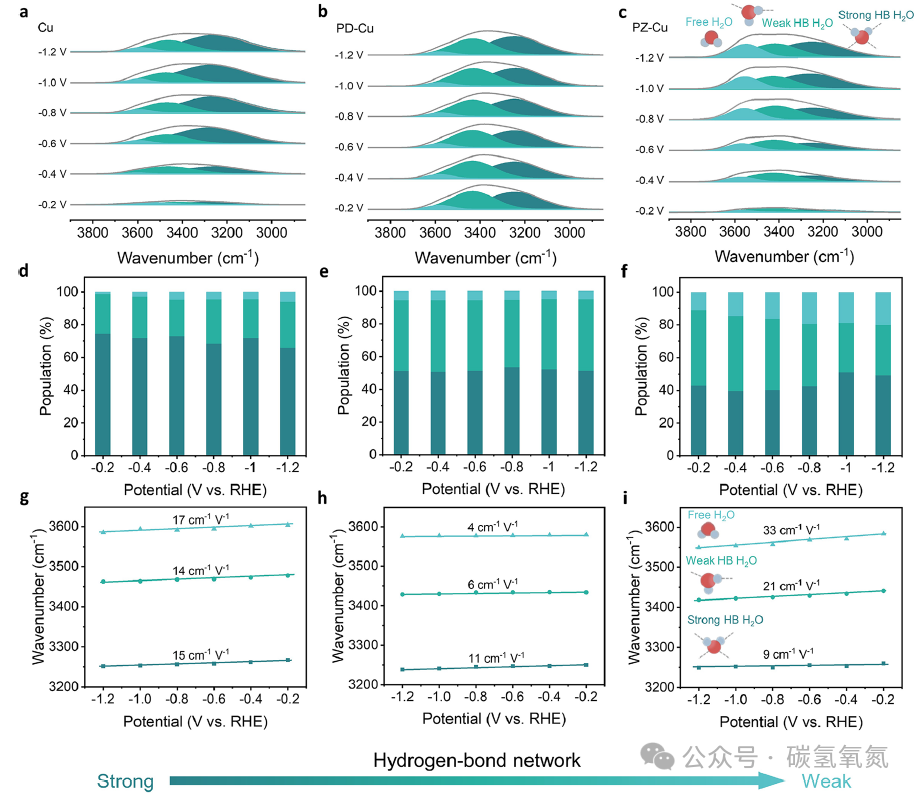
Figure 3 In situ infrared analysis of interfacial water typesa-c) O–H stretching vibration sub-peaks: free water (3600 cm⁻¹), 2HB water (3450 cm⁻¹), 4HB water (3270 cm⁻¹)d-f) Potential-dependent proportions: PZ-Cu maintains a higher proportion of free water + 2HB water compared to Cu/PD-Cu, with a significant reduction in 4HB waterg-i) Stark slope: PZ-Cu shows the largest slope for free water, indicating it is closer to the surface and more easily dissociable
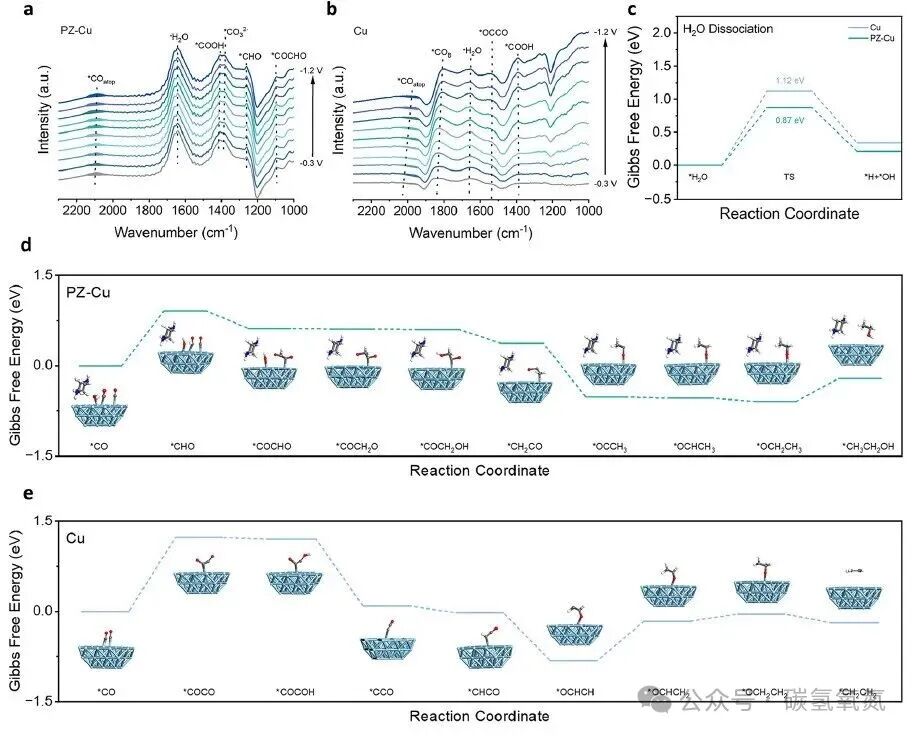
Figure 4 Theoretical-experimental correlationa-b) Intensity of CHO intermediate peak (~1260 cm⁻¹): PZ-Cu > Cu, positively correlated with ethanol selectivityc) Water dissociation energy barrier: PZ-Cu 0.87 eV < bare Cu 1.12 eVd-e) Free energy panorama: PZ-Cu rate-limiting stepCO→CHO, Cu isCO→COCO; subsequentCHO−*CO coupling pathway energy is smoother, guiding towards ethanol
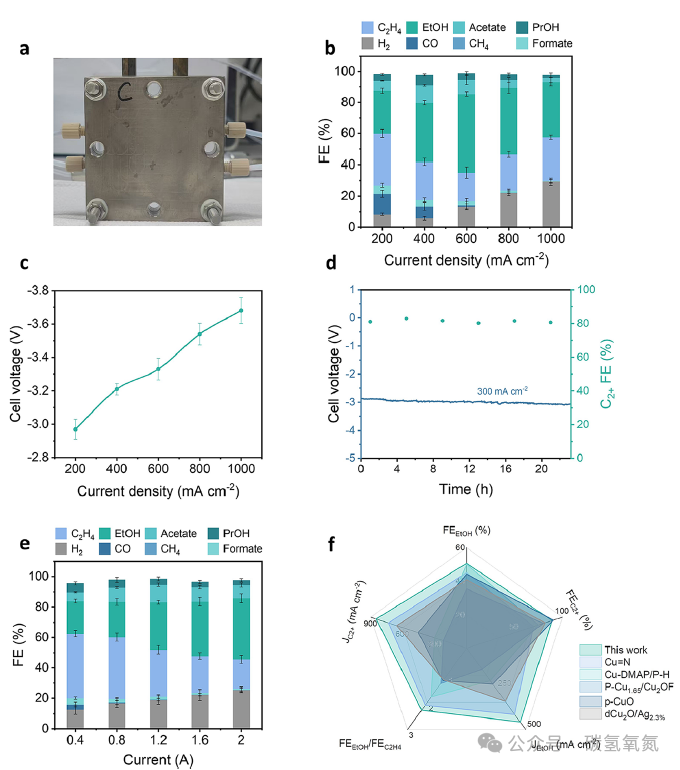
Figure 5 MEA ampere-level demonstrationa) Physical photo: 1 cm² MEA stackb) Product FE-current density: ethanol FE 50.1% at 600 mA cm⁻², total C₂⁺ FE >80%c) Polarization curve: voltage-current is linear, with low internal resistanced) Stability at 300 mA cm⁻²: voltage and FE show almost zero drift over 24 hourse) Scaled up to 4 cm², total current of 2 A: ethanol FE 40.1%, total C₂⁺ >70%f) Comparison with literature: current density, ethanol FE, and stability are all at the forefront of Cu-based materials
Conclusion and OutlookThis work elucidates for the first time the molecular chain linking “bidentate nitrogen center – interfacial water orientation – proton supply – ethanol selectivity”, validating the universal potential of organic molecular interfacial engineering in ampere-level CO₂ electrolysis. Future directions include: ① extending to other C₂⁺/C₃⁺ products; ② coupling with solid-state electrolytes and steam-supplied MEAs to achieve modular devices without liquid electrolytes; ③ transferring the bidentate nitrogen strategy to O₂ reduction, N₂ fixation, and other electrocatalytic systems, promoting the “molecular interfacial layer” to become a new standard for next-generation electrolyzer design.
Zheng, S., Han, J., Kou, Z., Liu, N., Chen, Y., Yang, B., Li, Z., Song, F., Lei, L., Sheremet, E., Zhang, T., Baek, J.-B., & Hou, Y. (2025). Bidentate piperazine matrices steering interfacial proton flux toward ampere-level ethanol electrosynthesis in CO₂ electrolyzers. Journal of the American Chemical Society. https://doi.org/10.1021/jacs.5c10975