Phone/WeChat: 13392863941
BONGSHIN sensors play a crucial role in industrial automation and measurement. They can accurately convert physical quantities (such as pressure, weight, temperature, etc.) into electrical signals, providing critical data for various devices and systems. The Korean Bongshin brand, as one of the leaders in the global sensor market, has earned the trust and praise of customers worldwide with its excellent quality, innovative technology, and wide range of applications. Bongshin sensors not only feature high precision and stability but also possess outstanding durability and adaptability, meeting measurement needs in various complex environments.
Brand: Korean Bongshin
Model: BCH-1t
Type: Column Load Cell Sensor
1. Detailed Parameters
|
Model |
BCH |
|
Rated Capacity (R.C.) |
1, 2, 3, 5, 10, 20, 30, 50 t |
|
Rated Output (R.O.) |
1.0mV/V ± 1.0% |
|
Non-linearity |
≤0.5% R.O. |
|
Hysteresis |
≤0.5% R.O. |
|
Repeatability Error |
≤0.5% R.O. |
|
Creep Error |
≤0.5% within 20 minutes |
|
Zero Balance |
1% R.O. |
|
Temperature Compensation Range |
-10 ~ 70°C |
|
Operating Temperature Range |
-20 ~ 80°C |
|
Temperature Effect on Rated Output |
±0.03% LOAD/10°C |
|
Temperature Effect on Zero Balance |
±0.03% R.O./10°C |
|
Input Resistance |
350 Ohms ± 10 Ohms |
|
Output Resistance |
350 Ohms ± 10 Ohms |
|
Insulation Resistance (Minimum) |
2000 MOhms at 50V DC |
|
Excitation Voltage |
3~12V (recommended), 15V (maximum) |
|
Electrical Connection |
Ø7mm x 6m (22AWG x 4-core shielded) |
|
Protection Level |
IP 64 compliant |
|
Safe Overload |
150% R.C. |
|
Ultimate Overload |
300% R.C. |
2. Application Scenarios and Selection Reference
The BCH-1t sensor is suitable for various application scenarios, such as material weighing on industrial automation production lines, goods sorting and measurement in logistics warehousing, and force measurement in testing equipment. When selecting, consider the following factors:
1. Measurement Requirements: Choose the appropriate sensor model based on the actual weight range and accuracy requirements.2. Operating Environment: Consider factors such as temperature, humidity, and corrosiveness of the environment where the sensor will be used, and select a sensor with the corresponding protection level and material.3. Installation Method: Choose the suitable sensor type and installation method based on the installation space and location requirements.
3. Installation Steps
1. Preparation: Ensure the installation environment meets the sensor requirements and prepare the necessary installation tools and materials.2. Installation Location Selection: Choose a stable, vibration-free, and easily maintainable installation location to ensure accurate measurement by the sensor.3. Wiring Method: Follow the wiring diagram in the sensor manual to connect the wires, ensuring the signal and power lines are correctly connected.4. Debugging and Calibration: After installation, perform debugging and calibration to ensure the sensor operates normally and meets measurement requirements.
4. Working Principle
The BCH-1t sensor operates based on the strain gauge principle. When subjected to external force, the strain gauge deforms and produces a change in resistance, thereby converting the physical quantity into an electrical signal output. This principle allows the BCH-1t sensor to have wide applications in industrial automation, weighing systems, and force measurement equipment.
5. Pricing and Procurement
The Bongshin BCH-1t sensor, as an original imported product, offers high quality and reliable performance. As the general agent for Bongshin, we have a large stock supply to ensure customers can quickly obtain the required products. For inquiries during procurement, please contact us via phone or WeChat: 13392863941, and we will provide you with professional sensor solutions throughout the process.
6. Detailed Dimensions
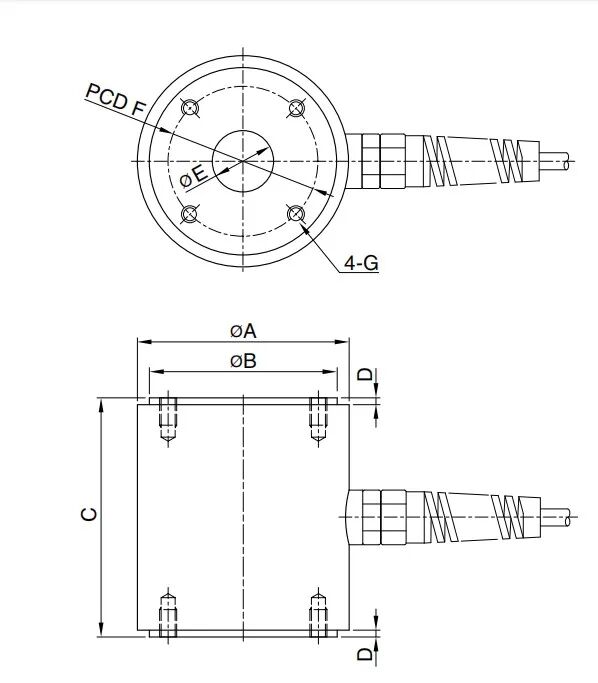
Dimensions – mm
|
Rated Capacity |
A |
B |
C |
D |
E |
F |
G |
Weight (kg) |
|
1t ( 9.807 kN ) |
62 |
55 |
70 |
2 |
18 |
44 |
2×4-M5x0.8P Depth 8 |
0.95 |
|
2t ( 19.61 kN ) |
62 |
55 |
70 |
2 |
18 |
44 |
2×4-M5x0.8P Depth 8 |
1.0 |
|
3t ( 29.42 kN ) |
62 |
55 |
70 |
2 |
18 |
44 |
2×4-M5x0.8P Depth 8 |
1.0 |
|
5t ( 49.03 kN ) |
62 |
55 |
70 |
2 |
18 |
44 |
2×4-M6x1P Depth 8 |
1.0 |
|
10t ( 98.07 kN ) |
62 |
55 |
80 |
2 |
18 |
44 |
2×4-M6x1P Depth 8 |
1.3 |
|
20t ( 196.1 kN ) |
88 |
80 |
100 |
2 |
20 |
60 |
2×4-M8x1.25P Depth 12 |
2.9 |
|
30t ( 294.2 kN ) |
100 |
90 |
120 |
2 |
20 |
70 |
2×4-M8x1.25P Depth 15 |
4.6 |
|
50t ( 490.3 kN ) |
134 |
120 |
150 |
2 |
30 |
90 |
2×4-M10x1.5P Depth 16 |
11 |