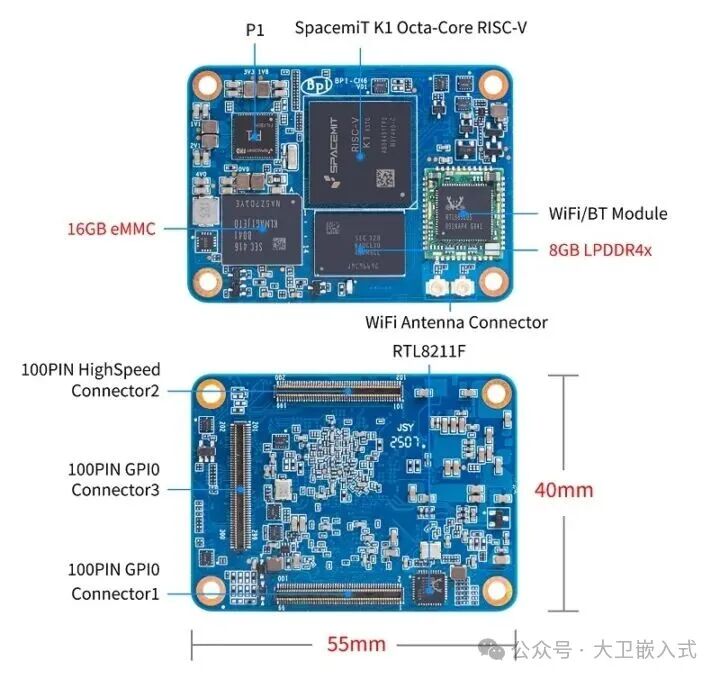
The Banana Pi BPI-CM6 (SoM) is driven by the SpacemiT K1 octa-core RISC-V processor and is compatible with most Raspberry Pi CM4 or CM5 module carrier boards.It comes standard with 8GB LPDDR4 and 16GB eMMC flash storage, equipped with a Gigabit Ethernet PHY, as well as WiFi 5 and Bluetooth 4.1 wireless modules. It supports a wide range of interfaces through three 100-pin board-to-board connectors, including HDMI 1.4, MIPI DSI, three MIPI CSI, 5-lane PCIe 2.1, USB 3.2/2.0 interfaces, among others. While it can support Raspberry Pi CM4/CM5 carrier boards via two B2B connectors, the company has also designed the BPI-CM6 IO carrier board to fully utilize all interfaces, especially the PCIe lanes.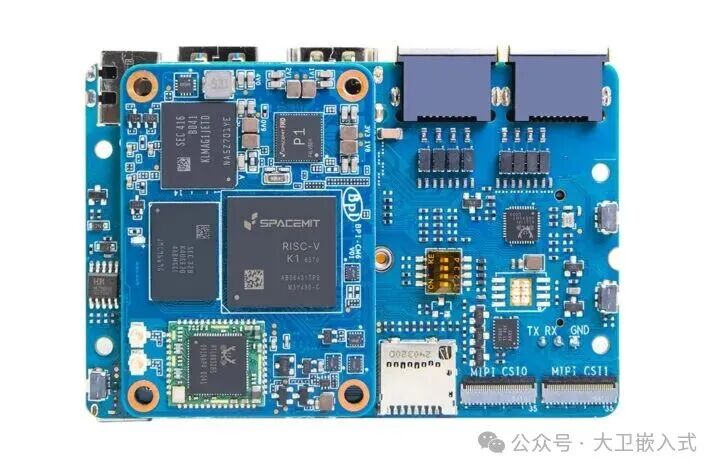 Banana Pi BPI-CM6 installed on the BPI-CM6 IO carrier board
Banana Pi BPI-CM6 SoM
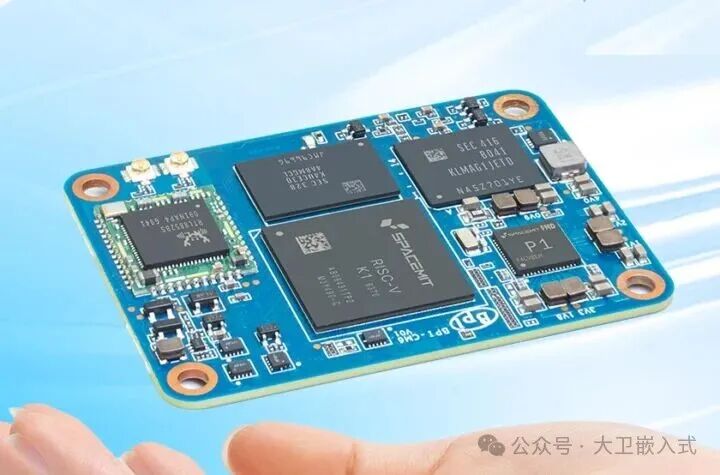
Banana Pi BPI-CM6 Specifications
Core SoC
-
SpacemIT K1 Chip
-
CPU: 8-core X60 RISC-V (RV64GCVB), 1.6GHz
-
Performance is roughly equivalent to Cortex-A55
-
GPU: Imagination IMG BXE-2-32 @ 819 MHz
-
OpenGL ES 3.2, Vulkan 1.3, OpenCL 3.0
-
20 GFLOPS
Video Engine (VPU)
-
Decoding: H.265 / H.264 / VP8 / VP9 / MPEG4 / MPEG2 up to 4K@60fps
-
Encoding: H.265 / H.264 / VP8 / VP9 up to 4K@30fps
-
Simultaneous processing capability:
-
1080p60 encoding + 1080p60 decoding
-
1080p30 H.264/H.265 encoding + 4Kp30 decoding
AI Performance
-
2.0 TOPS (INT8)
-
From “CPU core fusion”
-
Supports RVA22 Profile, RVV 1.0
Memory and Storage
-
Memory: 8GB (default) or 16GB LPDDR4
-
eMMC Storage: 8GB / 16GB (default) / 32GB / 128GB
Networking
-
Gigabit Ethernet PHY: Realtek RTL8211F
-
WiFi 5 + BT 4.1 (Realtek RTL8852BS)
-
RGMII interface
Display and Camera
-
Display: HDMI 1.4, MIPI DSI
-
Camera: 3-channel MIPI CSI
Expansion
-
3× 100-pin board-to-board connectors (important! Suitable as a Compute Module)
-
USB: USB 3.0 ×1, USB 2.0 ×2
-
PCIe: 5-lane PCIe 2.1
-
Low-speed IO: 10× UART (more interfaces pending documentation updates)
Power and Environment
-
PMIC: P1 PMIC
-
Dimensions: 55 × 40 mm (same size as Raspberry Pi CM4)
-
Temperature Range: -40°C ~ 85°C (Industrial grade)
The BPI-CM6 SoM benefits from the work done on the Banana Pi BPI-F3 SBC, which is also based on the same SpacemiT K1 processor. The company also provides Ubuntu and Debian images built on the Linux 6.1 kernel. Documentation also links to Titan Windows/Linux development tools and several source code repositories, including a port of OpenWrt, although no image for that version is provided.The target applications for the RISC-V module include NAS systems, laptops, smart robotics, industrial control, AI edge computing, and automation. While we have seen many Arm-based Raspberry Pi CM4/CM5 alternatives equipped with compatible B2B connectors, the Banana Pi BPI-CM6 currently appears to be the only available RISC-V compute module. We previously introduced the Milk-V Mars CM and Antmicro AVRSOM, but they are no longer for sale. Other SpacemiT K1 system modules include the Jupiter NX compatible with NVIDIA Jetson Nano NX and the Lichee LM3A SO-DIMM SoM.
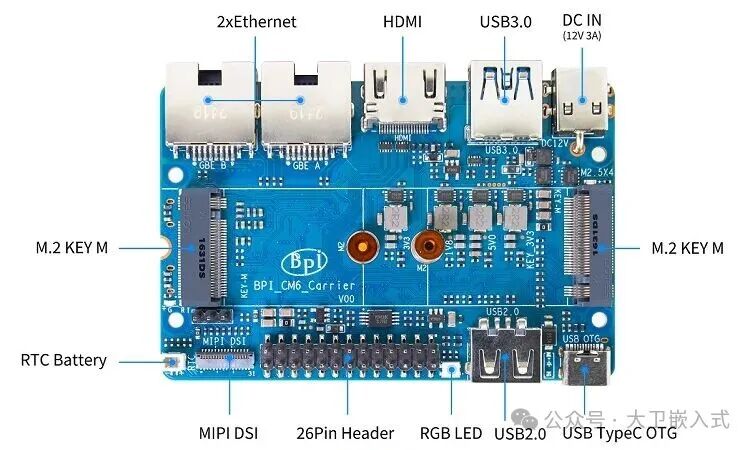
BPI-CM6 IO Carrier Board
-
Compatible SoM: Banana Pi BPI-CM6
-
Storage: MicroSD card slot, 2× M.2 M-Key 2230 (NVMe)
-
Display: HDMI, 4-lane MIPI DSI
-
Camera: 2× 4-lane MIPI CSI
-
Networking: 2× Gigabit Ethernet RJ45
-
USB: USB 3.0 Type-A, USB 2.0 Type-A, USB Type-C OTG
-
Expansion: 2× M.2 M-Key (PCIe 2.1 ×2 lanes, usable for NVMe or AI acceleration), 26-pin GPIO
-
Other: Power button, reset button, MaskROM button, RGB LED, 2-pin RTC interface
-
Boot mode dip switch
-
Power supply: 12V DC (5.5/2.1 mm)
-
Dimensions: 85 × 56 mm
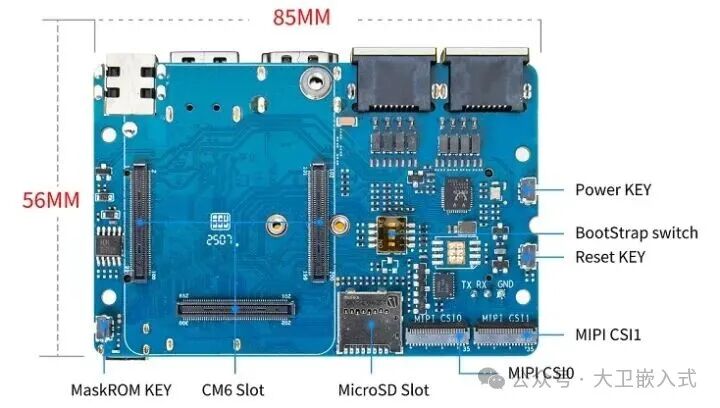 The usage of the 5-lane PCIe channels is as follows: one for one of the GbE ports, four (2+2) for the M.2 slots. Documentation links are the same as for the BPI-CM6 compute module.The default configuration of the BPI-CM6 RISC-V system module is available for purchase at the Banana Pi store for $67, with the IO board adding an additional $17, totaling $84.Asus PE3000N, an edge AI computer with 2070 FP4 TFLOPS computing power, what devices can afford it?Following the release of the next-generation flagship main control RK3688 and the serial device RK681M, Rockchip’s ambition in automotive electronics is evident.MuseLab nanoCH32V317: A compact RISC-V development board, perfect for experimentation.