Arm’s new generation mobile processor IP is about to be released, but it is now referred to as a platform. The article “From IP to Platform: Redefining Product Names at Arm” also mentions that Arm’s product naming convention will change, for example, the well-known Cortex-X series will no longer exist.
So how much performance improvement does the new generation platform offer? How is the naming categorized? More information is now available.
The Lumex CSS (Compute Subsystem) AI platform is designed specifically for mobile phones, personal computers, and AI.
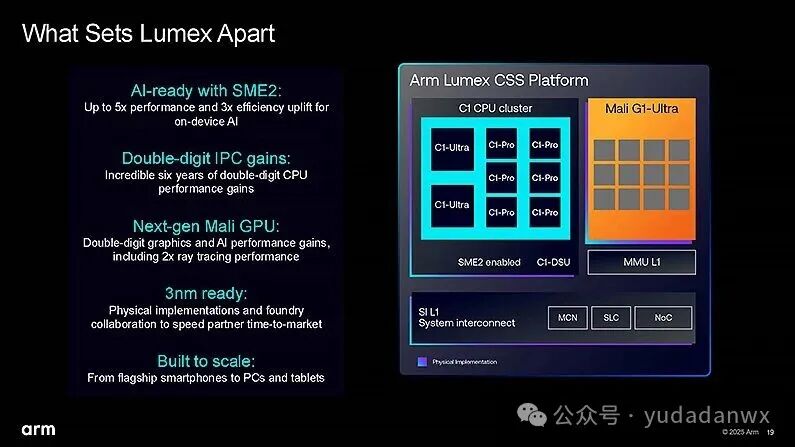
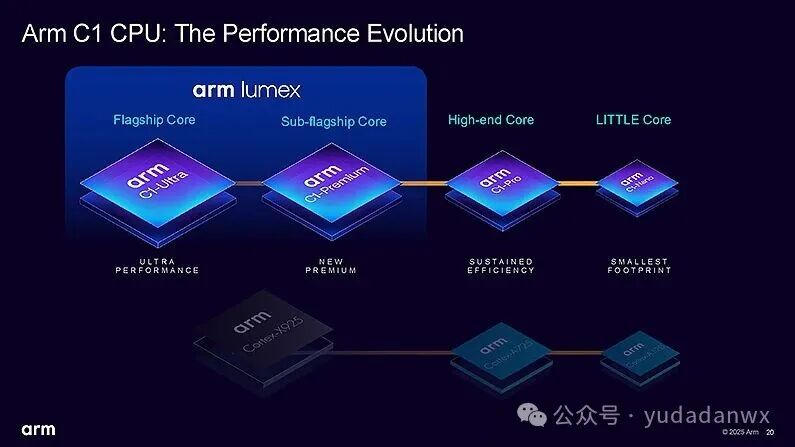
The CPU naming convention in the Lumex platform has changed; the first generation is called C1, which is divided into C1-Ultra, C1-Premium, C1 Pro, and C1-Nano, representing flagship, upper mid-range, high performance, and small core respectively. For instance, the former Cortex-X is now called C1-Ultra, C1-Pro is Cortex-A700, and Cortex-A500 is C1-Nano. I personally find this clearer.
The GPU naming has also changed; the first generation is called Mali G1, which includes Mali G1-Ultra, Mali G1-Premium, and Mali G1-Pro.
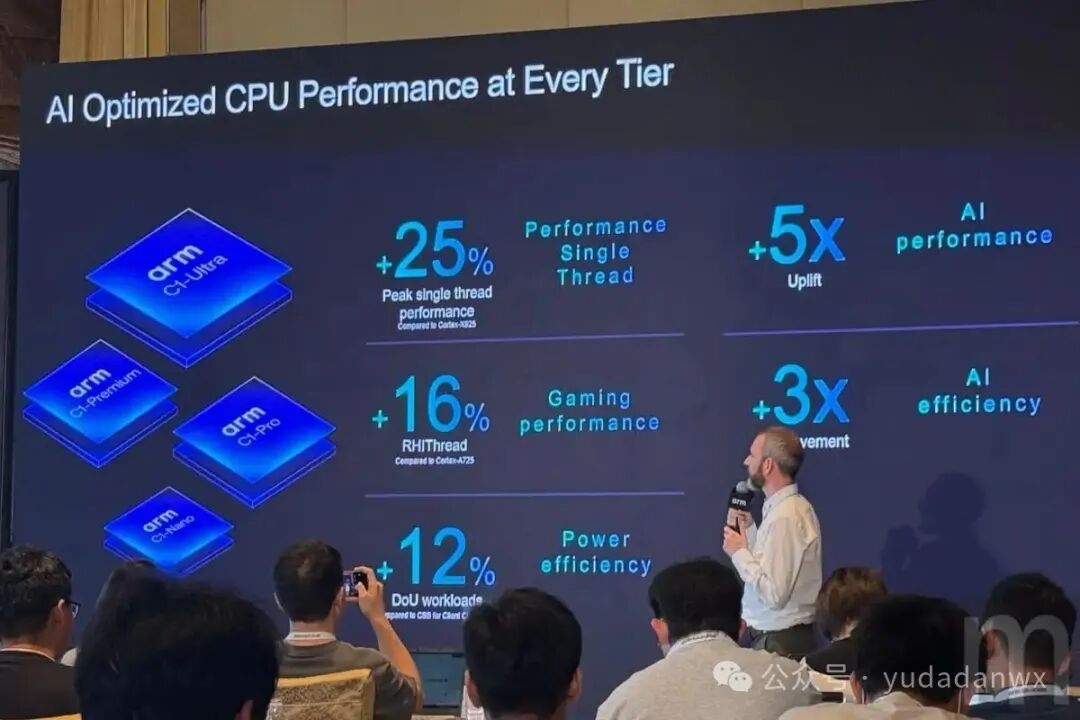
All cores in C1 utilize the latest Armv9.3 architecture and support SME2 extensions, aiming to maximize the CPU’s parallel computing capabilities. Under the same conditions, the AI computing capability has improved fivefold compared to the previous generation CPU.
In terms of overall performance, C1 shows a 30% improvement in computing performance under the same conditions, a 15% improvement in gaming and video application performance, and an average power consumption reduction of 12%.
The Mali G1 GPU also supports Arm Accuracy Super Resolution (Arm ASR) technology, which was mentioned in “Why Game Consoles are Adding NPU”. This technology can reduce mobile power consumption while using AI to maintain image quality and achieve high frame rates.
For example, the Mali G1-Ultra GPU employs second-generation ray tracing technology (Ray Tracing Unit v2, RTUv2), significantly enhancing lighting, shadow, and reflection effects, with performance doubling that of the previous generation and a 40% increase in frame rates.
In addition to gaming, the Mali G1 GPU introduces new matrix multiplication FP16 instructions. For the Mali G1-Ultra GPU, the computing capability can improve by 104% compared to the previous generation Immortalis-G925, and AI inference speed can increase by 20%.
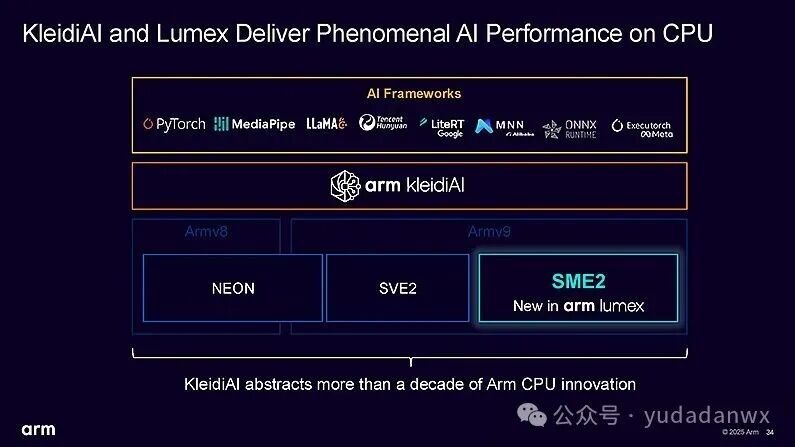
Arm has also been promoting its own KleidiAI framework, which integrates various AI frameworks and runtimes (such as Google LiteRT, llama.cpp, ONNX Runtime), allowing various models to run on mobile devices without code modification, and directly utilizing CPU SME2 instructions.
Finally, let me share my thoughts. For Arm, designing customizable platforms and comprehensive solutions is equally important, and providing more CPU extensions (like SME2) is necessary. Whether OEM manufacturers adopt these is a matter of trade-offs.
For OEM manufacturers, they can directly use the Arm Lumex platform to create system-on-chip (SoC) solutions or configure relevant modules in RTL according to their needs.
Related Articles:
- • “From IP to Platform: Redefining Product Names at Arm”