From the fourth quarter of 2016 to the first quarter of 2017, the mobile phone industry experienced a wave of updates for mid-to-high-end products. Among many products, we noticed a new trend: most major brand models adopted Qualcomm’s newly launched Snapdragon 625 platform. This includes Samsung C7, Huawei Maimang 5, Motorola Moto Z Play, Samsung 2016 Galaxy On7, China Mobile N2, Huawei Nova, Asus ZenFone 3, Huawei G9 Plus, Oppo R9s, and so on.
What is the reason that so many major brands have chosen this CPU as the standard configuration for mid-to-high-end devices? Besides dominating the mid-to-high-end smartphone market, how will this CPU perform in traditional handheld devices, police communication devices, and VR products?

As a pioneer in the IoT industry, after the Qualcomm MSM8937 platform SLM757 product caused a sensation in the industry (Meige Smart 4G communication module SLM757 explores new blue ocean for smart POS), another high-performance product is about to be unveiled. The smart core board SLM758, equipped with Snapdragon 625, is nearing the end of its internal research and development and will soon enter the IoT industry. Now, let’s detail what makes this CPU eye-catching.
The Snapdragon 625’s core architecture features eight Cortex-A53 cores, each with a maximum clock speed of 2.0GHz. Currently, all Snapdragon 600 family products are built on a 28nm process. To achieve a balance between power consumption and performance, the biggest characteristic of this series of processors is their lower clock speed; even the Snapdragon 652 has a maximum clock speed of only 1.8GHz. However, Snapdragon 625 is the first time Qualcomm has introduced a 14nm LPP process in a non-high-end flagship processor, allowing it to run at higher frequencies while also exhibiting lower heat and power consumption.
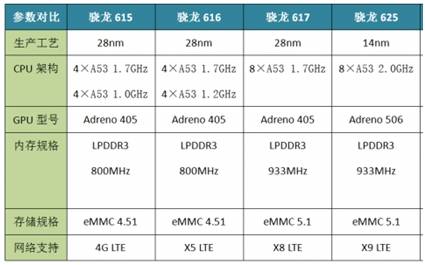
In addition to outperforming its Snapdragon 600 series siblings, the 625 also has a significant lead over other non-Qualcomm solutions. Here, we compare two products priced similarly to the 625: Kirin 655 (HiSilicon) and Helio P10 (MTK).
PK is here: Kirin 655 (HiSilicon) VS Snapdragon 625 (Qualcomm)
The Kirin 655 processor uses a 16nm FinFET Plus process, employing a big.LITTLE architecture with a 64-bit octa-core setup, featuring 4 cores at 2.1GHz A53 + 4 cores at 1.7GHz A51 + i5 co-processor architecture, with a GPU using Mali T830-MP2, supporting full network connectivity.
Snapdragon 625 adopts the leading 14nm LPP process, being Qualcomm’s second 14nm chip this year after the Snapdragon 820. It has 8 cores, all clocked at 2.0GHz A53, with an Adreno 506 GPU, supporting Cat.7 LTE networks, achieving a maximum download speed of 300Mbps and an upload speed of 150Mbps, supporting 802.11 ac Wi-Fi, and Quick Charge 3.0 fast charging protocol, also supporting full network connectivity.
From the performance comparison, the Honor Play 6X with Kirin 655 octa-core processor scores around 57,000 points, while the Huawei Nova and OPPO R9s with Snapdragon 625 octa-core processor score between 62,000 and 65,000 points, indicating that the Snapdragon 625 has superior overall performance compared to Kirin 655. Not only that, but Snapdragon 625 also boasts a more advanced 14nm process, indicating lower power consumption. Additionally, supporting QC3.0 fast charging is another significant advantage.
PK is back: Helio P10 (MTK) VS Snapdragon 625 (Qualcomm)
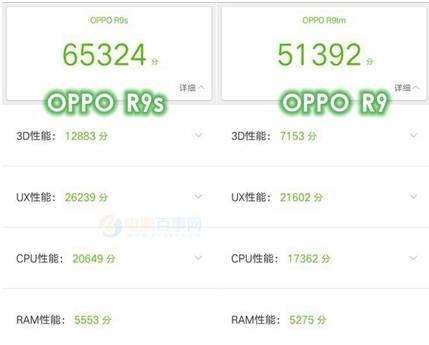
OPPO R9s is equipped with Qualcomm Snapdragon 625 processor, while R9 uses MediaTek P10 processor. Although both use an octa-core A53 architecture, Snapdragon 625’s use of a more advanced 14nm process results in better performance and power consumption control compared to the 28nm P10. Furthermore, the performance of the Adreno 506 graphics GPU in Snapdragon 625 is superior to the Mali-T860 MP2 in P10, providing a better gaming experience.
OPPO R9S uses Qualcomm Snapdragon 625 (MSM8953)
OPPO R9 uses MTK Helio P10 (MT6755)
Snapdragon 625 not only excels in benchmark scores and power consumption, but it is also the first CPU in Qualcomm’s 600 series capable of supporting 4K@30fps video encoding and decoding. Previously, to achieve 4K@30fps video encoding and decoding, people would think of the Snapdragon 800 series, which was perceived as expensive. Now with the 625, there is finally a cost-effective product available. Such outstanding video encoding and decoding capabilities also allow the 625 to be used beyond smartphones, performing excellently in products like VR/AR/360° panoramic cameras.
The speed of updates in the smartphone industry is astonishing. Let’s shift our focus back to IoT, handheld POS, handheld logistics devices, police communication devices, etc. One can imagine that with an 8-core 2.0G CPU built on a 14nm process, the devices in the hands of logistics personnel are no longer bricks; they can be multifunctional, low-power smartphones. Our beloved police officers will have devices with longer standby times, better recording, storage, and uploading capabilities, thus serving the public better.
Related Articles:
Meige Smart 4G Communication Module SLM757 Explores New Blue Ocean for Smart POS
Meige Smart NB-IoT Module SLM150 is About to be Released, Expanding Global IoT Market
Meige Smart LTE Cat 4 IoT Module SLM750 Boosts the Rapid Development of Vehicle Networking
Why Does Meige Smart Qualcomm Octa-Core 4G Module Dominate the Smart POS Industry?
Meige Smart Releases the First Dual-Screen Display Octa-Core 4G Communication Module in the Industry
Meige Smart LTE IoT Module SLM750 is Grandly Launched!
Meige Smart Partners with Global Fortune 100 Company Honeywell to Build a New IoT Ecosystem
Believe it or not, LTE will be the mainstream connection for IoT in the future – Interview with Mr. Du Guobin, General Manager of Meige Smart IoT Business Group, and Mr. Li Jianhua, Deputy General Manager
“The Rising Sun Brings Great Light” – A Record of Meige Smart’s 2016 Xi’an and Wuhan Management Meeting
Meige Smart Xi’an Research Institute – A New Force in the Wireless Communication Module Industry
Meige Smart Wireless Communication Module SLM753 Boosts the Rapid Development of Vehicle Networking
Speed is Key – Meige Smart Cat 6 Super Data Transmission Module SLM820 is Coming Soon
Meige Smart LTE 4G Module Ignites the Shenzhen International IoT Exhibition
Meige Smart SLM720 Wireless Communication Module Boosts Networked Laptop Market