 Produced by Zhineng Zhixin
In 2025, with the rapid development of artificial intelligence, Arm launched the new Lumex Computing Subsystem (CSS), which can be seen as an important foundation for edge AI experiences.
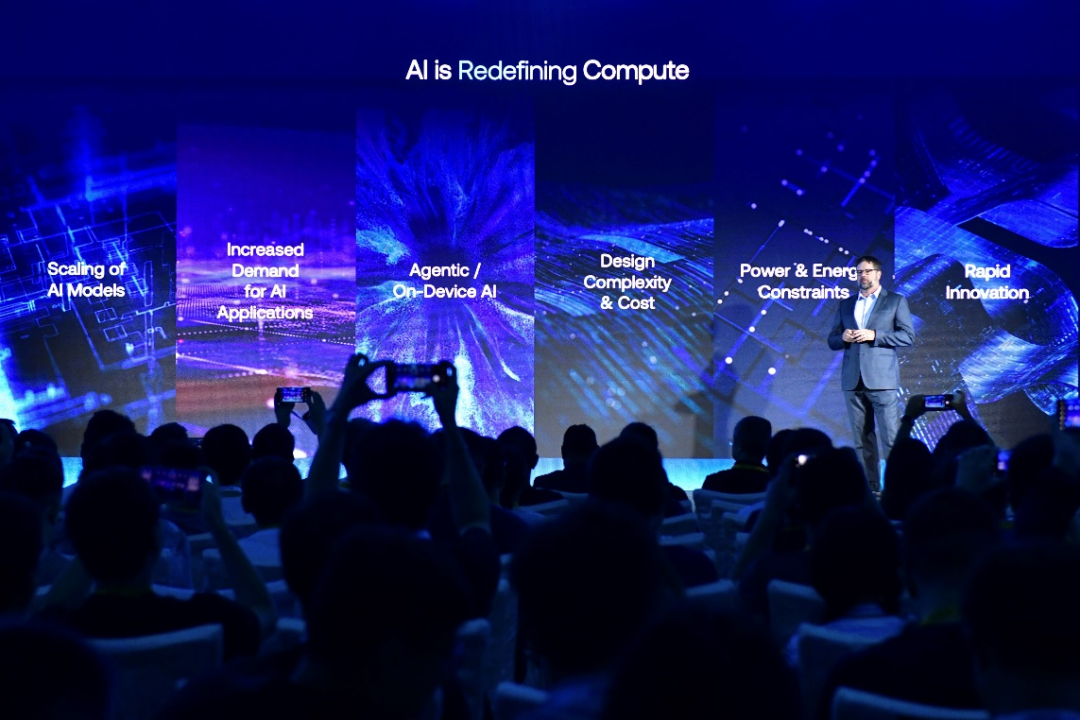
The Lumex CSS platform integrates the highest performance Arm CPU, GPU, and system IP equipped with SME2 technology, not only helping ecosystem partners accelerate the market launch of AI devices but also empowering a rich variety of edge intelligent experiences such as desktop-level mobile gaming, real-time translation, smart assistants, and personalized applications.
Part 1
Evolution of Technology and Expansion of Applications
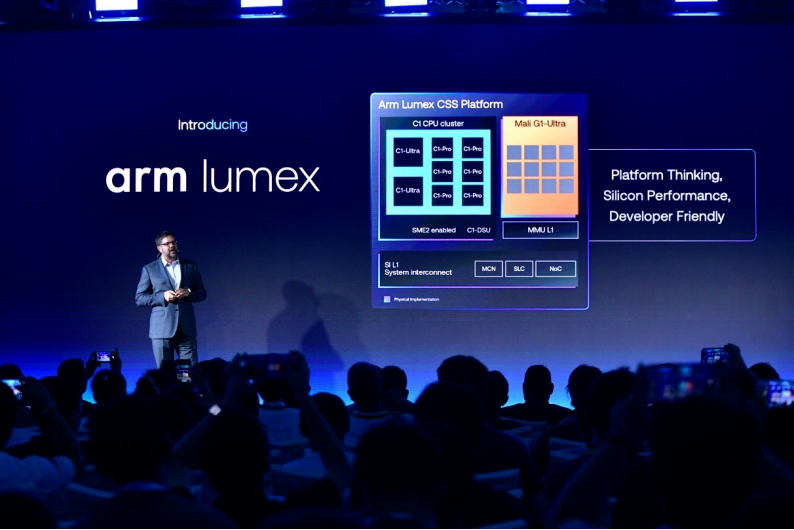
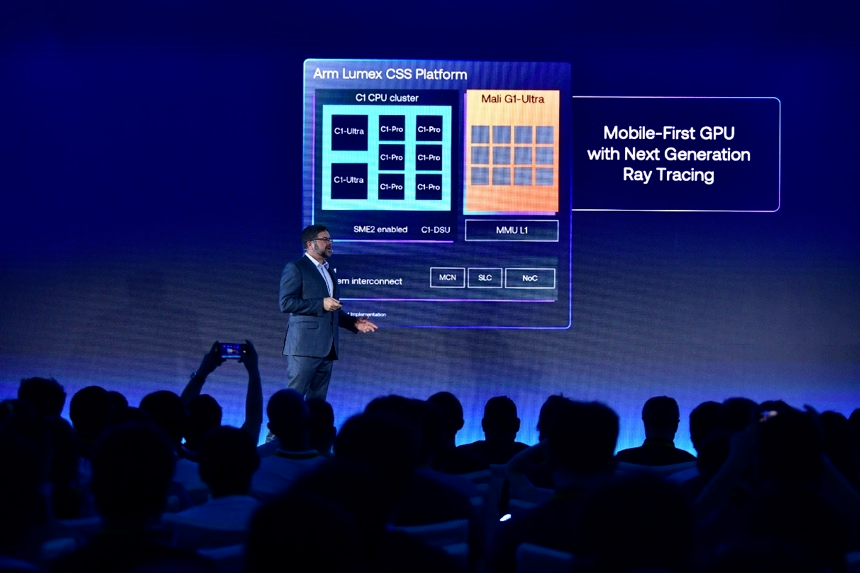
The most notable aspect of the Lumex platform’s release is its new C1 CPU cluster equipped with SME2 technology, as well as the Mali GPU featuring next-generation ray tracing technology.
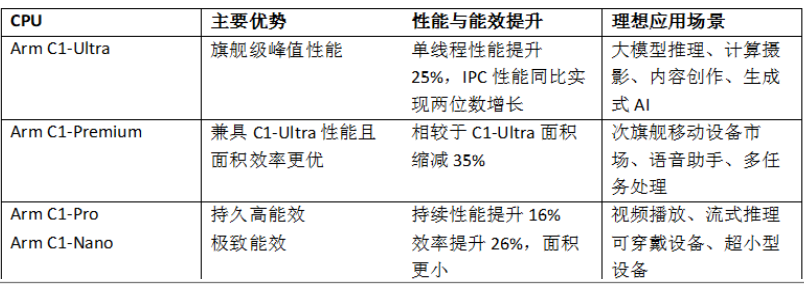
For this product launch, Lumex has adopted a new naming system: the CPU series is named C1-Ultra, C1-Premium, C1-Pro, and C1-Nano, while the GPU is uniformly named Mali under the Lumex system, replacing the previous “Immortalis” brand.
This adjustment not only makes it clearer and easier to understand but also reflects Arm’s “platform-first” strategy.
SME2 Drives a Leap in AI Performance
The introduction of SME2 technology has brought significant AI performance improvements to the Arm C1 CPU cluster that incorporates it. In practical application scenarios, this technology enables AI performance to increase by up to 5 times, reduces latency for voice workloads by 4.7 times, and accelerates audio generation speed by 2.8 times.
This leap in computing power makes complex real-time edge AI inference possible, providing users with a smoother and faster experience in audio processing, computer vision, and situational awareness interaction scenarios.
Compared to the previous generation SME, SME2 has expanded the instruction set to support 2-bit and 4-bit data types. This is crucial for mobile devices, as edge models increasingly rely on low-bit-width data.
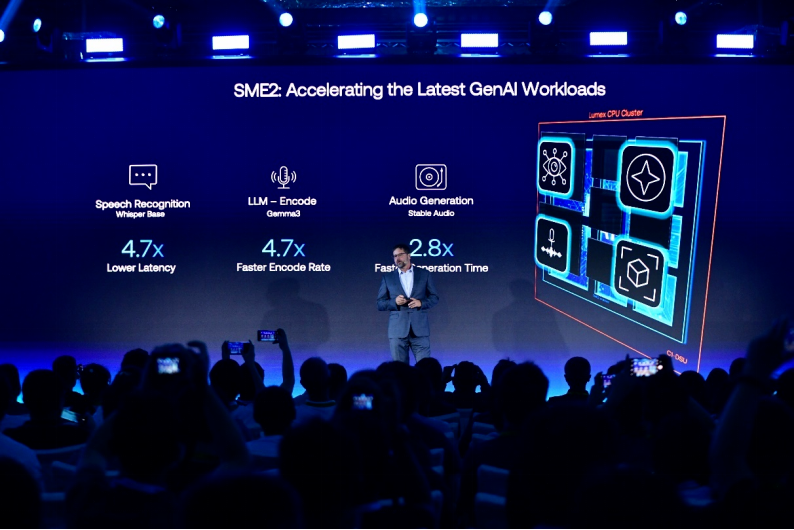
Importantly, SME2 offers high scalability. This means that the AI capabilities brought by SME2 can be applied not only to high-end smartphones priced above 4000 yuan but can also be scaled down to smartphones in the 2000 yuan price range, maximizing the promotion and implementation of edge AI technology.
The Mali G1-Ultra Redefines Gaming and AI Experience.
◎ The Mali G1-Ultra GPU is equipped with a new generation of ray tracing units (RTUv2), aimed at flagship smartphones and large-screen computing devices.
Compared to the previous generation Immortalis-G925 GPU, its ray tracing performance has improved by up to two times, and overall performance has increased by 20% in mainstream graphics benchmarks, bringing desktop-level gaming visual experiences to mobile devices.
◎ In terms of AI, the Mali G1-Ultra enhances the inference speed of AI and machine learning networks by 20% through a new FP16 matrix computation path, achieving a dual breakthrough in graphics and AI performance.
Chris Bergey, Arm’s Senior Vice President and General Manager of the Client Line of Business, stated at the launch event: “The new Mali G1-Ultra brings desktop-level gaming experiences to mobile devices through advanced ray tracing technology, redefining the graphics processing standards for smartphones.
Our platform strategy, which prioritizes developers, makes building AI applications faster, easier, and more scalable, enabling cross-platform inclusive applications.”
 Part 2
CSS Model and Corporate Positioning
Flexibility is a major highlight of the Lumex CSS platform.
Unlike traditional IP licensing, CSS provides RTL, reference designs, and mass-producible system solutions. CSS optimizes system performance, helping customers improve scores and actual experiences.
CSS brings flexibility to customers, allowing them to choose: to directly use Arm’s original solution, customize the original solution, or combine it with their own IP to launch differentiated products.
Chris Bergey, Arm’s Senior Vice President and General Manager of the Client Line of Business, stated: “We deliver CSS in a flexible manner; in some markets, we provide highly integrated computing grids, while in others, we use flexibly combinable sub-modules.
This flexible approach has already shown results; currently, there are over 16 technical licensing agreements for CSS globally, half of which have occurred in the past 12 months. This is our path to achieving scalable development and is key to Arm’s ecosystem leading the industry in the AI era.”
Self-developed chips are an industry trend, but most manufacturers are not skilled in CPU/GPU design. CSS’s plug-and-play solutions address the issues of manpower and experience shortages, accelerating product differentiation.
In China, the potential for CSS is significant.
◎ Smartphone shipments are stabilizing, with growth driven by high-end and AI. Arm noted that Chinese consumers are willing to spend on high-end and new technologies, with AI being a key factor. CSS enables manufacturers to launch leading experience products in a short time.
◎ Smart cars and robots are also key focuses for Arm. The Zena CSS has been used in automotive safety, and Arm architecture accounts for over 70% of the robotics market, recognized for its versatility.
Chinese manufacturers are attempting to customize chips, and CSS may become a tool for differentiation.
Globally, CSS marks Arm’s transition from an “IP provider” to a computing platform provider.
◎ Arm relies on CSS to improve revenue quality, not just depending on shipment volume;
◎ Customers use CSS to shorten R&D cycles and reduce risks, gaining an advantage in competition.
In summary, the CSS model has three points: optimizing performance and efficiency to meet core needs, providing flexibility to support innovation, and aligning with the trend of customization, especially in the high-end smartphone, automotive, and robotics sectors in China.
Conclusion
Arm’s strategy focuses on the dual upgrade of technology and corporate strategy. Technologically, SME2 and ray tracing technology enhance the capabilities of the C1 CPU cluster and Mali GPU, driving AI performance and energy efficiency, laying the foundation for widespread adoption.
Commercially, CSS shifts from being an IP supplier to a platform provider, increasing customer value and revenue quality. Despite the complex macro environment in the Chinese market, Arm’s collaborations are robust, deepening ties with local manufacturers.
The smartphone industry is transitioning from quantity to quality, with AI guiding the upgrade. The Arm Lumex CSS platform will play a key role in industry development. The growth of smart cars and robots will provide new growth points for Arm. By 2030, SME and SME2 are expected to add over 10 billion TOPS of computing power for more than 3 billion devices. The capabilities of Lumex and SME2 will be validated in a wider range of applications.