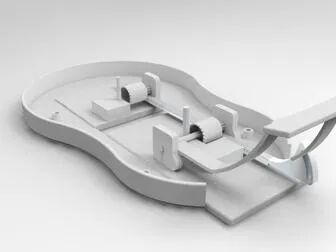
3D printing technology has evolved from prototyping to large-scale applications, covering multiple fields such as industrial manufacturing, healthcare, and aerospace. Its characteristics of “on-demand customization” and “integrated complex structures” are reshaping traditional production models.
1. Industrial and Manufacturing: Cost Reduction and Efficiency Improvement, Promoting Customized Production
- Rapid Prototyping Converts product design drawings directly into physical models, reducing the cycle from several weeks with traditional processes to just hours, significantly accelerating R&D iterations. For example, automotive manufacturers use 3D printing to create prototypes of components to validate structural rationality.
- Customized Component Production Allows for direct production of small batches and complex structures without the need for molds, reducing production costs. Typical applications include customized casings in the home appliance industry and irregular gears in the machinery sector.
- Mold and Tool Manufacturing Prints molds with complex cooling channels to enhance injection efficiency and product quality; simultaneously produces lightweight tooling fixtures to reduce worker operational intensity.
2. Healthcare: Precision Matching, Supporting Personalized Treatment
- Customized Implants Based on patient CT data, prints orthopedic implants (such as artificial joints and spinal supports) that precisely match human bones, reducing rejection reactions and shortening postoperative recovery time.
- Bioprinting Utilizes biocompatible materials (such as alginate and collagen) to print tissue engineering scaffolds, and even attempts to print simple organs like skin and cartilage, providing new directions for organ transplantation.
- Medical Models and Instruments Prints patient-specific surgical planning models (such as tumor location models) to help doctors simulate surgeries; simultaneously produces customized rehabilitation devices (such as prosthetic shells adapted to different hand shapes).
3. Aerospace: Lightweight Design, Breaking Material and Structural Limitations
- Lightweight Components Uses metal 3D printing technologies with titanium alloys and aluminum alloys to produce components such as aircraft engine blades and satellite brackets, reducing weight while ensuring strength, thereby lowering fuel consumption or launch costs.
- Integrated Complex Structure Forming Complex structures that traditionally require multiple components to be assembled (such as rocket fuel nozzles) can be formed in one piece through 3D printing, enhancing structural stability and production efficiency.
- In-Situ Manufacturing Exploration Organizations like NASA are researching the use of 3D printing technology to manufacture tools or components on the space station, reducing reliance on ground supplies and supporting long-term space missions.
4. Consumer and Cultural Creative Fields: Personalized Expression, Meeting Diverse Needs
- Customized Consumer Products Prints personalized goods based on user needs, such as custom footwear (adapted to foot shape data), jewelry (unique design styles), and home decor (exclusive patterns or sizes).
- Cultural and Artistic Creation Artists utilize 3D printing to create complex-shaped artworks or replicate cultural relic models (such as scaled-down models of the Terracotta Army in museums), balancing protection and cultural dissemination.
- Education and Popular Science Prints three-dimensional models (such as human organs, geographical terrains, and mechanical structures) to visualize abstract knowledge, enhancing teaching effectiveness.