
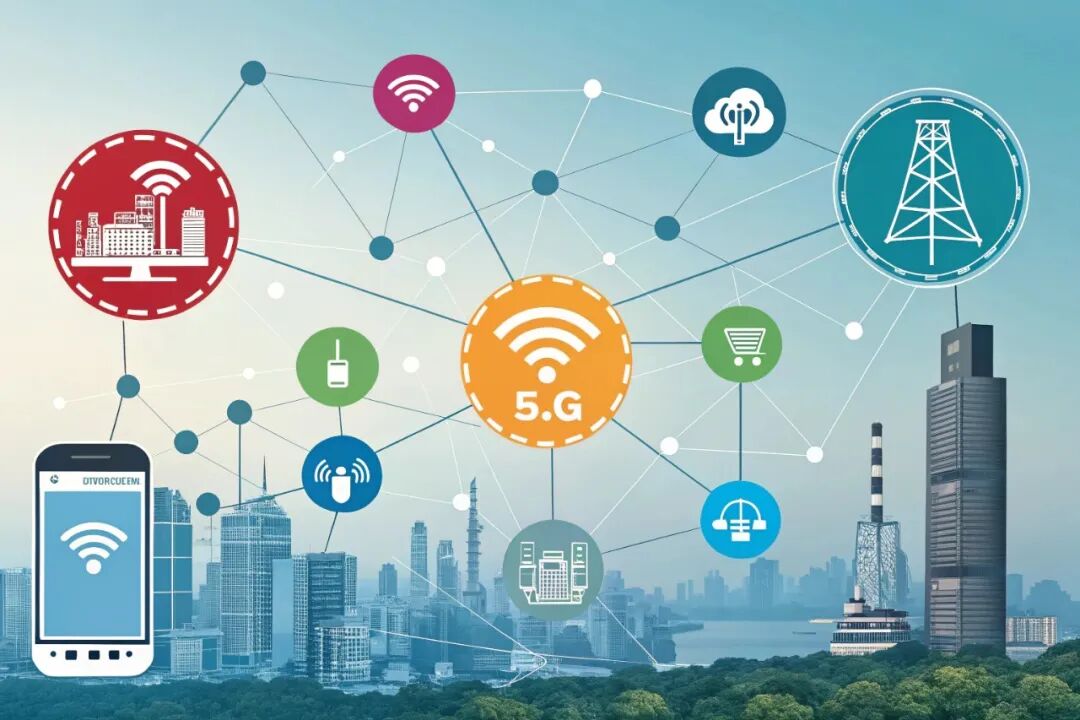
The core of the Internet of Things (IoT) lies in “connectivity.” From WiFi to 5G, and to low-power wide-area networks and satellite communications, various connectivity methods are reshaping how the smart world operates.……
The Internet of Things (IoT) is profoundly changing the way devices communicate with each other, creating an ecosystem where everyday items can share data and intelligently respond to their environment. The foundation supporting all of this isconnectivity—this “invisible infrastructure” enables billions of devices to communicate seamlessly on a global scale.
WiFi and Traditional Wireless Solutions
WiFi remains one of the most popular connectivity solutions for IoT devices, especially suitable for indoor scenarios and established wireless network environments. Its widespread application in homes, workplaces, and public spaces makes it an ideal choice for consumer IoT products and smart building applications.
WiFi networks have high bandwidth capabilities, allowing for the rapid and efficient transmission of large amounts of data. However, WiFi also has limitations, such as limited coverage, higher power consumption, and reliance on existing network infrastructure. In industrial IoT scenarios that require broader coverage, cellular networks become particularly crucial, with dedicated IoT SIM cards playing an important role in providing reliable wide-area network access for devices.
These dedicated connectivity solutions ensure that devices can maintain stable communication even in remote areas where WiFi coverage is lacking. Additionally, in high-density device environments, WiFi networks can easily become congested, affecting performance and reliability.
Cellular Networks and Mobile Connectivity
Cellular networks have become one of the infrastructures for IoT connectivity, providing reliable connections over large geographical areas due to their extensive coverage and stable communication capabilities. Traditional cellular technologies such as 3G and 4G LTE have played a significant role in supporting mobile IoT applications, from vehicle tracking systems to remote monitoring solutions.
The advantage of cellular networks is their ability to provide consistent connectivity regardless of the device’s location, making them ideal for applications that require mobility or lack fixed broadband infrastructure. As cellular technology evolves, operators have also introduced dedicated connectivity solutions tailored to IoT needs, such as IoT Flat Rates, which help businesses avoid additional data costs during large-scale device deployments with predictable pricing structures, allowing for more accurate budget planning.
The global coverage and high reliability of cellular networks make them indispensable in critical mission scenarios, such as medical health monitoring systems or industrial automation platforms, where any communication interruption could have severe consequences.
5G and Next-Generation Technologies
The arrival of 5G networks marks a new era in IoT connectivity. With itsultra-high speeds, ultra-low latency, and massive connection capabilities, it opens up possibilities for a new generation of application scenarios. 5G data rates can reach gigabit levels, with latency reduced to milliseconds, supporting real-time applications that were previously difficult to achieve with older networks.
At the same time, the enhanced capacity of 5G allows massive numbers of devices to connect simultaneously without degrading network performance, addressing the bottlenecks of previous generations in concurrent connections. Additionally, with the **Edge Computing** capabilities of 5G, computational power can be pushed closer to the IoT devices themselves, reducing the need for data to be sent back to remote cloud servers, significantly enhancing real-time decision-making capabilities.
Industries such as autonomous driving, augmented reality (AR), and industrial robotics will significantly benefit from these advancements, as 5G can meet their stringent communication performance requirements.
Emerging Connectivity Solutions
In addition to traditional wireless communication technologies, new connectivity solutions are continuously emerging to meet the diverse needs of different IoT applications.Low-Power Wide-Area Networks (LPWAN) technologies, such as LoRaWAN and NB-IoT, are gradually gaining popularity in scenarios that require ultra-long battery life and wide coverage but have lower data transmission requirements.
At the same time, satellite communications are expanding the boundaries of IoT, covering truly remote areas and being applied in agriculture, environmental monitoring, and cross-regional asset tracking.Mesh networks create highly robust networks with self-healing capabilities through self-organizing and multi-path forwarding among multiple nodes, ensuring stable overall connectivity even if some nodes fail.
These diverse connectivity solutions reflect the maturity of the IoT ecosystem and provide developers with high flexibility to find optimal solutions based on application needs in terms ofpower consumption, coverage, bandwidth, andcost-effectiveness.
Source: Qianjia Comprehensive Wiring Network
Disclaimer
This article’s images are sourced from the internet, primarily for the purpose of sharing information and allowing more people to access the information they need. Copyright belongs to the original author. If your rights or copyrights are infringed, please notify us promptly, and we will delete it within 24 hours..