Analysis of Manned/Unmanned Teaming Technologies in Foreign Militaries
This article was published in “Command Control and Simulation”, 2024, Issue 1
Abstract: Manned/unmanned platform formations can fully leverage the low-cost and expendable advantages of unmanned platforms, expand the operational space of manned platforms, and improve the situational awareness, penetration strike, and survivability of manned platforms. This article surveys the development trends of manned/unmanned teaming technologies in countries such as the U.S., U.K., France, Australia, and South Korea, providing examples of typical applications of manned/unmanned formations in maritime, land, and air combat domains, and analyzes the technical challenges and key technological pathways in areas such as transmission networking, remote measurement and control, autonomous decision-making, and human-machine interaction. Finally, the article forecasts the development trends of manned/unmanned teaming technologies, which can provide references for future cooperative combat patterns in joint operational systems and related fields of technical research.
With the rapid development of advanced technologies such as Wireless Datalink Communications, Artificial Intelligence (AI), and Electronic Countermeasures (ECM), the application scale of unmanned platforms such as Unmanned Aircraft Vehicles (UAVs), Unmanned Ground Vehicles (UGVs), Unmanned Surface Vehicles (USVs), and Unmanned Underwater Vehicles (UUVs) in modern warfare continues to expand. The application of unmanned platforms in multi-domain operations and cross-domain joint operations is mainly reflected in the expansion of reconnaissance detection ranges, improvement of target location accuracy, reduction of kill chain closure time, coordinated attack and defense, and coordinated electronic countermeasures, significantly enhancing the overall combat effectiveness of aerial combat formations, naval vessel formations, land aviation maneuver formations, and air-sea and air-land cross-domain cooperation.Due to the current level of development of AI technology, weak AI applications such as target recognition, object detection, and trajectory tracking can only provide partial decision-making support functions, while strong AI applications such as reinforcement learning and generative learning face issues of interpretability and robustness, limiting the enhancement of unmanned platform autonomous decision-making capabilities. Especially in complex countermeasure environments, fully autonomous operations of unmanned platforms are still far from realization, thus unmanned platforms and unmanned swarm formations require guidance from manned platforms to achieve a “human-in-the-loop” human-machine collaborative application model. Manned-Unmanned Teaming (MUM-T) technology is one of the main operational patterns for future multi-domain collaborative operations.
1 Latest Developments in Foreign Manned/Unmanned Teaming
Unmanned systems theoretically can perform any tasks currently executed by manned vehicles; therefore, manned/unmanned formations are usually deployed as a composite combat unit rather than individually, thereby enhancing the coverage area, strike capability, and survivability of manned vehicles. Typical application scenarios for manned/unmanned teaming technology include armed escort, target reconnaissance, battle damage assessment, relay communications, and electronic countermeasures. As shown in Figure 1. In the armed escort application, unmanned platforms can suppress enemy defensive facilities before manned platforms execute missions to avoid significant casualties among manned platforms. Additionally, unmanned platforms can serve as external weapon stores for manned platforms, enabling manned platforms to attack numerous enemy targets in each mission.
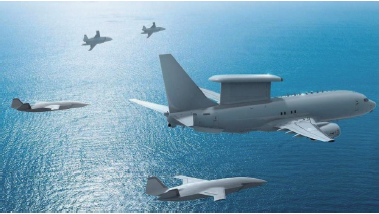
Figure 1 Manned/Unmanned Teaming Technology Schematic
In the U.S. Navy’s “Distributed Maritime Operations” (DMO) and the U.S. Air Force’s “Next Generation Air Dominance” (NGAD) plans, manned/unmanned teaming has been identified as a core design element, and equipping current fighter jets, carrier-based aircraft, and destroyers with manned/unmanned teaming capabilities is a common goal for modern naval and air forces.
This article surveys the current development status of manned/unmanned teaming capabilities in the U.S., U.K., France, Australia, and South Korea, as described below.
1.1 U.S. Army Manned/Unmanned Teaming
1) Army Rotorcraft Systems
Manned/unmanned teaming technology was first developed by the U.S. Army, and current efforts are focused on the joint operation of the AH-64 Apache Guardian attack helicopter and fixed-wing unmanned aerial vehicles (UAVs). Manned/unmanned teaming will also become an important component of the U.S. Army’s future attack/reconnaissance aircraft and future long-range strike aircraft.
The AH-64E Apache Guardian is the latest model of the Apache attack helicopter, which has upgraded sensors and avionics, significantly enhancing its data link networking capabilities to support manned/unmanned teaming operations. It is equipped with a second-generation Manned/Unmanned Teaming (MUMT-2) data link, allowing seamless transmission of sensor and target data between manned aircraft and UAVs. The manned helicopter can also relay sensor data from UAVs to ground forces, helping to establish comprehensive situational awareness and operational networks.
In the future, the MUMT-2 data link will be replaced by the MUMT-X data link developed by L3 Harris, which will include a Rover 6 transceiver, multi-band RF devices, and a multi-directional antenna capable of simultaneously transmitting multiple high-definition video streams. MUMT-X will increase available bandwidth, extend communication range, and improve situational awareness and operational efficiency for airborne forces and friendly units.
2) Capability Development
In 2015, the U.S. Army conducted its first operational deployment of manned/unmanned teaming, successfully integrating AH-64s from the 101st Airborne Division with the Air Force’s MQ-1C UAVs. UAVs controlled by ground operators were able to locate and laser-designate targets for Apache missiles, allowing the manned helicopter to focus on combat, successfully eliminating multiple moving targets on the ground and improving strike efficiency.
With technological development and capability advancement, one AH-64E Apache helicopter can now control up to three MQ-1C Gray Eagle UAVs or RQ-7B Shadow UAVs, including flight operations, sensor, and weapon control, achieving the highest interoperability level.
In 2020, the U.S. Army’s manned/unmanned teaming capabilities reached a new milestone, forming a three-aircraft formation with AH-64E, RQ-7B, and MQ-1C spaced 50 km apart. The RQ-7B reconnaissance UAV detected a target and relayed the coordinates to the Apache pilot. The pilot controlled the UAV’s laser targeting system to illuminate the target while directing the MQ-1C to launch Hellfire missiles, successfully hitting the target.
Using unmanned platforms as alternative sensor and weapon platforms allows manned helicopters to engage targets beyond their targeting range, enhancing protection, striking more enemy targets, and dispersing enemy forces.
1.2 U.S. Air Force Manned/Unmanned Teaming
1) SkyborgThe U.S. Air Force’s manned/unmanned teaming was initially referred to as “Loyal Wingman” to reflect the support function of unmanned platforms to manned fighters; it is now defined as Skyborg to highlight the AI autonomous control capabilities of unmanned platforms. The U.S. Air Force’s UAVs are being developed towards low-cost applications, but this does not mean that unmanned platforms are disposable tactical assets; they simply have shorter lifespans. The design of shorter-lifecycle unmanned platforms allows for rapid iteration of new models to reflect the latest technologies and operational concepts.2) Capability DevelopmentThe successful integration of manned/unmanned teaming in Skyborg hinges on the Air Force Research Laboratory’s (AFRL) development of the Skyborg AI System. This software suite will enable unmanned platforms to possess autonomous flight capabilities and respond perfectly to external control, referred to as the Autonomy Core System (ACS).The autonomous operation capabilities of the ACS system were validated in a series of tests in 2021, completing basic aviation behaviors, responding to navigational commands, reacting to geographic fencing, and demonstrating reasonable maneuverability while maintaining flight trajectories.The ACS system can be integrated into two heterogeneous unmanned platforms, Kratos’ UTAP-22 MAKO and General Atomics’ MQ-20, possessing cross-platform deployment capabilities and laying the foundation for future joint operational multi-task control capabilities. Boeing, GA-ASI, Kratos, and Australia’s Aerospace Technologies (ATS) are all involved in the next phase of testing for the ACS system.
1.3 U.S. Navy Manned/Unmanned Teaming
1) Large Unmanned Surface Vehicle (LUSV)The U.S. Navy’s fourth-generation Large Unmanned Surface Vehicle (LUSV), designed and manufactured by Leidos, has a maximum range of 1,200 nautical miles and can carry various payloads including sonar, radar, optical reconnaissance, and non-lethal weapons, executing combat missions such as anti-submarine warfare, mine countermeasures, target strikes, and damage assessments. The unmanned surface vessel supports the distributed combat concept of the Hunter-Killer Surface Action Group (Hunter-Killer SAG), typically configured with one manned ship paired with four unmanned vessels, with interconnectivity between the manned ship and unmanned vessels through the Naval Tactical Datalink System (NTDS) and Cooperative Engagement Capability (CEC), enabling operational information sharing and coordinated combat actions in manned/unmanned formations. The large unmanned surface vessel can also carry UAVs for wide-area aerial surveillance, assisting manned combat vessels (including cruisers, destroyers, and littoral combat ships) in using long-range air defense and strike weapons to eliminate aerial threats, enhancing the strike capability of the manned vessels.2) MQ-25 Unmanned Aerial RefuelerThe U.S. Navy plans to introduce a carrier-based unmanned aerial refueler, with the first four MQ-25A UAVs expected to achieve initial operational capability in 2024. Its performance parameters include: 1) range: 930 km; 2) enabling effect: expands the operational radius of F/A-18 and F-35 by 500 km; 3) secondary missions: communication relay, reconnaissance, and combat.3) EA-18G Growler Electronic Warfare AircraftIn early 2020, Boeing utilized the autonomously controlled EA-18G electronic warfare aircraft as an unmanned platform, using a third manned EA-18G as a mission controller for the other two, completing a total of 21 demonstration missions. This technology enables the Navy to expand sensor coverage while keeping manned platforms out of harm’s way, allowing a single crew member to control multiple aircraft without significantly increasing workload. This experiment indicates that the U.S. Navy may soon be able to deploy unmanned strike fighters and electronic warfare aircraft equipped with jammers and anti-radiation missiles.4) Capability DevelopmentThe U.S. Navy is currently developing a next-generation aircraft dominance program based on aircraft carriers (Next Generation Aircraft Dominance, NGAD), planned to replace the F/A-18 starting in 2030, consisting of a manned core aircraft supported by various unmanned platforms. The unmanned platforms’ equipment options include: 1) reconnaissance sensors; 2) communication links/relays; 3) kinetic weapons and electromagnetic weapons.The comprehensive development goal of NGAD’s manned/unmanned teaming technology is to counter anti-access/area denial (A2/AD) strategies, with both manned and unmanned platforms possessing low observability characteristics, facilitating penetrative attack tactics to approach enemy ships and aircraft.Controlling multiple platforms will enable F/A-XX crews to engage a broader range of targets during missions and dispatch unmanned platforms to counter tightly defended targets. In this way, carrier-based manned/unmanned formations can breach enemy A2/AD systems and then conduct systematic attacks.
1.4 Other Countries’ Manned/Unmanned Teaming
The Royal Air Force (RAF) of the United Kingdom has a Loyal Wingman program known as the “Mosquito Program.” In January 2021, the UK Ministry of Defence issued a prototype design and manufacturing contract, with the main contractor being Spiral Aerospace Systems, and partners including Northrop Grumman and Brave Thinking, with the former responsible for AI, networking, and human-machine interfaces, and the latter for avionics and power. The “Mosquito Program” will rapidly enhance the UK’s autonomous fighter capabilities, deploying air-to-air and air-to-ground weapons and collaborating with Typhoon and Tempest fighters.
French companies Dassault and Airbus are developing manned/unmanned teaming technologies and the Future Combat Air System (FCAS), which includes manned platforms and various unmanned platforms, also known as Remote Carriers (RCs). The diverse range of remote carriers includes small loitering munitions and large loyal wingmen capable of deploying air-to-air, air-to-ground, and electromagnetic weapons. Manned platforms and remote carriers will seamlessly network to form the Next Generation Combat System (NGWS). Dassault’s FCAS has conducted multiple test flights over the Mediterranean, demonstrating manned/unmanned teaming capabilities through remote control of RCs by manned platforms.
The Royal Australian Air Force and Boeing Defense developed and produced the MQ-28A Ghost Bat unmanned combat aerial vehicle (UCAV) in 2020. This model has a maximum range of 3,700 km, featuring a modular integrated sensor package capable of supporting intelligence, surveillance, reconnaissance, communication relay, and kinetic strike missions. By 2025, it is expected to have a deployment capability of over 10 aircraft.
The new armed helicopter (LAH) and new maritime attack helicopter (MAH) of the South Korean Army will both possess manned/unmanned teaming capabilities, with these two manned helicopters pairing with domestically developed unmanned platforms (KAM-T). The KAM-T is divided into four different mission payloads: reconnaissance, electronic warfare, deception, and suicide missions. The LAH can carry up to 13 UAVs, with 4 in the front compartment and 9 in the rear compartment. The joint deployment of manned and unmanned combat formations can increase firepower and sensing capabilities while reducing the risk to human crew members.
2 Typical Applications of Manned/Unmanned Teaming in Foreign Militaries
At the operational level, manned/unmanned teaming executes missions such as reconnaissance, electronic warfare, decoy operations, and aerial combat through multiple unmanned platforms carrying different payloads, directed by manned platforms in the rear. This not only reduces the risk of manned platforms being shot down but also improves operational effectiveness. Based on the typical applications of foreign militaries’ manned/unmanned teaming, this article focuses on analyzing three application areas of manned/unmanned collaborative combat patterns.
2.1 Air-Sea Defense Counterattack
A typical scenario of air-sea defense counterattack occurs in international waters near enemy coasts, with force deployment including dedicated air combat management aircraft (ABM), fighters (F-35), and multiple unmanned wingmen, where manned and unmanned aircraft can form a manned/unmanned formation. The manned/unmanned formation is also supported by an intelligence, surveillance, and reconnaissance information support from a high-altitude long-endurance aircraft (HALE), as shown in Figure 2.
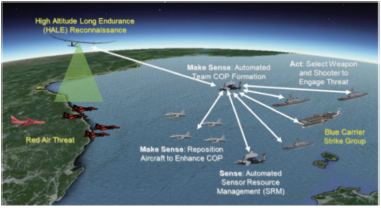
Figure 2 Air-Sea Defense Counterattack
The kill chain of air-sea defense counterattack employs a simplified OODA loop, including sensing, orienting, and acting, to achieve rapid closure of the kill chain. In the sensing phase, autonomous control algorithms are used for sensor resource management (SRM), which can be implemented based on machine learning (ML) technologies to dynamically manage and optimize sensor configurations, ensuring that threats are detected and identified in countermeasure environments. Proactive SRM can significantly improve the intelligence collection capabilities for sensor detection and threat identification. The judging phase employs information dissemination algorithms to fuse and share information, forming a common operational picture (COP) for the team, ensuring that each platform sees the same threat. The acting phase uses auction techniques for weapon selection and task assignment, achieving optimal or suboptimal coordinated strike decisions.
2.2 Air-Sea Collaborative Anti-Submarine Warfare
The air-sea collaborative anti-submarine warfare mainly centers around an unmanned swarm control center, with other components including UAVs, unmanned vessels, unmanned underwater vehicles, and communication buoys, as shown in Figure 3. The control center is the core of the intelligent unmanned combat platform, aggregating information from unmanned systems, achieving observation, judgment, and attack decision-making with AI assistance. Unmanned helicopters are primarily used for long-range reconnaissance, employing optical, radar, and other mission payloads to scout wide areas of the sea surface or shallow water targets, and leveraging AI capabilities for autonomous threat assessment.
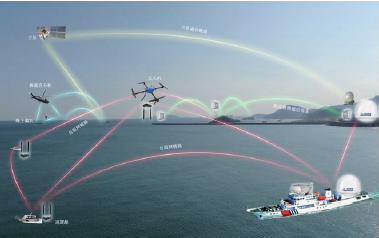
Figure 3 Air-Sea Collaborative Anti-Submarine Warfare
Unmanned vessels equipped with radar detection, satellite communication, and weapon payloads can detect near-sea targets and can also be used for weapon attacks. At the same time, unmanned vessels provide take-off and landing platforms, recovery equipment, towing devices, and storage space for unmanned helicopters; unmanned underwater vehicles serve as covert reconnaissance nodes, primarily for scouting and detecting underwater targets, including mines and submarines; communication buoys are used for cross-domain communication transmission.
Due to the short range of maritime wireless communications and the significant impact of hydrological and meteorological conditions, dynamic subnetwork, wireless relay, and satellite relay technologies are required to achieve interconnectivity, with self-organizing and self-repair capabilities to meet communication needs under specific conditions.
2.3 Ground Forces Defense
The U.S. Army is developing an Air Launch Effect (ALE) combat concept for future air/ground forces, where unmanned aerial systems (UAS) can be launched from larger manned aircraft, such as the Gray Eagle UAV. ALE operates in groups, autonomously without human control, executing a series of reconnaissance and attack missions to support the Army’s air and ground operations, as shown in Figure 4.
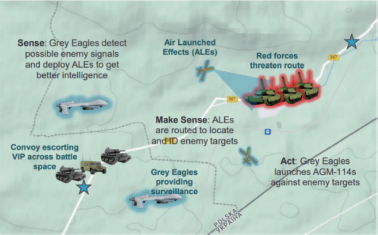
Figure 4 Ground Forces Defense
The purpose of the ALE system is to operate in the combat front, potentially facing two types of environmental threats: one is that due to terrain obstructions and varying perspectives, low-altitude operations increase the information disparity for the ALE group, posing some obstacles to forming a common operational picture (COP); the other is the complex electromagnetic environment under countermeasure conditions, limiting the capability for reliable and substantial information exchange, where low interception probability communications can only guarantee minimal communication capabilities.
3 Key Technologies for Manned/Unmanned Teaming
From a multi-domain operational perspective, manned/unmanned teaming represents a class of exponential capability enhancement technologies, where manned platforms expand operational space and improve task execution success rates through unmanned platforms and their payloads. The enhancement of operational effectiveness in manned/unmanned teaming is exponentially related to the number of connected platforms. For example, a manned platform commanding multiple unmanned platforms with different mission payloads can provide improved and enhanced tactical strategies for various stages of combat missions through the latest Tactics, Techniques, and Procedures (TTP), enhancing the lethality and survivability of manned platforms on both offense and defense.
From a technical perspective, the enhancement of operational effectiveness in manned/unmanned teaming primarily derives from four aspects:
1) Data Link Transmission Networking: Achieving interconnectivity, interoperability, and operability between manned and unmanned platforms, supporting agile adaptive networking under conditions of node damage, link interruption, channel deterioration, and electromagnetic interference, facilitating intelligence feedback, command control, target knowledge, and collaborative operations among platforms;
2) Autonomous Intelligent Control: With the assistance of strong and weak AI tools, unmanned platforms’ autonomous situational analysis, trajectory planning, motion control, and a certain degree of autonomous decision-making capabilities will free human operators’ hands and reduce their cognitive burden, making UAVs true operational assistants;
3) Intelligent Swarm Control: With the help of swarm intelligence algorithms such as navigators, artificial potential fields, and bio-inspired swarms, multiple unmanned platforms can autonomously coordinate formation control and task distribution, relieving human operators from the need to simultaneously operate multiple UAVs or meticulously assign tasks to each UAV, reducing the workload of human operators;
4) Task-Level Human-Machine Collaboration: Under the guidance of new-generation AI algorithms such as situational awareness, knowledge graphs, and neural-symbolic reasoning, human operators will communicate at the task level with unmanned platforms regarding situational maps and mission objectives, achieving mutual understanding between humans and machines, and automatically planning and executing tasks, thereby reducing the burden on human operators.
3.1 Data Link Transmission Networking
Data link self-organizing networks organically connect various sensors (infrared, CCS, SAR, etc.) and weapon platforms (air-to-ground missiles, anti-radiation missiles, electromagnetic weapons, etc.) of unmanned platforms through wireless communication links, networking protocols, and transmission control technologies, rapidly collecting, transmitting, processing, and distributing various sensor information, forming network communication capabilities between sensors-sensors, sensors-weapons, to meet weapon-level collaborative combat requirements.
To achieve agile adaptive networking under conditions of node damage, link interruption, channel deterioration, and electromagnetic interference, data link self-organizing networks need to possess characteristics such as low-latency transmission, decentralized intelligent networking, and good link anti-jamming capabilities, enhancing the resilience and self-healing capabilities of communication systems.
Data link self-organizing networks can adopt industry-leading technologies such as multi-frequency transmission, dynamic resource allocation, and software-defined self-organizing networks to address the agile adaptability issues faced by manned/unmanned platforms in battlefield environments.
3.2 Remote Interoperability Standards
Manned/unmanned teaming technology is defined at the technical level as “a standardized interoperable system architecture and communication protocol that employs real-time communication, intelligent assisted decision-making, and sensor/effector control methods, enabling manned systems to control and monitor unmanned vehicles and their payloads to collaboratively accomplish combat missions.” Through the use of multi-domain data links, manned/unmanned teaming technology enables interconnectivity and interoperability between manned and unmanned platforms, thereby improving the efficiency of decision-making and task execution.
To effectively support combat collaboration between manned and unmanned platforms, different levels of information links are realized based on payload capabilities, and the capability levels of manned/unmanned teaming technology are directly reflected in interoperability levels. According to NATO’s STANAG 4586 standard (the standard control interface for unmanned platform interoperability), the interoperability levels of manned/unmanned teaming are divided into five levels, as shown in Table 1.
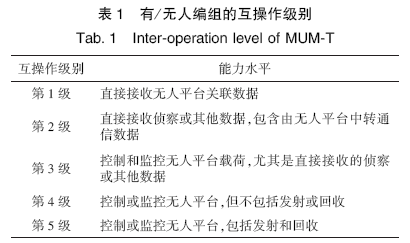
The interoperability levels of manned/unmanned teaming technology determine the interconnectivity of interfaces between platforms and the levels of information links, thereby affecting the control methods, collaborative combat patterns, and kill chain reconstruction capabilities of formations. Level 1 interoperability can only support situational distribution applications; Level 2 interoperability can only support static target reconnaissance and intelligence feedback applications; Level 3 interoperability can support dynamic target reconnaissance and collaborative detection applications; Level 4 interoperability can support multi-platform formations and most tactical collaborative applications, such as collaborative detection, collaborative strikes, and collaborative electronic warfare; Level 5 interoperability can support manned platforms carrying unmanned vehicles, fully supporting various collaborative combat applications, including collaborative defense, induced deception, and suppression of interference.
3.3 Intelligent Formation Control
The behavior of unmanned platforms must adhere to human control, but human capabilities, energy, and the ability to precisely control unmanned platforms are limited, making it impossible to control unmanned platforms constantly; thus, unmanned platforms must possess autonomous working capabilities.
To achieve autonomous intelligent control of unmanned platforms, it is necessary to expand the carrier, enhance functions, improve intelligence levels, and complete self-repair capabilities, adopting distributed control systems and hierarchical control strategies, with different intelligent decision-making strategies employed at each level, which is an effective method to reduce system complexity.
Formation control refers to the process where unmanned platform swarms control unmanned platforms to form and maintain specific geometric configurations during mission execution, adapting to platform performance, battlefield environments, tactical tasks, etc. It primarily addresses two aspects: the generation and maintenance of formations, including optimization of configurations oriented towards space, time, and communication topology; and the dynamic adjustment and reconstruction of formation configurations, such as separation and re-fusion of formations when encountering obstacles, adjustments of formations when the number of formation members increases or decreases, and reconstruction of formations under changing combat objectives or threat environments.
Collaborative decision-making among unmanned platform swarms includes dynamic allocation and scheduling of tasks such as threat assessment, prioritization of targets, and target distribution, requiring careful consideration to resolve conflicts in task distribution among multiple platforms, eliminate task coupling among multiple machines, and respond to dynamic and uncertain external environments, achieving collaborative decision-making based on tasks and unmanned platform capabilities.
Bio-inspired swarm technologies mimic the behavior of biological swarms in nature, such as the chaotic yet organized movements of fish schools, collaborative foraging of ants, nectar-seeking bees, and flocking birds, all exhibiting characteristics of self-organization, decentralization, and distribution, and demonstrating adaptability to the environment through flexible collaboration.
3.4 Task-Level Human-Machine Collaboration
The multi-platform collaboration of unmanned systems, human/unmanned collaboration, and air-land-sea collaboration are important measures to enhance combat capabilities. Collaborative control abroad has begun to enter the stage of collaborative coordination among unmanned boats, UAVs, or unmanned vehicles, evolving towards multi-domain collaboration of multiple unmanned boats, UAVs, and unmanned vehicles supported by real-time cloud services. Significant achievements have been made in areas such as situational awareness, mission planning, task allocation, and multi-platform collaborative positioning based on combat clouds, with operational applications underway.
Given that unmanned platforms can intelligently understand tasks and situations and possess autonomous and collaborative control capabilities, the command and control of manned/unmanned formations by human platforms employs the Observe-Orient-Decide-Act (OODA) loop theory, forming a multi-layer OODA loop for human/unmanned collaborative task processing: during combat, human platforms delegate partial “decision-making” authority to unmanned platforms, allowing unmanned platforms to autonomously “observe-judge” the battlefield situation and then “decide-act,” with the entire process forming a large-scale collaborative combat multi-OODA loop supported by combat clouds.
4 Development Trends and Outlook
Based on the latest developments in foreign manned/unmanned teaming, the U.S. military and member countries of NATO have prioritized manned/unmanned teaming technology as a strategic development focus, progressively advancing technological research and application verification across the air, land, and naval forces. The capabilities of foreign manned/unmanned teaming, such as stealth infiltration, beyond-visual-range strikes, and swarm attacks, pose significant threats to anti-access/area denial (A2/AD) operational concepts, necessitating thorough attention at both tactical and technical levels, along with proactive layout, technological breakthroughs, demonstration validation, and practical deployments.
The technological development of manned/unmanned teaming needs to emphasize the following directions: 1) Open architecture design, through service-oriented open software architectures, to meet current and future functional scalability and technical upgrade requirements for unmanned systems; 2) Multi-link integrated communication, employing RF integration and software radio architectures to achieve heterogeneous access, cross-domain interconnectivity, and multi-link forwarding, effectively supporting remote measurement and control, intelligence feedback, and situational decision-making in collaborative combat; 3) Intelligent formation control, continuously improving multi-platform unmanned systems, with reinforcement learning technology gradually shifting from single-platform applications to swarm combat command and decision-making development; 4) Human-machine collaborative combat, with combat modes evolving towards collaborative formations, continuously improving collaborative command and control technologies to accomplish typical foundational tasks of collaborative combat.
This article is reproduced from the “Wisdom and Intelligence” WeChat official accountCopyright belongs to “Wisdom and Intelligence” WeChat official account (Xi’an Institute of Applied Optics, Yang Shuo, Editor)

New Optoelectronics

Long press the QR code to follow us
Welcome to reprint, please indicate the source!
Welcome to follow the “Applied Optics” WeChat official account
Welcome to reprint, please indicate the source!