In recent years, thanks to major cloud service providers like Amazon developing their own Arm architecture server CPUs, Apple’s Mac products transitioning to self-developed Arm processors, and Qualcomm launching the Snapdragon X Elite processor for the PC market, Arm has gained a certain market share in both the server and PC markets.
In July of this year, Arm CEO Rene Haas revealed that a significant portion of Arm’s growth in the data center market is due to artificial intelligence. Since 2021, with the explosion of the AI boom, the number of startups using Arm chips has surged by 12 times. Currently, the number of server customers using Arm architecture processors has grown to 70,000, a 14-fold increase since 2021.
Bernstein Research predicts that by 2023, nearly 10% of servers worldwide will use Arm server CPUs, with half of them deployed by AWS, which has over 2 million self-developed Graviton chips in its cloud.
Additionally, with Apple’s Mac product line fully transitioning to self-developed Arm architecture M-series processors, Qualcomm launching the Snapdragon X Elite processor for the PC market, and NVIDIA collaborating with MediaTek to launch personal supercomputers based on Arm architecture CPUs like the DGX Spark, Arm’s share in the PC market continues to grow.
At this year’s COMPUTEX 2025 exhibition, Arm announced that nearly 50% of the computing power shipped to top-tier hyperscale cloud service providers is based on Arm architecture. Arm also estimates that in the PC and tablet market, Arm architecture will account for 40% of total shipments.
The reason Arm has achieved such progress is mainly due to its outstanding performance in AI computing capabilities and energy efficiency, and it also has a cost advantage over x86 solutions.
However, at the recent IFA 2025 in Berlin, Jack Huynh, Senior Vice President and General Manager of AMD’s Computing and Graphics Division, told local media ComputerBase that x86 is making a strong comeback, and Arm has no advantages compared to x86.
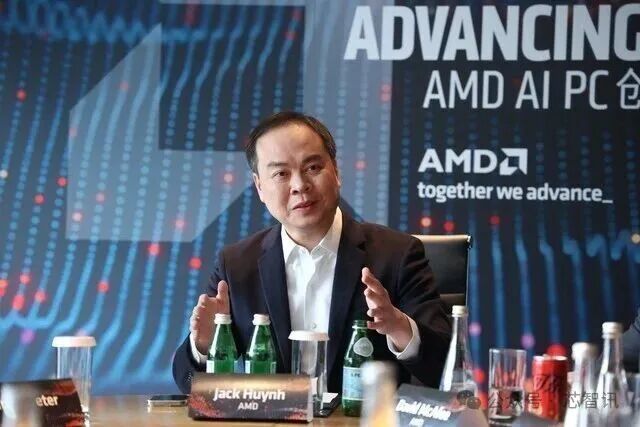
△Jack Huynh, Senior Vice President and General Manager of AMD’s Computing and Graphics Division (Image Source)
For example, in terms of AI performance and energy efficiency, AMD, like Intel before it, refutes the misconception that “x86 is not efficient enough.” They believe that whether equipped with AMD Ryzen or Intel Core processors, laptops can provide longer battery life while ensuring performance, fully utilizing the powerful x86 ecosystem. This will prevent Arm from surpassing x86 in overall user experience.
Although Apple’s Mac products equipped with M-series processors and Qualcomm’s Snapdragon X series PCs have demonstrated excellent energy efficiency, this advantage of Arm CPUs is diminishing as AMD and Intel accelerate the development of new AI PC chips.
For instance, Intel’s Lunar Lake has an NPU performance of up to 120 TOPS, with significant upgrades in energy efficiency. Acer claims that its Lunar Lake laptops can achieve up to 29 hours of battery life with a 65 WHr battery and IPS LCD screen; ASUS also claims that its Expertbook laptop based on the Lunar Lake processor can provide up to 29 hours of Netflix playback time.
AMD’s latest APU, Strix Point and Strix Halo, have also achieved optimal performance/energy efficiency ratios, leading to widespread adoption in laptops, MiniPCs, and handheld devices. Importantly, AMD’s flagship Ryzen 9 AI MAX+ 395 has an overall performance of 126 TOPS, surpassing Arm’s solutions, proving that x86 has a clear advantage over Windows on Arm.
AMD clearly states that AI PCs can only grow from a good PC. Jack Huynh explains that AMD’s primary goal is to provide hardware and software for the “perfect PC,” and he also participated in partner events with Lenovo at IFA 2025. In this regard, it is crucial to implement AMD’s ambitious roadmap while maintaining a reliable pace for partners.
Of course, this does not mean that the Arm PC era is over, but it at least ensures that x86’s position remains solid, especially with the support of new-generation products like Intel’s Panther Lake and AMD’s Medusa Point.
Editor: Chip Intelligence – Wandering Sword
Previous Exciting ArticlesChip team of thousands transferred to Singapore subsidiary? ByteDance respondsNew Kailai has orders exceeding 10 billion, valuation close to 100 billion?Global semiconductor R&D investment Top 20: Intel first, TSMC seventh!H100/H200 supply tight? NVIDIA: Supply is sufficient, unrelated to H20!6 Chinese companies capture 68.8% of the global power battery market!237.31 MTr/mm²! Rapidus’s 2nm transistor density exceeds TSMC?Domestic GPU newcomer Lishuan secures 500 million yuan in financing: revenue is zero, pre-investment valuation is 3.5 billion yuan!Huahong plans to acquire 97.4988% of Huali Micro!Breaking! The US revokes the “exemption” for Samsung and SK Hynix’s wafer fabs in China!Jensen Huang: Blackwell GPU may enter the Chinese market!SMIC plans to fully control SMIC North!Chip Original acquires Chip Coming, embarking on a bright future for RISC-VNVIDIA’s Q2 performance exceeds expectations, but H20’s revenue in the Chinese market is zero!Trump intervenes, seizing Biden’s 7.4 billion semiconductor research fund!TSMC’s 2nm production line will exclude equipment from mainland China!
For industry communication and cooperation, please add WeChat: icsmart01Chip Intelligence official group: 221807116