👆If you wish to meet often, feel free to star 🌟 and bookmark it~
In recent years, as the global mobile game user base continues to rise, players’ demand for immersive experiences and stunning visual effects has become increasingly urgent. Developers are facing the dual challenges of accelerated technological iteration and performance upgrades. In the context of continuous breakthroughs in mobile graphics technology, Arm has consistently focused on the developer ecosystem, committed to empowering the mobile game industry through technological innovation and tool upgrades.
Recently, to further share the latest developments and future plans in the field of mobile graphics technology, Arm held an online technical media communication meeting, focusing on the implementation path of console-level graphics effects on mobile platforms, injecting new thoughts into industry development.
Steve Steele, Director of Product Management at Arm’s Client Division, pointed out that breaking through the limits of mobile graphics performance is not a new challenge for Arm.
For many years, Arm has continuously pushed for excellence in image quality, including the introduction of features such as ray tracing and variable rate shading in 2022, aimed at providing a high-quality and high-performance experience; in 2023, it introduced delayed vertex shading technology to accelerate the processing of geometry-intensive workloads; and in 2024, it further enhanced its performance and functional capabilities. Recently, Arm’s Advanced Super Resolution technology (Arm ASR) has brought high-quality optimization upgrades to existing mobile devices through efficient algorithms based on shaders.
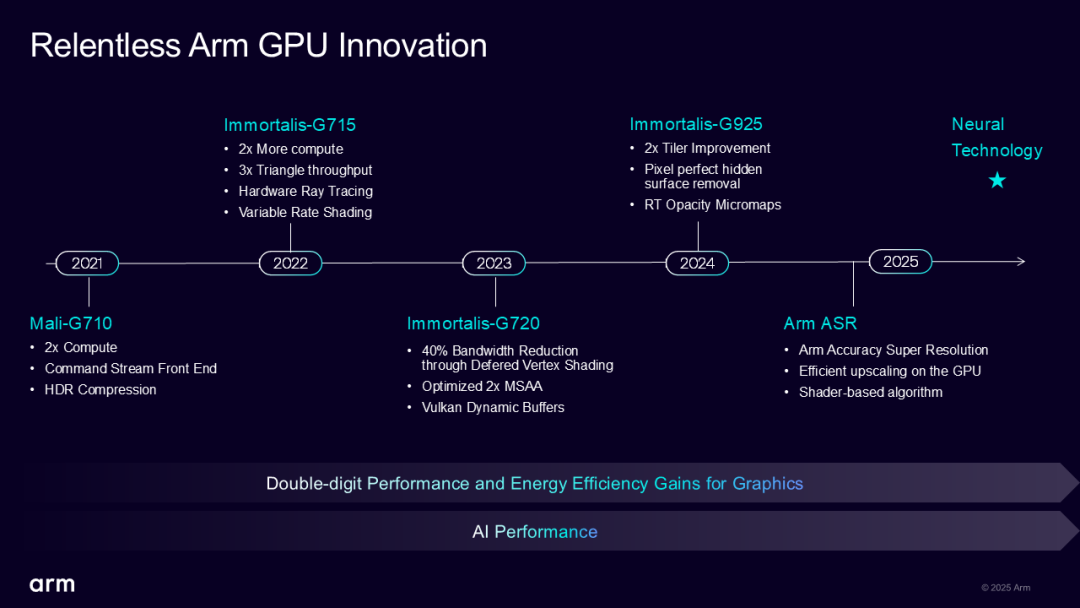
It can be seen that Arm is committed to enhancing GPU AI performance by improving the performance of compute shaders.
In the face of current industry challenges and opportunities, Arm is actively positioning itself, bringing innovative solutions to the market through continuous technological innovation and product development—adding the Arm Neural Technology, a dedicated neural accelerator for Arm GPUs, which brings unprecedented AI computing capabilities to mobile GPUs.
The launch of this technology may mark an important step for Arm in the field of AI graphics, potentially achieving PC-level AI graphics performance on mobile devices for the first time, laying a solid foundation for future edge AI innovations.
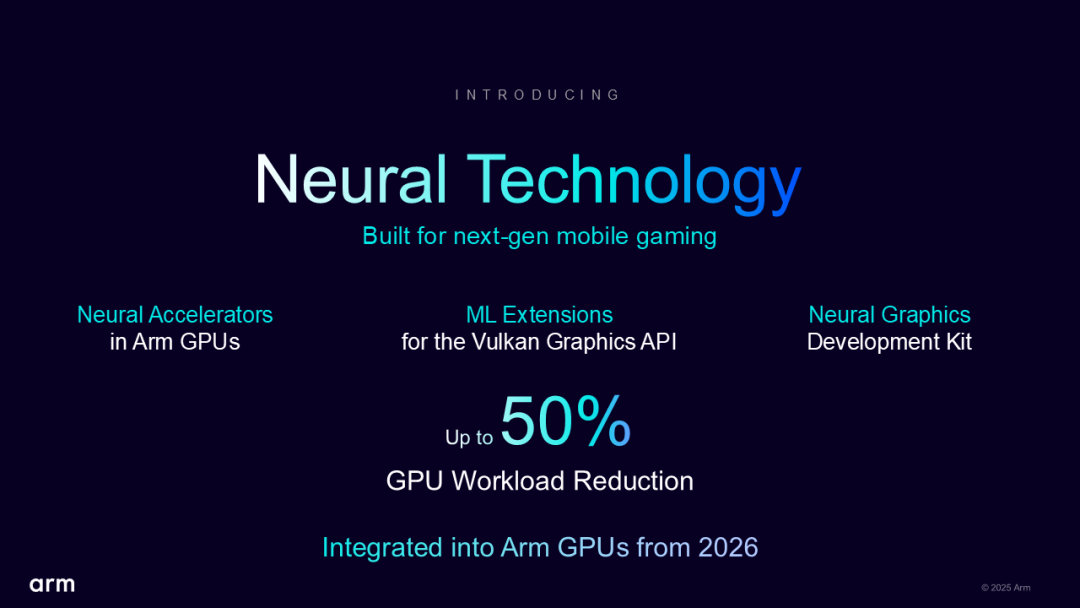
According to Steve Steele, the core goal of Arm Neural Technology is to provide developers with more powerful and efficient tools through deep integration of hardware and software, to meet the growing demand for AI graphics applications. As AI and graphics technology continue to merge, developers’ demand for technologies that can achieve high-quality graphics processing on mobile devices is becoming increasingly urgent. The birth of Arm Neural Technology is aimed at filling this market gap, allowing developers to easily integrate AI technology into their graphics applications, providing users with an unprecedented visual experience.
Arm Neural Technology: A Key Breakthrough in Performance Enhancement
It is reported that the dedicated neural accelerator equipped for GPUs is the core hardware component of Arm’s neural technology. This accelerator is meticulously designed to be tightly integrated into the shader cores of the GPU, enabling efficient AI computing.
Unlike traditional GPU architectures, the dedicated neural accelerator is optimized for AI workloads, significantly enhancing AI computation speed without compromising graphics rendering performance. For example, when processing tasks such as super-resolution and frame rate enhancement, the neural accelerator can offload part of the workload from the GPU, allowing the GPU to focus on graphics rendering, thus achieving overall performance improvement.
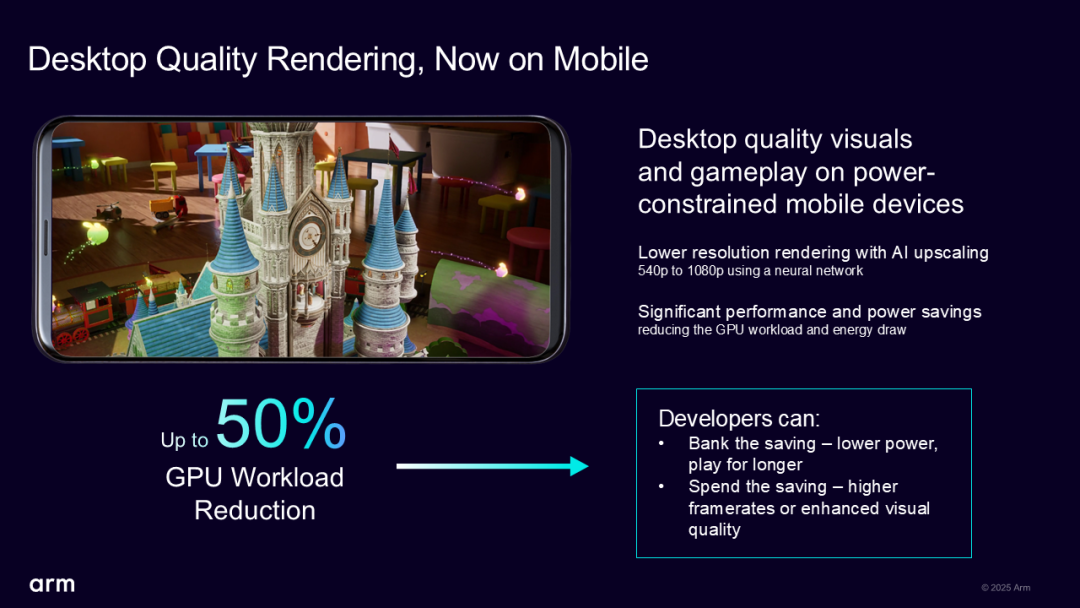
According to Arm’s test data, GPUs equipped with dedicated neural accelerators can reduce GPU workload by up to 50% when processing AI graphics tasks, while also achieving significant improvements in image quality and processing speed. This means that through Arm Neural Technology, developers can achieve graphics effects on mobile devices that were previously only possible on PCs or high-end gaming consoles. Whether it’s high-resolution game graphics, realistic virtual reality scenes, or real-time video processing, Arm Neural Technology can provide powerful support.
It is worth noting that Arm Neural Technology is not only applicable to the gaming field but will also have a tangible impact on applications such as neural camera workloads, providing developers with powerful tools for large-scale implementation of graphics technology from quality optimization upgrades to path tracing and other edge use cases.
Open Development Kit: Empowering the Developer Ecosystem
Steve Steele pointed out that Arm chose to announce this technology before the official launch of the GPUs equipped with it because to truly unleash the potential of such technology, game developers need to innovate based on it.
To better support developers in innovating with Arm Neural Technology, Arm has simultaneously launched an open development kit for neural technology. This development kit includes a wealth of tools and resources designed to help developers quickly get started and optimize their AI graphics applications.
The development kit covers all the resources needed to integrate and customize AI visual effects, including:
-
Unreal Engine plugin
-
PC-based Vulkan simulation
-
Updated analysis tools
-
Fully open models provided through GitHub and Hugging Face
-
Arm Machine Learning (ML) extensions for Vulkan
The open development kit provides an Unreal Engine plugin, allowing developers to easily integrate features such as neural super sampling into their games with simple operations; a Vulkan PC simulation environment that allows developers to develop and test in advance while mobile hardware is not yet ready. If developers want to integrate this technology into their own engines, the kit also provides a wealth of sample code and documentation.
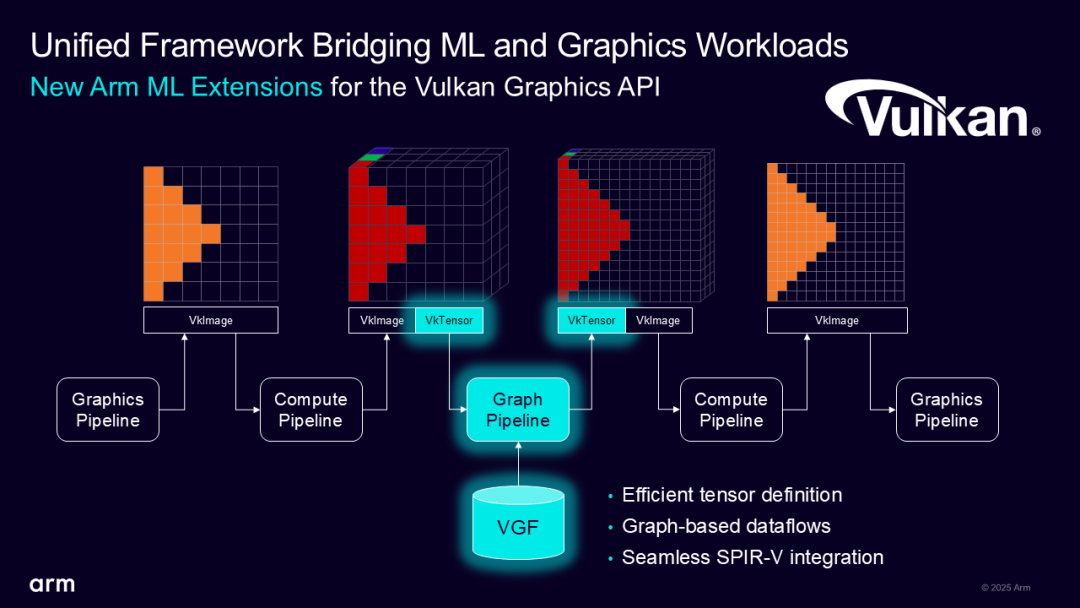
The Vulkan-based open Arm ML extension allows developers to directly introduce AI into familiar rendering pipelines. Traditional Vulkan supports graphics pipelines and compute pipelines, while the Arm ML extension introduces a third pipeline, the graph pipeline, specifically designed for neural network inference. This allows developers to more easily integrate AI as a native part of the graphics pipeline into mobile rendering.
First Application: Stunning Debut of Neural Super Sampling
Among them, as the first application of Arm Neural Technology, the Neural Super Sampling (NSS) technology has also attracted much attention in this sharing. Neural Super Sampling technology combines Arm’s super-resolution technology with AI neural networks, significantly reducing GPU workload while maintaining high-quality visual effects.
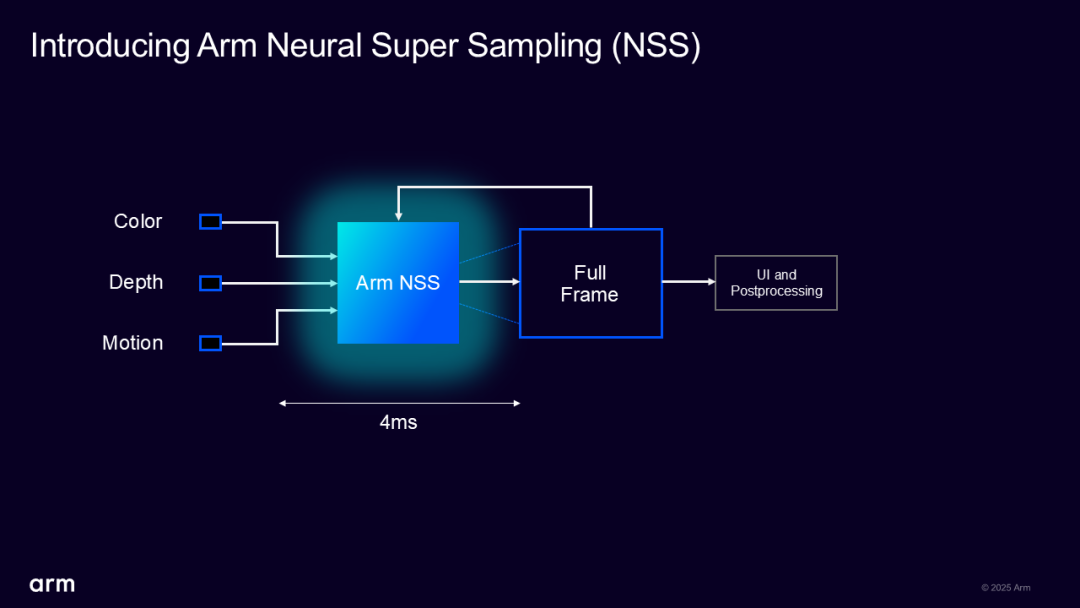
Specifically, Neural Super Sampling technology analyzes and processes low-resolution images, using AI neural networks to predict and supplement detail information in the images, thereby achieving an increase in image resolution.
According to Arm’s demonstration, Neural Super Sampling technology can elevate the resolution from 540p to 1080p with a delay of only 4ms per frame, achieving effects close to native quality. Compared to traditional super-resolution technology, Neural Super Sampling technology not only eliminates motion blur but also enhances clarity and detail representation while increasing resolution.
In gaming scenarios, the advantages of Neural Super Sampling technology are particularly evident. By reducing GPU workload, game developers can use the saved resources to enhance frame rates, improve special effects, or optimize other game performance metrics. “Arm Neural Super Sampling achieves further graphics performance enhancement with faster, clearer, and more energy-efficient real-time AI rendering,” Steve Steele explained, “This means a comprehensive breakthrough: faster speeds, lower energy consumption, and higher image quality.”
Looking Ahead: Arm Continues to Innovate, Leading Edge AI Development
With the launch of Arm Neural Technology, we have already seen the tremendous potential for enhancing edge AI graphics performance. However, this is just the beginning. According to Steve Steele, Arm plans to further expand the application scope of neural technology in the future, bringing more surprises to developers and users through continuous innovation and optimization.
Next, Arm will further enhance graphics performance through the launch of Neural Frame Rate Upscaling (NFRU) and Neural Super Sampling and Denoising (NSSD) applications.
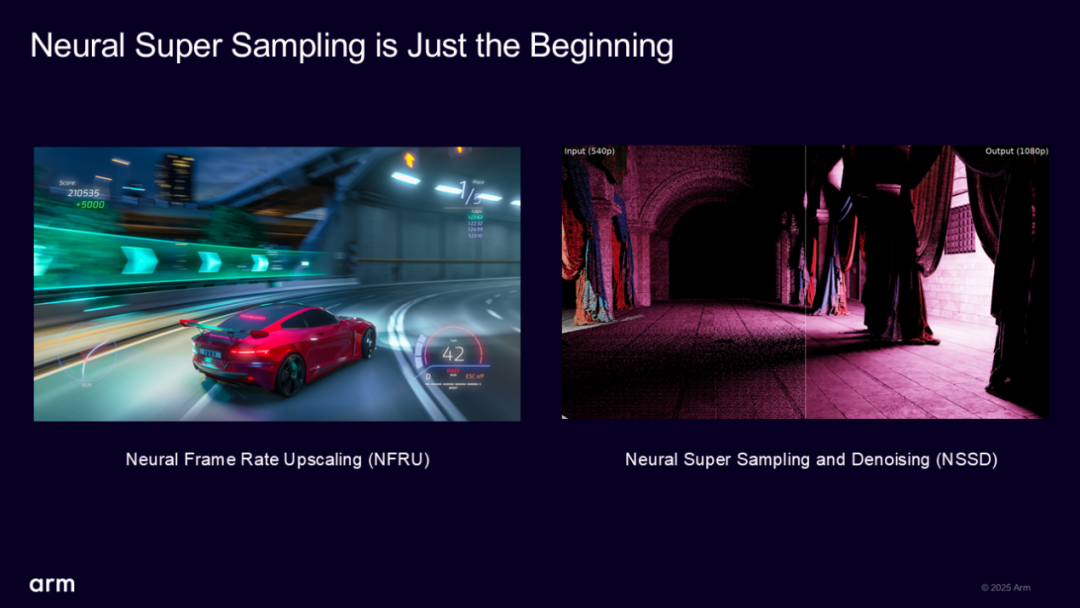
The Neural Frame Rate Upscaling technology will analyze consecutive video frames, using AI to generate intermediate frames, thereby doubling the frame rate and providing users with a smoother visual experience; while the Neural Super Sampling and Denoising technology will focus on enhancing the image quality of real-time path tracing by reducing the number of ray casts and using neural technology to fill in missing detail information, thus lowering computational costs while maintaining high-quality images.
At the same time, Arm also announced early access plans for the NFRU and NSSD use cases. Unlike Arm NSS, these two use cases currently lack the technical ecosystem that supports Arm ASR, so Arm is actively recruiting game studios to join the development, assisting Arm in refining the technology in preparation for future public release. Enduring Games, NetEase Games, Sumo Digital, Tencent Games, and Traverse Research have already collaborated with Arm to jointly develop the neural graphics development kit.
Although Arm Neural Technology functionally resembles similar technologies on desktop and console platforms, it adopts a completely different approach in providing technology to developers. Steve Steele emphasized that unlike the closed desktop ecosystem, Arm fully opens all neural technologies—game studios can access the complete model architecture, weight parameters, and toolchain needed for retraining models.
This strategy stems from Arm’s core gene of “empowering the ecosystem”: different games have differentiated needs, and only by opening up the underlying technology can developers deeply adapt and optimize for unique workloads. While providing out-of-the-box tools such as engine plugins, Arm also retains complete control of the underlying for developers to meet their advanced tuning needs.
By releasing technology ahead of the official hardware launch, Arm demonstrates its commitment to upgrading ecosystem development. In addition to focusing on core technology research and development, Arm is also dedicated to shortening the value realization cycle for developers, which is precisely the purpose of creating Arm ASR, Kleidi, and the neural graphics development kit—to ensure that technology not only meets performance standards but also benefits all ecosystem participants.
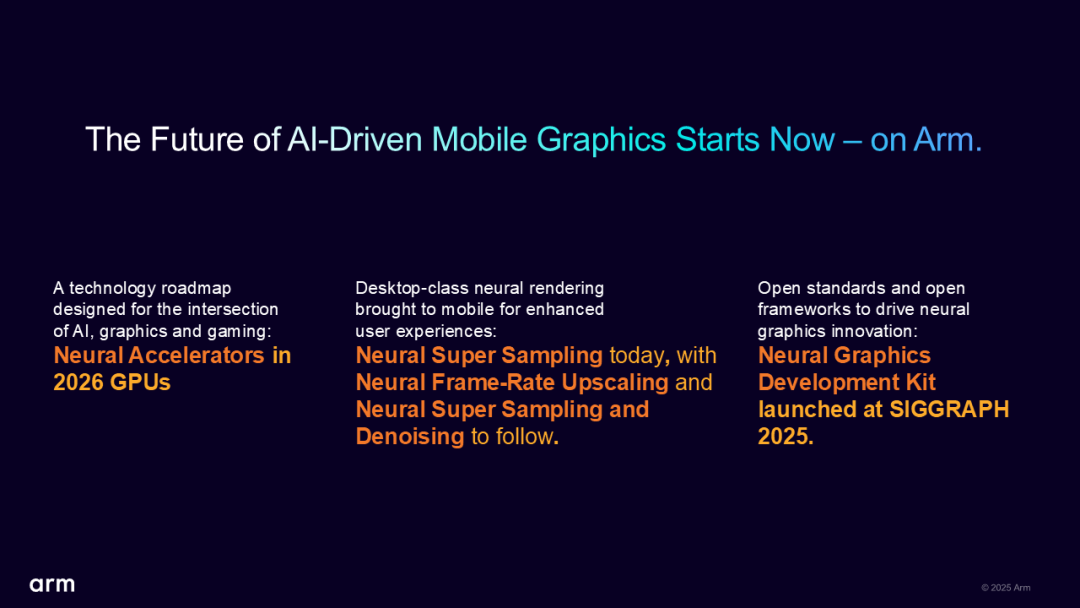
From a technical roadmap perspective, the built-in neural accelerator in GPUs is expected to be realized in Arm GPU products by 2026. Relying on the open software, models, and data in the neural graphics development kit, Arm is introducing desktop-level AI applications in a lightweight manner to mobile platforms, continuously driving technological innovation. It can be said that the AI-driven mobile graphics era has already begun, and openness and developer-friendliness will become the core labels of the Arm platform.
Conclusion
Overall, the launch of Arm Neural Technology undoubtedly injects a shot of adrenaline into the current AI graphics market. Through dedicated neural accelerators, open development kits, and innovative technologies and applications such as Neural Super Sampling, Arm not only demonstrates its strength in technology research and development but also points the way for future edge AI innovations.
As these technologies gradually land and apply, devices equipped with this technology are expected to be launched by the end of 2026. We have reason to believe that in the near future, whether in gaming, the metaverse, or other graphics-intensive application fields, we will enjoy more exciting and realistic visual experiences.
Click here👆 to follow for more original content
*Disclaimer: The content of the article reflects the author’s personal views, and Semiconductor Chip News reprints it only to convey a different perspective, which does not represent Semiconductor Chip News’s endorsement or support of this view. If there are any objections, please feel free to contact us.
Recommended Reading
100 trillion, invested in semiconductors
Chip giants, market value plummets
Jensen Huang: HBM is a technological miracle
Jim Keller: RISC-V will definitely win
The 10 highest-valued chip companies globally

If you like our content, please click“Looking”” to share with your friends~