
With the wave of AI and large models entering vehicles, the smart cockpit SoC market is about to experience a new round of intense “chaos”.
This year, manufacturers such as BYD and Zhiji have successively introduced AI Agents into their smart cockpit systems to create higher-level AI smart cockpit systems with proactive cognition and emotional interaction, triggering a new wave of upgrades in smart cockpit SoC.
According to Gaogong Intelligent Automotive, Tier 1 manufacturers such as Visteon, Desay SV, and Botai Internet of Vehicles are accelerating the development of next-generation smart cockpit solutions based on Qualcomm’s Snapdragon cockpit platform Supreme Edition (QAM8397P), while Beidou Zhilian is developing smart cockpit solutions based on the MT8678 platform. Additionally, many automakers have partnered with MediaTek, AMD, Intel, and other manufacturers.
Behind this, most of the smart cockpit chips that have been mass-produced in the market cannot support the computing power required for the deployment of AI large models. Even small parameter models have requirements for the computing power, bandwidth, and power consumption of vehicle-side chips.
Previously, most AI large models were deployed in the cloud, which not only incurred high costs for frequent calls but also posed challenges for response speed and data privacy. For example, at the beginning of this year, domestic automakers uniformly accessed Deepseek R1 through cloud deployment, but most automakers only made simple interventions with the original models and did not achieve a deep integration at the user experience level.
Industry insiders unanimously believe that the localization of AI large models on smart cockpit SoC chips will be an inevitable trend in the future. However, this requires smart cockpit SoC to have more abundant CPU, NPU, and other performance capabilities, as well as ultra-large bandwidth capacity, which traditional cockpit chips clearly cannot meet.
In this context, the competition for the next-generation AI smart cockpit SoC platform has already begun. Chip manufacturers such as Intel, MediaTek, and Chipone have all “drawn their swords” with new-generation AI cockpit SoC products to support the deployment of AI large models with 70 billion parameters and above on the edge.
01
AI Large Models ‘Reconstruct’ Cockpit SoC
As more and more AI large models like ChatGPT and Deepseek take over smart cockpit interactions, traditional chip architectures are increasingly unable to support the deployment of tens of billions or even hundreds of billions of AI large models at the vehicle end, and the smart cockpit chip industry is entering a new round of transformation.
It is well known that previously, the AI applications in smart cockpits were mainly deployed in the cloud, and the edge generally only supported “small models” with less than 1 billion parameters, most of which could only perform basic commands such as navigation reminders and music playback, making it difficult to understand complex voice commands.
Nowadays, the AI capabilities of smart cockpits have evolved from basic voice interaction to multimodal interaction, personalized recommendations, and proactive intelligence, officially entering the AI cockpit era.
In this process, smart cockpits need to deploy increasingly larger parameter-level edge large models to complete the upgrade of AI smart cockpits. According to relevant data, L3-level AI smart cockpits can support edge large models with 5-15 billion parameters, while L4-level AI smart cockpits often require support for edge large models with over 30 billion parameters.
“If it is basic human-machine interaction, deploying a few small models on the edge can achieve it, but the output accuracy is far inferior to that of larger models, and it is difficult to have strong reasoning capabilities. To achieve a better human-machine interaction effect in smart cockpits, it often requires deploying large model versions of 30B and above.” Industry insiders have stated that with the gradual implementation of AI Agent technology, smart cockpits will accelerate their evolution towards multimodal integrated interaction, full-scene proactive cognition, real-time data processing, and immersive experiences in L3-level AI cockpits, which will often require support for large models with hundreds of billions of parameters.
Since last year, major automakers have been promoting the upgrade of cockpit chip platforms, with Qualcomm’s 8295 chip becoming the mainstream configuration for the next generation of AI smart cockpits in flagship models. According to data from the Gaogong Intelligent Automotive Research Institute, from January to December 2024, the delivery of passenger cars equipped with Qualcomm’s 8295 cockpit platform in the Chinese market (excluding imports and exports) has reached 1.3707 million units, compared to only 1,426 units in the same period of 2023.
Chipone’s CTO, Sun Mingle, introduced that evaluating the deployment effect of AI large models on the edge of smart cockpits requires comprehensive consideration of input length (Context Length), first token generation latency (First Token Latency), and sustained output speed (Tokens per Second) and other comprehensive indicators. For example, the performance indicators required for the currently mainstream 7B multimodal large model are to output the first token within one second under an input length of 512 tokens and to run at a speed of 20 tokens/s.
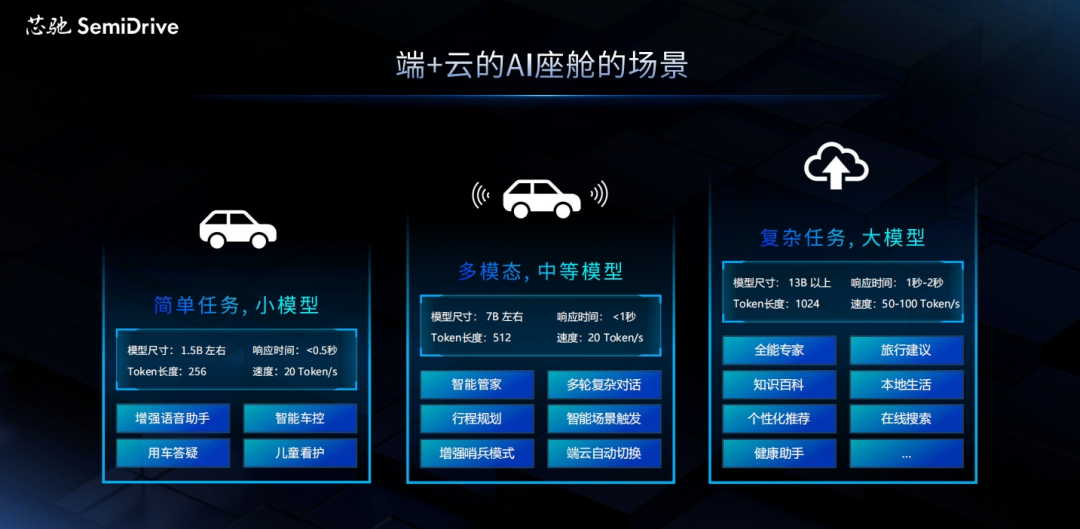
“During the operation of AI large models, the performance bottleneck and main resource consumption are not CPU, but rather NPU and system bandwidth.” Sun Mingle stated that generating each token of a large model requires reading a large number of model parameters, which is extremely bandwidth-intensive. Most existing cockpit chip platforms are derived from mobile chip designs, and while the performance of NPU can meet the requirements, their memory bandwidth is usually 64 bits, with a total bandwidth of about 60-70GB/s, which is often insufficient for running 7B multimodal models.
It is understood that deploying 7B multimodal large models on the edge requires the cockpit processor to have more than 30TOPS of NPU computing power, and the DRAM bandwidth in the SoC needs to reach around 90GB/s.
“Being able to deploy and being able to run effectively are two different things.” Industry insiders have stated that some companies have run 7B large models on cockpit SoC platforms with 30-40TOPS of computing power, but they are basically still in the demo stage of smart cockpits, and there is still a long way to go before true implementation. In the future, as larger parameter multimodal large models accelerate their entry into vehicles, the integration of cockpits will deepen, and the demand for algorithms will become stronger, which will put significant pressure on the computing power of smart cockpit SoC.
Therefore, with the accelerated entry of large models with hundreds of billions of parameters, the industry is increasingly demanding smart cockpit chips with higher computing power, larger bandwidth, and faster transmission speeds.
02
Smart Cockpit SoC Chaos “Upgraded Again”
To better support the deployment of larger parameter AI large models on the edge, automotive chip giants including MediaTek and Intel, as well as local manufacturers like Chipone, have launched a new round of smart cockpit SoC upgrade battles.
For example, MediaTek has launched the 3nm process CT-X1, which refreshes the performance ceiling of cockpit SoC with AI computing power of 400TOPS. It is reported that CT-X1 also integrates NVIDIA Blackwell GPU and deep learning accelerators to build a flexible computing architecture with dual AI engines, capable of supporting large language models with 1.3 billion parameters, including various mainstream large language models (LMs) and multimodal generative AI models for deployment at the vehicle end, capable of generating AI images within one second.
Intel has also released the second-generation Intel AI enhanced software-defined vehicle (SDV) cockpit SoC, which adopts a Chiplet architecture, allowing for the matching of high-performance and suitable chips for each functional module. Based on this, manufacturers can customize computing, graphics, and AI functions according to their needs, reducing development costs and shortening time to market.
According to Intel, the second-generation cockpit SoC supports the integration of cockpit and driving, and the performance of generative and multimodal AI can be improved by up to 10 times, while graphics performance can be improved by up to 3 times, and it is expected to be officially equipped in mass-produced vehicles by 2026.
Last year, Intel released the first-generation cockpit SoC and the first dedicated vehicle graphics card, the ARC A760-A, which is expected to achieve mass production in 2025. According to public information, Intel’s first-generation smart cockpit SoC matches the vehicle-mounted dedicated graphics card ARC A760-A (with a computing power of 229TOPS), supporting up to 8 4K displays and enabling the deployment of ultra-large or multiple large models at the edge. For example, it can run two 7B models simultaneously, as well as 4-5 models with over 2B parameters.
As a representative of local suppliers, Chipone has also launched a new generation of AI cockpit SoC——X10, which adopts a 4nm process, with NPU computing power reaching 40TOPS, and is matched with a 128-bit LPDDR5X memory interface, with a bandwidth of up to 154 GB/s, more than twice that of the current flagship cockpit chip bandwidth.
Sun Mingle stated that Chipone X10 can effectively support the operation of AI large models, achieving an output of 20 tokens/s for a 7B (700 million parameters) model, with a response time controlled within one second. In addition, Chipone X10 can effectively solve the occasional delay issues caused by busy networks or fluctuations in cloud server loads in cloud deployment scenarios, ensuring consistency in user experience.
It can be seen that with the continuous efforts of automotive chip giants like MediaTek and Intel, as well as the rapid rise of domestic chip manufacturers, the smart cockpit chip market has entered an unprecedented “chaos era.”
According to the market share ranking of cockpit chip suppliers in the Chinese market (excluding imports and exports) released by the Gaogong Intelligent Automotive Research Institute, the top five suppliers are Qualcomm, NXP, Renesas, MediaTek, and Texas Instruments, with foreign manufacturers still holding a significant share, but the market share of domestic solutions has increased to 7.4%.
In terms of specific market share, Qualcomm leads with an absolute market share of 32.01% and has become the main platform for domain control upgrades. The Gaogong Intelligent Automotive Research Institute believes that with the accelerated entry of multimodal AI large models, the market pattern of smart cockpit SoC will be completely reshaped.
Currently, major manufacturers and Tier 1 suppliers have developed new-generation cockpit systems based on Qualcomm’s 8397, MediaTek’s CT-X1, Intel, and other high-performance AI cockpit SoC. For example, Visteon, Desay SV, and Botai Internet of Vehicles are developing new-generation smart cockpit domain controllers based on Qualcomm’s Snapdragon cockpit platform Supreme Edition (QAM8397P). Data shows that Qualcomm’s 8397 chip has a CPU computing power of 660KDMIPS and an AI computing power of 360TOPS, capable of supporting up to 16 4K displays, real-time ray tracing, and immersive 3D experiences, as well as facilitating the higher performance operation of edge AI large models.
In addition, many automakers have chosen the new generation of high-performance AI cockpit SoC from MediaTek, AMD, Intel, Chipone, etc., while automakers like Lynk & Co have also chosen to support the entry of AI large models by equipping dual cockpit SoCs, leading to increasingly diverse chip options.
It is undeniable that manufacturers and supply chain companies have launched a new round of upgrade battles for AI smart cockpits. Finding a balance between performance improvement and cost control, as well as how to better utilize computing power, remains a common challenge for automakers and suppliers.
Previous Recommendations
Exploring the transition from ‘autonomous driving’ to ’embodied intelligence’ by industry leaders
AI Copilot transformation, the transformation of traditional development models and new explorations
Losses/growth stagnation, is TomTom betting on Chinese automakers going global?
The next-generation technology competition for AR HUD has begun, and industry reshuffling is imminent
Functional safety issues, is the endpoint of smart vehicles a fire?