2025.06.18
Word count: 2313, estimated reading time: about 4 minutes
Author | First Financial Qiao Xinyi
A high-level table tennis “match” can start at any time.
In one corner of the table tennis table, a serving robot resembling an industrial robot is making final preparations before serving. Based on the training mode selected by the user, the path planning module in the system program is adjusting the joint angles, and the torque control module is also adjusting the racket angle to 15°, preparing to simulate the classic parabolic trajectory of Ma Long’s serve.
First Financial reporters observed at the simulated competition site that with the development of embodied intelligent large models, traditional serving robots are becoming “more like coaches”. Unlike the previous generation of serving robots, it not only “hits” but also attempts to think and provide feedback like a “coach”. A developer told reporters that they are trying to develop this product into an embodied intelligent product equipped with a “ChatGPT for sports”, allowing users to feel as if they are receiving professional guidance from “AI Liu Guoliang” during training.
However, after interviewing AI hardware engineers and club coaches, First Financial reporters learned that transitioning from “understanding the game” to “understanding people” presents a long-term market tug-of-war for companies aiming to truly cultivate an AI coach. Reducing the usage threshold through technology and providing intelligent supporting services to expand the customer base are key issues for companies looking to establish a commercial closed loop for coach-type serving robots.

Half the cost of a human coach
“Our club purchased a serving robot last year, and we have already started selling classes.” Andy, a coach at a table tennis club in Changning District, Shanghai, revealed to First Financial reporters that the price of practicing with the serving machine is nearly half that of a human coach. “The price for a human coach is around 150 yuan per hour, while the usage price for the serving machine is about 80 yuan per hour.”
However, Andy stated that he would only recommend the serving machine for students with some basic experience; for beginners, he still suggests learning with a human coach. “Humans are definitely more targeted and can teach according to the student’s needs.”
“Not smart enough” is Andy’s evaluation of most table tennis serving robots on the market. He mentioned that he has used serving robots from traditional sports brands like DHS and Double Happiness, whose main functions still remain at the parameter setting level, lacking in intelligence. Users can customize spin, landing points, and serving frequency, but it is difficult to have features like strategy generation, action recognition, and feedback adjustment. “More often than not, the machine is a training aid rather than a partner to ‘play ball’ with you.”
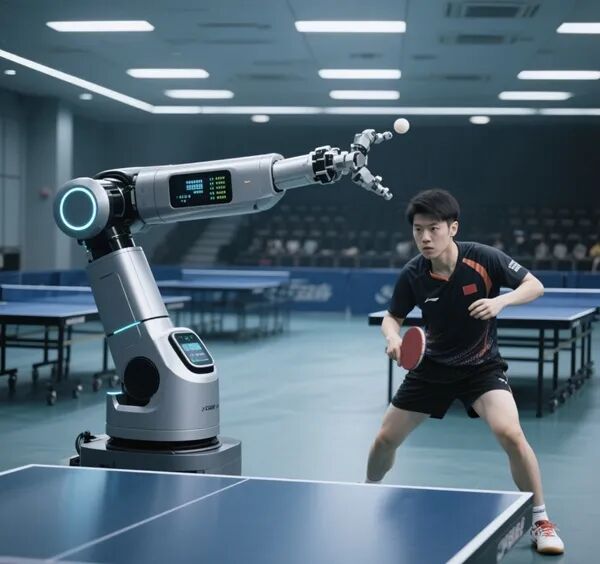
World champion-level training partners may soon be available to table tennis enthusiasts. (AI-generated image)
Li Qing (pseudonym) is a researcher at a serving robot company. She told First Financial reporters that unlike the currently popular end-to-end model architecture in the humanoid robot field, most intelligent serving robots still adopt a classic modular hierarchical structure.
For example, the M-ONE from serving robot manufacturer Chuangyi Technology has a “hand” that is a table tennis racket, with its surface covered in real competition-grade rubber.
Before each serve, the robot’s “hand” performs a complete motion of pulling back and swinging forward, rather than simply “spitting” the ball out from the traditional serving robot’s ball hole.
The moment the racket surface and the table tennis ball make contact determines the spin and arc trajectory of each ball. Li Qing explained that the widespread use of a layered architecture means that data processing needs to flow between different modules, while table tennis is a sport that requires rapid responses in a short time, creating a natural contradiction between the two.
“This is a problem that most manufacturers have not yet solved. Establishing a complete sensing, algorithm, and strategy mechanism is key to making this wave of serving robots ‘more like coaches’, which still requires a lot of data and algorithm fine-tuning,” Li Qing said.
Serving robots still have hurdles to overcome
Searching for serving robots on the shopping website Taobao, First Financial reporters found products including clamp-type, floor-standing, and desktop serving robots, with prices ranging from dozens to tens of thousands of yuan. As the usage scenarios change, the technical systems supporting serving robots are also continuously updated.
Li Qing told reporters that for the training needs of professional players, the system can collect multi-dimensional data including the flight trajectory of the table tennis ball, user swing actions, and hitting points, and generate training feedback and strategy adjustment suggestions based on this data. In addition to hardware, most manufacturers also have supporting apps that allow users to choose serving modes or set training goals according to their needs.
The reporter experienced a serving robot and learned that while practicing, the supporting system can also display current ball speed, net height, and landing point scores. An internal staff member from a serving robot company told reporters that currently, C-end user orders actually exceed 50%, with the remaining B-end customers being schools and professional training venues.
With the development of large language models and embodied multimodal large models, more and more companies are trying to expand their target customer base from professional athletes and sports enthusiasts to a broader audience.
Li Qing revealed that designing a more generalized “ChatGPT for sports” still has a long way to go. Compared to large language models and traditional industrial robot models, the data dimensions for sports training are more complex, involving not only image and language inputs but also action rhythms and technical flaws in time series, requiring the model to possess multiple capabilities such as video understanding, action recognition, and strategy generation.
This also means that to enable the model to have a chain of thinking from “content understanding” to “task decomposition”, it remains a complex engineering problem. An AI hardware engineer told First Financial reporters that building such a vertical large model requires connectivity between image, action, and language modalities, and accurately translating analysis results into serving strategies, while also overcoming inference delays caused by terminal computing power. “This path is very long and requires continuous investment in manpower and resources.”
However, the market still holds expectations. At the end of last year, Woan Robotics launched the Acemate tennis robot on an overseas crowdfunding platform, raising $1.8 million in 30 days. Li Qing believes that the multimodal large model architecture of tennis serving robots is fundamentally similar to that of table tennis serving robots, but adjustments need to be made based on the size, hardness, and hitting parameters of the ball. “However, tennis is a more globalized sport, and we hope to enter a larger market through this business.”
According to statistics from market research firm QYResearch, the global market size for tennis serving machines is estimated to be $27.4 million in 2024, expected to grow to $40.3 million by 2035. In May of this year, Chuangyi Technology also secured a new round of financing, with participation from Huachuang Capital, BlueRun Ventures, and Jinqiu Fund.
Capital and the market are providing new opportunities for the industry. Zhou Di, an expert from the National Science and Technology Expert Database, told First Financial reporters that for serving robots to reach a broader customer base, the model’s generalization and fault tolerance capabilities need to be continuously iterated. “In this context, both R&D and market education require higher investments, and whether a truly ‘coaching-style’ training progression system can be established around users of different skill levels is also key to future commercialization.” He believes that future competition will gradually transition from “understanding the game” to “understanding people”.
WeChat Editor | Xia Mu Recommended Reading