Industry Definition
Exoskeleton Robot (Exoskeleton Robot) is a wearable robotic system that collaborates with the human body through mechanical structures to enhance mobility, reduce muscle burden, or assist in rehabilitation training.Recently, exoskeleton robots have gradually gained public attention as a new type of “medical assistive equipment, with several related companies receiving capital favor under this trend.
Although also called robots, exoskeleton robots are fundamentally different from traditional robots. They are wearable devices that essentially “enhance” or “assist” human bodily functions rather than replace them. They are always attached to the human body, with the user being the active initiator of movement, while the device provides mechanical support or training feedback based on human actions.
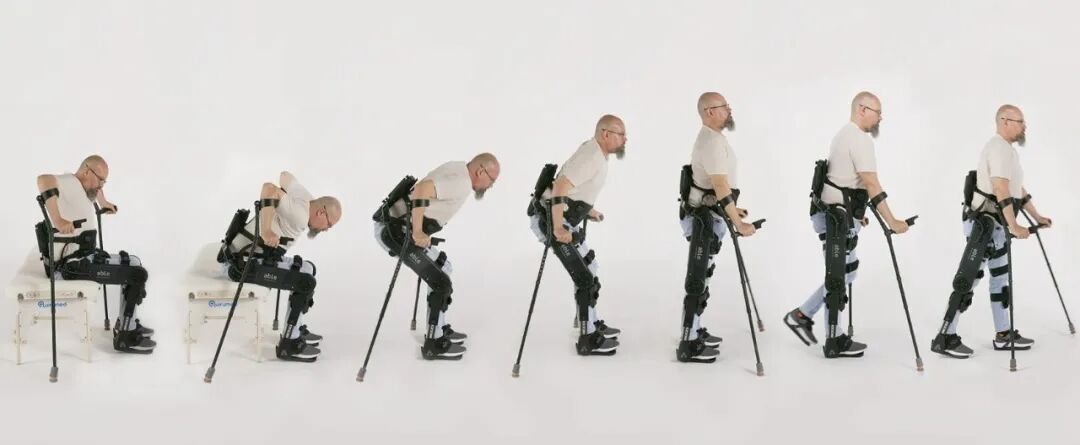
Source:Exoskeleton Report
The “14th Five-Year Plan for the Development of the Medical Equipment Industry” is a guiding document for the development of China’s medical equipment industry, systematically proposing the strategic layout and key development directions of the medical equipment industry for the first time. With the acceleration of an aging society and the growing demand for rehabilitation medicine, the “Plan” focuses on health promotion and rehabilitation equipment as key areas. Specifically, it includes: intelligent rehabilitation robots, developingexoskeleton robots and cognitive training systems for patients with motor function disorders; digital devices for traditional Chinese medicine, promoting intelligent acupuncture devices and TCM constitution identification systems, etc., to promote the integration of Chinese and Western medicine rehabilitation models; home care equipment: developing remote health monitoring mattresses, smart walkers, etc., to promote integrated medical and health services.
Exoskeleton robots achieve highly coordinated assistive movement with the human body through three core steps: perception, decision-making, and execution. The operational process typically begins with the user donning the device. The system first collects human movement intentions through various sensors, including inertial measurement units (IMU), pressure sensors, and electromyography sensors (EMG), to monitor key parameters such as limb angles, gait rhythm, or muscle activity. Subsequently, the sensor data is transmitted to the built-in control system, which uses preset algorithm models or artificial intelligence reasoning mechanisms to judge and predict the user’s movement intentions and generate control signals in real-time. Finally, these signals are transmitted to the drive units of the robot’s joints (such as servo motors, pneumatic/hydraulic actuators), achieving limb assistance, gait correction, or motion guidance through torque output. The entire process is highly real-time and requires the action output to remain synchronized with human intentions, thus achieving natural collaboration between humans and machines.
For example, in medical rehabilitation, exoskeleton robots assist patients in training according to standard gait; while in industrial assistance scenarios, they provide support and amplification for the waist or lower limbs based on the user’s lifting or bending actions.
The exoskeleton robot industry chain can be completely described in three major segments: upstream core technology and component supply, midstream complete machine manufacturing and system integration, and downstream application scenarios and services. In the upstream segment, the development of exoskeleton robots relies on several key technological foundations, including high-performance sensors (such as inertial measurement units, electromyography sensors), drive devices (such as servo motors, pneumatic muscles, hydraulic components), material science (lightweight metals, composite materials, flexible fabrics), as well as core control algorithms and software technologies like artificial intelligence. Basic electronic components such as chips, batteries, and connectors are also indispensable parts of the industry chain. The maturity of these components and technologies directly affects product performance, weight, energy consumption, and response speed.
The midstream mainly involves the design and manufacturing phase of the complete machine, where exoskeleton robot companies are responsible for integrating the software and hardware resources provided by the upstream, including mechanism design, structural optimization, system debugging, and the implementation of human-machine collaborative control algorithms. Some companies have the capability to independently design main control chips,BMS systems, and data collection and analysis platforms, forming strong vertical integration capabilities. Some companies also conduct customized development of functional modules around specific application scenarios, forming differentiated competition.
In the downstream segment, exoskeleton robots are widely used in various fields such as medical rehabilitation, industrial assistance, national defense and military, and consumer entertainment. Rehabilitation products mainly serve hospitals, health care centers, and home rehabilitation scenarios, helping patients with strokes, spinal cord injuries, and other conditions to regain motor function; industrial assistance devices are deployed in labor-intensive industries such as automotive manufacturing, heavy assembly, and logistics handling to reduce the risk of worker injuries and improve operational efficiency; the defense sector focuses on load-bearing marching and soldier fatigue control; at the same time, with the lightweight and cost reduction of consumer-grade products, scenarios such as travel in scenic areas, climbing assistance, and elderly assistance have also become new growth points. In addition, derivative services around product after-sales service, training guidance, and data analysis are gradually building a new commercial value chain.
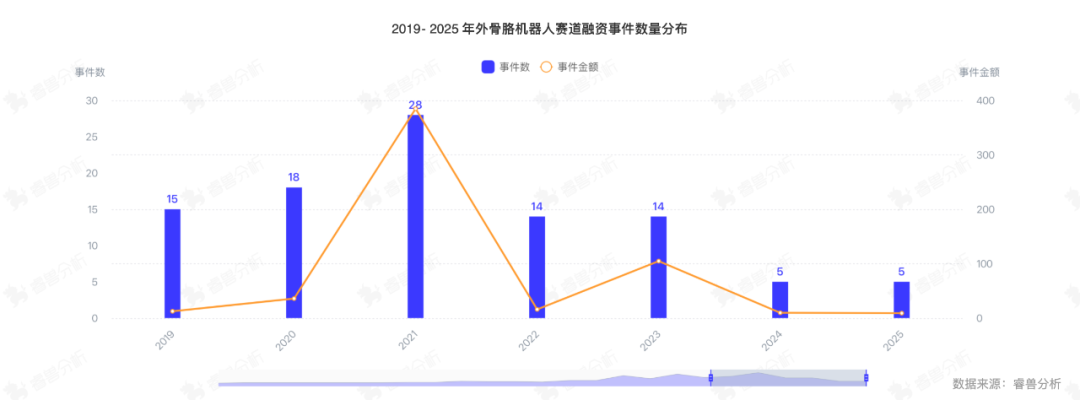
According to Ruishou Analysis, the recent financing situation of related companies shows that from 2019 to 2024, the number of financing events in the exoskeleton robot sector has shown a trend of first rising and then falling. In 2019, there were 15 financing events, which slightly increased to 18 in 2020, and then peaked in 2021 with 26 events, indicating that this sector quickly gathered a wave of heat due to policy promotion and market attention. After 2022, it entered an adjustment period.

Related Companies
Youlong Robotics
Youlong Robotics Co., Ltd. was established inApril 2020, and is a developer of intelligent rehabilitation exoskeleton robots, focusing on the research and industrialization of flexible exoskeleton robots, with dozens of invention patents and selected in the Ministry of Industry and Information Technology’s “Directory of Promoted Smart Health and Elderly Care Products and Services”.
Youlong Robotics originated from the Shenzhen Institute of Advanced Technology, Chinese Academy of Sciences, and has long focused on research and development in the field of exoskeleton robots. Its main product is the flexible exoskeleton robot, which has now evolved to the third generation, with the technology path gradually developing from rigid support to muscle-powered assistance. The company’s products have been applied in multiple provinces in China and have entered several medical institutions, while some devices, such as ankle training devices, have also been exported to markets in the United States, India, and Russia.
In terms of financing, in May 2025, Youlong Robotics officially announced the completion of strategic financing of several tens of millions, with this round of investment exclusively funded by Changsha Urban Development Group’s flagship platform—Changsha Urban Development Group’s Lianxin Fund.

Aoshark Intelligent
Aoshark Intelligent Technology Co., Ltd. was established inApril 2018, focusing on the research and application of exoskeleton robot technology, committed to building an exoskeleton robot technology platform through independently developed core technologies, providing innovative solutions for industries such as manufacturing, medical, and firefighting, helping users cope with complex and dangerous work tasks. According to public information, the company is a national high-tech enterprise and has been selected as a specialized and innovative small and medium-sized enterprise in Shanghai, as well as a benchmark enterprise in intelligent robotics in Shanghai.
Aoshark Intelligent’s products are currently applied in various industrial fields such as automotive manufacturing, ground services in aviation, mining operations, and logistics transportation, and have established sales channels in 17 countries including Germany, the United States, and Southeast Asia. In the consumer market, the company is collaborating with tourist attractions and health care institutions to explore emerging application scenarios such as outdoor assistance and home care. Additionally, its exoskeleton robot products have also appeared in the movie “The Wandering Earth 2,” with Aoshark Intelligent providing technical sponsorship as the equipment support party.
For the mass market, Aoshark Intelligent has launched several lightweight and relatively affordable exoskeleton devices, includingPES-U energy storage upper limb exoskeleton, FIT-U intelligent electric upper limb exoskeleton, and FIT-HV intelligent electric waist exoskeleton robot, further broadening the product coverage.
In addition, it has also released the Qiyuan TR01 humanoid exoskeleton composite robot, which stands about 190 cm tall, weighs 120 kg, and is equipped with 27 bionic joints, capable of carrying a load of 40 kg, with a battery life of over two hours. The TR01 integrates exoskeleton assistance and humanoid robot functions, allowing for flexible switching between AI learning-driven exoskeleton mode and autonomous humanoid mode, suitable for more complex operational scenarios.
In May 2025, Aoshark Intelligent announced the completion of two rounds of financing, led by Binfu Capital, with existing shareholder Guoyi Capital continuing to increase its investment. In August 2023, it completed its Series A financing, the amount of which has not been disclosed, with Guoyi Capital as the investor. In July 2024, it completed several tens of millions in Series A+ financing, with Dunhong Asset as the investor.

Yinghansi Power
Shenzhen Yinghansi Power Technology Co., Ltd. was established inMay 2018, focusing on motor design and deeply cultivating the robotics power field, building an innovative self-developed and 100% domestically produced technology matrix in both algorithm and power, forming a robot power algorithm and hardware solution of “AI learning model + torque adaptive algorithm + QDD power unit”.
The EX-07 developed by them is a wearable power exoskeleton robot equipped with a lightweight power device that provides continuous and stable resistance support for the user’s hip flexion and extension movements during high-intensity training, forming a real-time responsive digital training system. This device also has motion data collection and analysis capabilities, allowing for real-time recording of key parameters such as the angle, speed, strength, and power of the user’s hip joint during movement, providing objective data references for coaches to formulate training plans or for rehabilitation processes.
In June 2025, Yinghansi Power completed several tens of millions of RMB in Pre-A+ financing, led by Sequoia China, with XBOTPARK Fund and Brizan Ventures among other investment institutions participating.


Hot News
In June 2025, a “mind-controlled” lower limb walking exoskeleton, expected to be commercialized next year, was developed in Chengdu
Recently, there has been new news in the field of brain-computer interfaces. The “brain-controlled exoskeleton robot has entered the clinical trial stage. It is expected to obtain a Class III medical device registration certificate in the first half of 2026 and enter the commercialization phase,” said Fan Xinhua, executive president of Buffalo Robotics Technology (Chengdu) Co., Ltd. One of the cores of the brain-controlled exoskeleton robot is the brain-computer interface. “Currently, we are applying brain-computer interface technology in the treatment of depression, traffic driving, and other fields.”
In May 2025, German Bionic released the world’s first AI-enhanced general-purpose exoskeleton Exia
On May 27, German robotics company German Bionic made a significant announcement in New York, releasing the world’s first AI-enhanced general-purpose exoskeleton Exia. This device is driven by end-to-end AI, capable of real-time learning and adapting to every movement of the user based on billions of real work scenario data, dynamically assisting up to 38 kg. Exia is not only suitable for high-intensity industries such as manufacturing, logistics, and medical, but also brings revolutionary changes to the nursing and rehabilitation fields. German Bionic plans to open the Exia platform to global developers in the future, creating an exoskeleton AI ecosystem..
In May 2025, Zhiyuan Research Institute released the first consumer-grade AI exoskeleton “Tashan AsExo-TK1000” in China
On May 10, Zhiyuan Research Institute officially released the first consumer-grade AI exoskeleton “Tashan AsExo-TK1000”. This device is a lightweight wearable assistive product that integrates artificial intelligence gait prediction and torque adaptive adjustment technology. It can capture user movement data in real-time and automatically optimize the experience through deep learning algorithms, achieving an accuracy rate of up to 99.2%. This product has a “growing” algorithm that can continuously self-learn based on user habits and enhance adaptability during use. Zhiyuan Research Institute plans to promote the widespread application of this product in rehabilitation, climbing, and daily walking assistance scenarios, accelerating the commercialization process of exoskeleton robots.
In April 2025, a company in Hangzhou launched an exoskeleton robot “Miao Kong”, with rich application scenarios
According to media reports, recently, Hangzhou Cheng Tian Technology Development Co., Ltd. listed a consumer-grade exoskeleton robot for sale on a shopping platform at a price of2500 yuan, targeting individual users. Within just 15 seconds of the new listing, hundreds of units were sold out. The company claims that there are still hundreds of people waiting to reserve the next batch, indicating that the market’s popularity far exceeds expectations. It is reported that this exoskeleton walker can help wearers save about ten percent of their physical strength when walking ten thousand steps, with assistance capable of reaching several tens of torque, equivalent to offsetting the weight of two large bottles of cola.
In February 2025, the Taishan Scenic Area introduced an AI exoskeleton robot to assist elderly tourists in climbing
On February 10, the Taishan Scenic Area in Shandong introduced an AI exoskeleton robot developed jointly by Taishan Cultural Tourism Group and Shenzhen Kenqing Technology to provide climbing assistance for the elderly and those with mobility difficulties. This device weighs 1.8 kg, is worn on the waist and thighs, and uses AI technology to provide synchronized assistance, reducing joint pressure. During the Spring Festival, ten exoskeleton robots were rented out, with about half of the users being elderly. The Taishan Cultural Tourism Group stated that it will continue to promote intelligent elderly assistance devices. Kenqing Technology plans to launch a lighter new model this year to further expand the intelligent elderly care and rehabilitation assistance market, helping to meet the needs of China’s aging society.
More Track Information
Log in to Ruishou Analysis to view👇
 Follow Ruishou Analysis Video Account
Embrace the New Era of AI👇
Unlock Ruishou Analysis Personal Annual Membership
Capture the Latest Industry Dynamics