
Editor: AI for Humanities Editorial Department
Section 1: The Starting Point of AI Agents
Today we discuss the concept of “AI Agent”, which refers to an intelligent entity capable of autonomous perception, understanding, planning, and executing tasks. However, you may not know that the prototype of this concept actually emerged a long time ago, and it initially carried a kind of “humanoid” characteristic.
Early researchers proposed that an Agent is not a passive program waiting for commands, but a digital character with basic proactivity and judgment. It should:
Make decisions on its own (autonomy)
Collaborate and communicate with other systems (social ability)
Quickly respond to environmental changes (reactivity)
And have a certain awareness of action planning (proactivity)
It can be said that this set of “personality traits” defines the core spirit of an Agent—not a passive tool, but a purposeful “doer”.
However, it should be noted that early Agents, although conceptually rich, were quite “thin” in reality.
Limited by the hardware performance of that era and the need for manually pre-written logical rules, these Agents actually performed more like:
“What you feed it in advance is what it can do”;
When faced with unexpected situations, it would either “crash” or “react randomly”;
Lacking learning capabilities, it could not truly adapt to the complexities of reality.
In other words—the Agents of that time had conscious “ambitions” but lacked intelligent “organs”.
Only today have we finally seen a generation of AI Agents equipped with language understanding, strategic planning, knowledge learning, and tool invocation capabilities truly emerge and begin to move towards practicality and popularization.
1.1 What is an Agent? A Concept Originating from 1959 in Artificial Intelligence
AI Agents may sound like some futuristic high-tech product, but their concept can actually be traced back to 1959.
That year, one of the founders of the field of artificial intelligence, John McCarthy, proposed a hypothetical system called “Advice Taker”.
He envisioned not a rigid command-executing program, but an intelligent agent capable of understanding advice, reasoning, and taking action. It should be able to listen, understand context, possess common sense, and act on its own.
You can think of it as an agent that knows what it wants to do, rather than a helper waiting for commands.
This is the starting point of the Agent concept.
In 1995, the authors of “Artificial Intelligence: A Modern Approach”, Stuart Russell and Peter Norvig, provided a more systematic definition:
“Anything that can perceive its environment through sensors and act upon that environment through actuators.”
In a sense, this greatly broadens the scope: as long as you can receive environmental information + actively respond, whether it is a mobile robot equipped with sensors and actuators or an intelligent program running on a computer or network, can be considered an Agent.
In the same year, AI scholars Wooldridge and Jennings proposed the famous distinction between “strong Agents / weak Agents”.
In reality, most Agent systems adopt what is called the “weak definition”: theythink like humans but do not have subjective consciousness, as long as they meet four basic conditions:
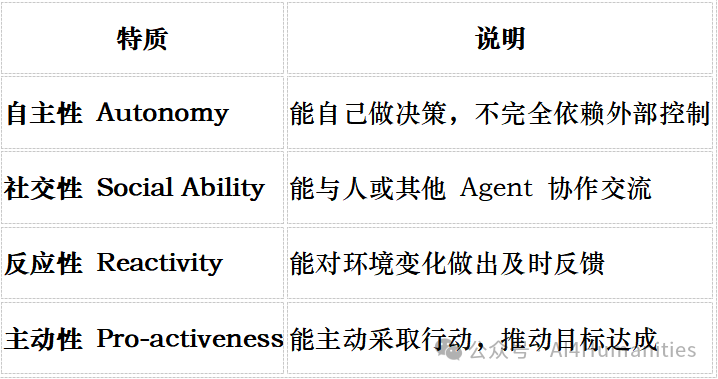
Under this definition, an Agent is like a “perceptive, acting, and continuously operating” small digital character. It is not a passive function waiting to be called, nor is it rigidly stored data, but an intelligent executor that is always online and capable of feedback to the environment.
This “weak definition” has been widely adopted in academia due to its universality and practicality, gradually becoming the foundation for all subsequent AI Agent technologies and frameworks.
1.2 Three Approaches to Traditional Agent Architecture: Rational Thinking, Instinctive Reaction, and a Combination of Both
In the early development of AI Agents, between the 1970s and 1990s, scholars explored three philosophically significant technical paths regarding “how an intelligent agent should think and act”:
The first is called Deliberative Architecture
The starting point of this architecture is: intelligence should be a systematic thinking process, similar to human logical reasoning and rational decision-making. In its design, the Agent has an internal world model, with a symbolic representation of the external environment. It will deduce, plan, evaluate, and then take action based on the facts it currently “believes”.
The second is Reactive Architecture
Rather than “planning before acting”, it is more about “reacting immediately to stimuli”. Its inspiration comes from biological systems, such as the escape reflex of insects—without modeling or deep reasoning, but making quick decisions through direct perception-reaction channels. It does not build a world model or think about “what do I want”, but it can exhibit strong robustness in complex, unknown environments.
The third is Hybrid Architecture
This is a compromise solution that attempts to combine the advantages of the first two: retaining the fast instincts of the reactive approach to respond to emergencies; while also possessing the logical planning ability of the deliberative approach to handle complex tasks.
1.2.1 Deliberative Architecture: BDI Architecture (Belief-Desire-Intention Architecture)
In the eyes of early AI researchers, if an Agent is to make complex decisions like a human, it must first understand the world it is in, then plan, and finally execute.
This idea developed into the Deliberative Architecture, also known as Symbolic Architecture. Its core idea is:
To make an intelligent agent smart, it must be taught to “understand the world using symbols”.
This sounds abstract, but it essentially means representing complex states in the real world (such as whether the weather is good, how many cars there are, whether a person is hungry)—using a set of “labels” that programs can recognize, and then setting rules and reasoning relationships between these labels to enable the system to make decisions.
This idea is backed by a far-reaching hypothesis called the Physical Symbol System Hypothesis, proposed by AI pioneers Newell and Simon in the 1970s.
It means:
“If a system can manipulate symbols, it has the potential to achieve general intelligence.”
In other words, as long as we can make machines operate information like we process text and language, they may learn to think like humans.
BDI Architecture: From “Knowing” to “Wanting to Do” to “Doing” Like Humans
Under this framework, one of the most representative designs emerged: BDI Architecture, which stands for Belief-Desire-Intention, meaning:
Belief: What do I know?
Desire: What do I want?
Intention: What do I decide to do now?
You can think of it as a psychological decision funnel:
Beliefs are the Agent’s understanding of the current world, such as “it is daytime now”, “the door is open”, “there is a target object next to me”;
Desires are the things it might want to accomplish based on these cognitions, such as “I want to enter the room”, “I want to avoid obstacles”;
Intentions are the selection of one desire to actually pursue at that moment, such as “I decide to push the door now”.
Once an intention is formed, it will initiate the corresponding execution plan to realize this decision.
The key to BDI is: it does not execute immediately, but rather filters layer by layer and commits gradually:
Extracting useful information from the world to form beliefs;
Generating multiple possible desires from beliefs;
Then selecting an executable intention from desires;
And then initiating the corresponding actions or plans.
This is like a student:
Belief: It is now 9 PM, and I have an exam tomorrow;
Desire: I want to review, but I also want to play on my phone;
Intention: I decide to review for an hour now.
It simulates not “reaction”, but “choice”.
BDI architecture is particularly suitable for applications that require stable goal maintenance, complex task structures, and rational planning. It can support trade-offs between multiple goals, task progress tracking, and intention-driven coordinated actions.
1.2.2 Reactive Architecture:Subsumption Architecture
In the world of agents, there is an extreme ideology that believes:
“The smarter the system, the more it should not waste time thinking.”
It sounds counterintuitive, but the philosophy behind it is:
Rather than understanding the world first and then making decisions, it is better to act directly, evolving suitable behaviors through continuous interaction with the environment, which is the core of Reactive Architecture.
Its representative figure is robotic scientist Rodney Brooks, who proposed the famous Subsumption Architecture in 1986, a control architecture designed specifically for mobile robots, emphasizing the need for no world model and hierarchical parallel control.
Brooks criticized the traditional AI (such as BDI architecture) decision-making process of “first building a world model → then reasoning and planning → then executing” as being too slow and unstable in real environments.
He pointed out: the real world changes rapidly, and by the time you finish modeling, reality may have already changed. Instead, let the Agent act like an insect, relying on a set of behavioral response modules, directly driven by perception, without relying on a centralized world model.
In the Subsumption Architecture, the intelligence of the Agent does not come from a unified brain, but from a set of layered, instinctive behavior modules, each responsible for an independent action goal, such as:
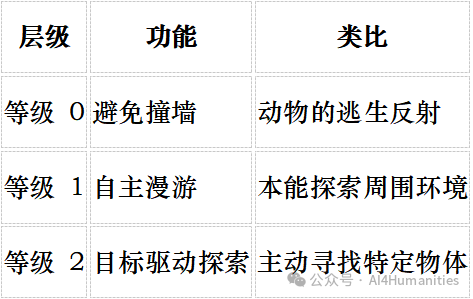
Each layer is an independent, small behavioral system that perceives and makes decisions on its own, without relying on global scheduling. These layers do not depend linearly on each other, but rather combine and run in parallel.
The term “subsumption” refers to: in Brooks’ design, high-level behaviors do not completely replace low-level behaviors, but rather take over or override their outputs when necessary.
For example:
A robot is executing a complex task of “finding an exit” (high-level behavior). If its sensors detect an obstacle suddenly appearing ahead, the low-level “obstacle avoidance” mechanism will immediately take effect, causing it to turn or stop.
This means:
High-level decisions can only control actions when conditions allow;
Low-level reactions remain active, so even if the upper level does not respond in time, the robot can still exhibit basic reasonable behavior.
Since these behavioral modules run in parallel, the system needs a way to decide “who controls the action”. Brooks proposed the so-called inhibitory control mechanism:
When the high-level has a clear output, it will override the low-level behavior output;
If the high-level temporarily fails or cannot respond in time, control will automatically revert to the low-level, allowing the robot to continue acting.
The greatest advantage of the Subsumption Architecture is its extreme robustness (even if the environment changes suddenly or some modules fail, the system can still maintain basic functionality) and quick response.
It does not rely on complex reasoning chains, so when facing rapidly changing environments, it will not miss the opportunity to react due to long modeling and reasoning times;
Low-level behaviors, after repeated debugging, can ensure that even if the high-level crashes, the system will not completely collapse;
It is suitable for highly dynamic scenarios that require rapid response, such as robots, drones, and battlefield automation devices.
1.2.3 Hybrid Architecture: Touring Machine—A Dual Engine of Rationality and Instinct
Deliberative architecture is visionary and capable of long-term planning, but it reacts too slowly and is easily interrupted by sudden situations; Reactive architecture responds quickly and robustly, but is short-sighted and may lead to suboptimal or even harmful results.
Researchers gradually realized: a truly intelligent system cannot rely solely on “deep thinking” or “immediate reaction”.
Thus, the Hybrid Architecture was born, attempting to merge the advantages of both:
Inheriting fast response and robustness from the reactive architecture;
Introducing goal orientation and forward-looking planning from the deliberative architecture.
Touring Machine Architecture: A Three-Layer Parallel Brain
In 1992, Innes Ferguson proposed a typical hybrid architecture model: Touring Machine.
Touring Machine Architecture (Ferguson, 1992)
Core Idea:
Divide the control system of the agent into three layers, each of which can independently perceive the environment and propose action suggestions, and then a arbitration mechanism decides which one to execute.
Three-Layer Structure
Reactive Layer
Instinctive Quick Reaction
Directly triggered by perception
Example: Detecting an obstacle → Turn
Modeling Layer
Maintains an internal representation of the environment, makes predictions and explanations
Proposes action suggestions based on the model
Example: Predicting slippery ground → Suggest slowing down
Planning Layer
Conducts goal-oriented reasoning and task planning
Proposes long-term action plans
Example: To complete the task → Suggest going straight through the corridor
Arbitration Mechanism
All three layers may simultaneously propose different action suggestions.
Control Policy module is responsible for arbitration, using two types of rules:
1. Censor Rules: Filter out obviously unsafe or inappropriate suggestions;
2. Suppressor Rules: Allow more critical behaviors to override others in emergencies.
Ultimately ensuring that at any moment only one clear action is executed.
Example: A robot in a hospital corridor
Planning Layer: Suggests “go straight 20 meters to the endpoint”;
Reactive Layer: Detects a cart ahead, suggests “turn right to avoid”;
Modeling Layer: Detects slippery ground, suggests “slow down”;
Arbitration Mechanism:
Suppressor rules trigger → Execute “turn right to avoid” first;
Once the obstacle disappears, the censor rules determine → Block “go straight”, adopt “slow down” or require re-planning.
Advantages:
The reactive layer ensures timeliness;
The modeling layer ensures environment understanding and prediction;
The planning layer ensures goal orientation;
The arbitration mechanism allows the agent to flexibly switch between the three, being able to act decisively while also being contemplative.
1.2.4 Comparison and Reflection on Traditional Agent Architectures
In the early research of agents, different architectures not only reflected divergences in technical choices, but also concealed different understandings of the fundamental question of “what intelligence really is”.
BDI architecture: It believes that the essence of intelligence lies in reasoning and planning on a symbolic world model. The agent acts like a logician, relying on abstract representations to determine actions.
Subsumption architecture: It believes that intelligence comes from direct interaction with the environment. The agent acts like an insect, adapting to external changes in real-time without the need for modeling and reasoning.
These two seemingly opposing ideas have long been debated academically: is intelligence “calculated logic in the mind” or “behavior explored in the world”?
However, the emergence of the Touring Machine architecture provides a compromise technical solution. It retains the foresight of planning and modeling while also incorporating the robustness and real-time nature of reactive architecture.
Researchers have gradually recognized that: a truly complete agent needs both the foresight of deliberative layers, capable of setting goals and formulating strategies; and the realistic foundation of reactive layers, ensuring quick decision-making in complex environments.
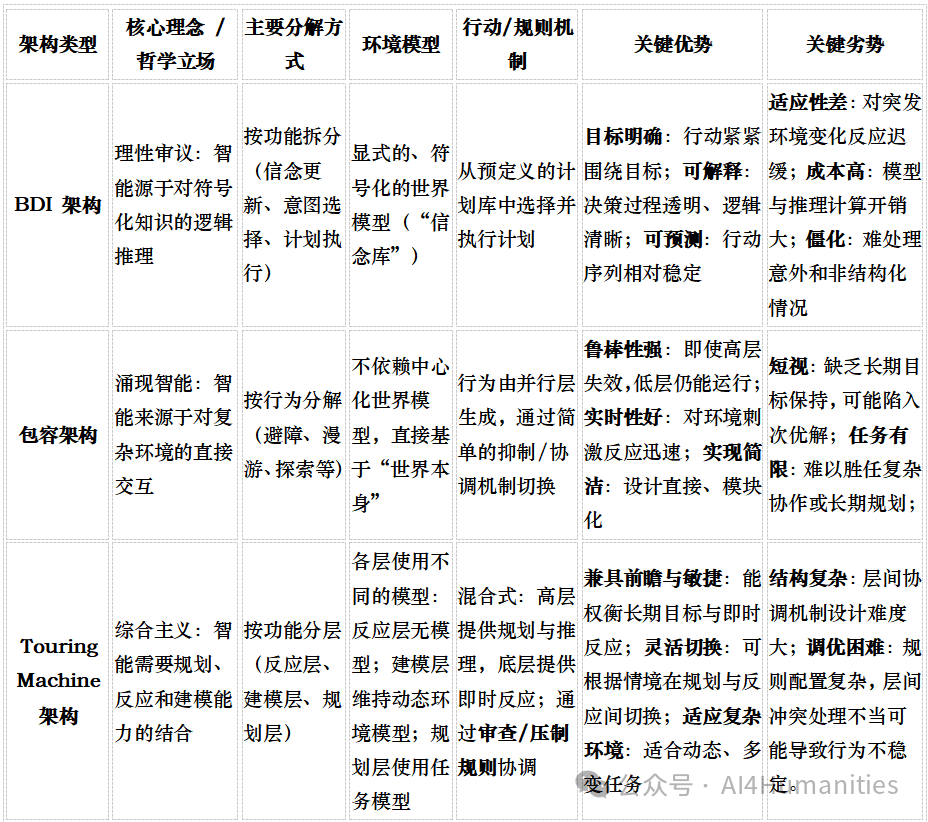
1.3 Limitations of Traditional Agent Architectures
Early Agent architectures were constrained by two systemic dilemmas: on one hand, there were hardware bottlenecks, and on the other hand, there was the rigidity of pre-programmed methods. This made traditional Agents struggle in complex, dynamic environments.
1) Hardware Bottlenecks
In the 1980s and 1990s, the mainstream computing platform was the CPU, characterized by serial processing—processing only one instruction at a time.
This made it relatively easy to implement the BDI architecture based on reasoning loops (gradually updating beliefs, filtering intentions, executing plans), but designs requiring high parallelism were limited.
Meanwhile, a well-known problem emerged in the field of computer architecture:the “Memory Wall”.
Processor performance was improving exponentially at that time;
but the bandwidth and latency improvements of memory lagged far behind.
As a result: while the CPU was fast, it was often slowed down waiting for data. For Agents, this meant that the reasoning and decision-making processes were too time-consuming, making it impossible to respond in real-time to rapidly changing environments.
2) The Dilemma of Knowledge Updating
Another major limitation is that traditional Agents heavily rely on pre-programming by developers.
Behavioral logic and plans are mostly written into the system by experts in advance;
The system assumes that “common situations” can be pre-covered;
Agents only execute these hard-coded rules.
The problem with this approach is:
Lack of learning ability: the system cannot improve from experience;
Lack of adaptability: when faced with unforeseen situations, it will directly “malfunction”;
Lack of flexibility: behavior is rigid, making it difficult to handle complex and dynamic real-world environments.
In simple terms, traditional Agents are more like “script actors” that can only recite lines, rather than intelligent entities that can adapt, learn proactively.
Summary
Looking back at the development of traditional Agents, we can see a clear thread: from the symbolic reasoning of the BDI architecture to the instinctive reactions of the Subsumption architecture, and then to the compromise integration of the Touring Machine—each architectural innovation corresponds to researchers’ different understandings of “the essence of intelligence”.
BDI architecture emphasizes reason and logic, enabling Agents to engage in goal-oriented planning;
Subsumption architecture highlights environmental interaction and immediate reaction, ensuring the system’s response in rapidly changing environments;
The Touring Machine attempts to combine both, constructing a hybrid intelligent agent that can both think deeply and act decisively.
However, constrained by hardware performance (CPU serial processing and the “Memory Wall” issue) and the rigidity of static pre-programming, traditional Agents still fall short in practical applications. They often struggle to handle rapidly changing environments and lack learning and self-updating capabilities.
In other words, traditional architectures provide a theoretical prototype for “what an agent is”, but also clearly reveal that relying solely on symbolic logic or simple reactions is insufficient to meet the demands of a complex world.
These limitations ultimately drove researchers towards new exploratory directions: learning-driven agents and AI Agents with generative and adaptive capabilities. It is in these subsequent developments that today’s “AI Agent wave” gradually took shape.
END

Humanities
Humanities
Exploring the intersection of artificial intelligence and the humanities