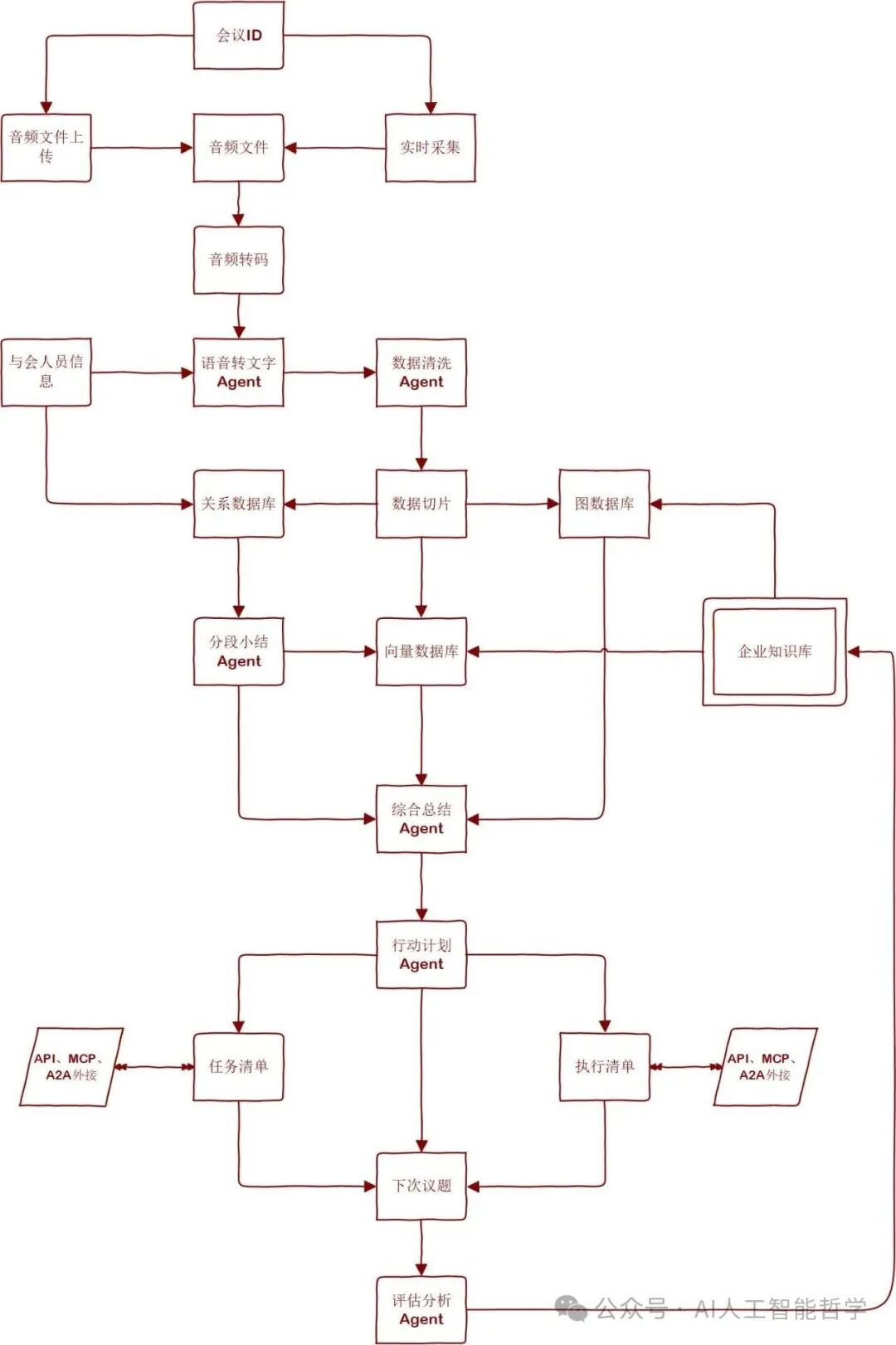
“ Analyzing the intelligent meeting minutes system from the perspective of business architecture, the business architecture is the cornerstone of the system. A good business architecture can clarify the core objectives and boundaries of the system, streamline clear business processes and module divisions, ensuring that technical implementations always revolve around actual needs;”
The architecture is compatible with the characteristics and expansion needs of AI technology, reserving standardized interfaces; it can reduce system coupling, allowing various business modules (such as voice interaction module, data storage/retrieval module, execution module, result feedback module) to iterate independently and collaborate efficiently, avoiding global risks caused by local adjustments; it can enhance resource utilization efficiency by optimizing computing power allocation and data flow paths through reasonable architectural design, adapting to practical scenarios of “lightweight deployment and cost-effective implementation”; it can lower team collaboration and knowledge transfer costs, with a clear architectural layering (such as business layer, technical layer, data layer) facilitating understanding of the overall system logic, while reserving space for future “architectural iteration and cross-system integration”; it can enhance the stability and scalability of the system, supporting the functionality of current practical projects while smoothly integrating more complex AI capabilities in the future.
01
—
Business Architecture Diagram
02
—
Business Architecture Description
-
Real-time and non-real-time share the same path, with real-time data collected by uploading a segment of audio every two minutes.
-
Audio transcoding: The model is trained with a 16K sampling rate, while users may record at 44K sampling rate, so the first step is to perform uniform transcoding;
-
Speech-to-text conversion needs to distinguish speakers, recording each speaker’s identity, start time, and content;
-
Participant information: Establish speaker information, including position, responsibilities, etc.; update the speaker in the speech-to-text conversion to facilitate AI understanding of the spoken content;
-
Data cleaning: Remove unnecessary filler words and small talk to avoid affecting subsequent AI analysis;
-
Data slicing: To prevent one person from speaking at length, if a speaker’s content exceeds the token limit, split the lengthy speech into multiple segments, keeping within a reasonable word count;
-
After slicing, store the information in both relational and vector databases, while also constructing a graph data storage database;
-
Segment summaries: To prevent exceeding the token limit, divide the meeting content into multiple segment summaries, storing them in relational and vector databases; multiple summaries can be created as needed;
-
Comprehensive summary: Integrate segment summaries with the corporate knowledge base for a comprehensive summary;
-
Action plan: Based on the meeting content, formulate an action plan, including a task list and execution list;
-
Task list: Based on meeting resolutions, create a task list, which can be integrated with the company’s work order system to form quantifiable, trackable tasks, and collect execution results for future meeting topics and evaluation analysis;
-
Execution list: Utilize system tools to execute immediate message queues and follow up on execution results; for example: generate/publish notifications, create regulations, calendar reminders, etc.;
-
Next meeting topics: Automatically generate topics for the next meeting based on the meeting content and task execution status;
-
Evaluation analysis: Analyze meeting quality and post-meeting task execution status, with higher-dimensional analysis possible regarding the meeting’s role in the project;
03
—
Summary
Fully leverage the capabilities of the knowledge base and tools to achieve more precise analysis and deeper integration into existing systems; differentiate from cloud AI competition;