Cutting-edge Technology

National Level
Specialized and Innovative
“Little Giant”
In 2025, AI Agent technology will encounter significant development opportunities, becoming the focus of enterprise-level applications.AI Agent technology will bring unprecedented productivity improvements and business innovation opportunities to enterprises. With continuous technological advancements and deepening application scenarios, AI Agents are expected to achieve breakthroughs in more fields, promoting the intelligent development of enterprises and society.
01
The Year of AI Agents:
Gradual Formation of Technical Architecture and Product Forms
AI Agent (intelligent agent) is an application system that implements control flow decision-making based on large models, with the core idea of allowing large models to autonomously call various tools to perform more complex tasks.According to a report by Rongzhong Consulting, a single LLM (Large Language Model) cannot effectively execute some long-chain tasks and often requires the invocation of various tools in many scenarios. Therefore, there is a clear progressive relationship between AI Agents and LLMs.The main features of AI Agents include autonomy, planning and memory, and closed-loop execution capabilities.Autonomy means that AI Agents can independently achieve goals without continuous human intervention. Planning and memory refer to the ability of AI Agents to decompose complex tasks into multiple sub-tasks and store and retrieve information through effective memory mechanisms. Closed-loop execution capability means that AI Agents can continuously monitor execution effects and self-optimize through learning feedback.
In 2025, with the continuous emergence of various C-end and B-end Agent products both domestically and internationally, AI Agents are gradually forming in terms of technical architecture and product forms. Although current Agent products may still have some capability shortcomings, they have already established the basic framework for future universal Agent products, marking 2025 as the so-called “Year of AI Agents.”
According to a report by Guotai Junan Securities, the upstream of the AI Agent industry chain is controlled by technology giants, who provide the foundational large models and computing power that determine the upper limits of Agent capabilities, dominate interaction protocols, and seize ecological discourse power. The midstream has seen a surge of open-source and commercial development frameworks/platforms that significantly lower the development threshold for Agents through low-code or no-code interfaces. The downstream applications present two main directions: one is general-purpose Agents that autonomously complete complex tasks, and the other is vertical Agents deeply integrated with industry knowledge, which have already shown significant commercial value in legal, financial, medical, and other scenarios.
Globally, according to IDC’s forecast, the global market size for AI Agents will be approximately $5.29 billion in 2024. According to Rongzhong Consulting data, in 2024, China’s AI Agent market size is expected to reach approximately 69.5 billion yuan, and in 2025, it is expected to exceed 173.5 billion yuan, further expanding to 544.2 billion yuan by 2027, with an average annual compound growth rate of about 77% from 2023 to 2027.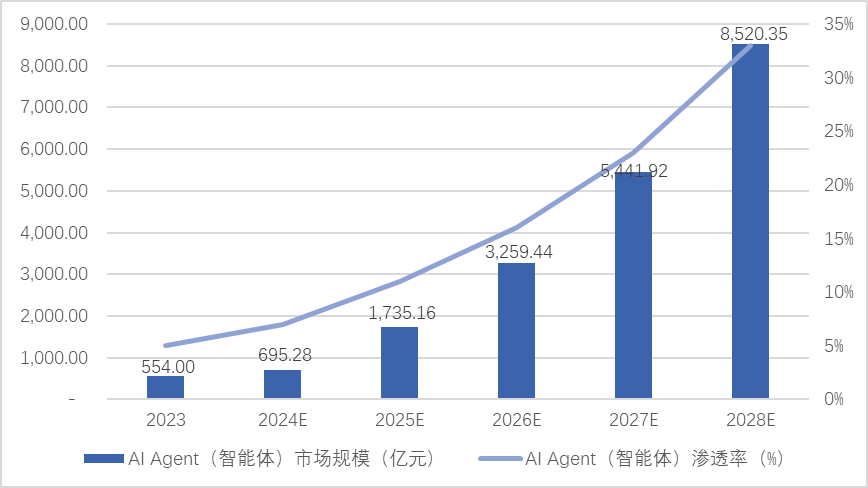 Statistics and forecasts of China’s AI Agent market size,Source: Rongzhong Consulting
02
AI Agents Support Intelligent Development in Enterprises
In 2025, AI Agent technology will encounter significant development opportunities, becoming the focus of enterprise-level applications.
According to Jiazi Guangnian, the demand for AI Agents from enterprises has shifted from the proof-of-concept stage to actual implementation applications, expecting them to handle complex business processes, such as automatically generating reports and solving complex customer service issues, thereby bringing exponential efficiency improvements.
AI Agent technology will bring unprecedented productivity improvements and business innovation opportunities to enterprises. With continuous technological advancements and deepening application scenarios, AI Agents are expected to achieve breakthroughs in more fields, promoting the intelligent development of enterprises and society.
For enterprises, the application of AI Agents requires caution. When developing a new Agent, enterprises must first conduct scenario investigations to determine whether it is suitable to implement an Agent. Regarding how enterprises can build AI Agents, the Dune Think Tank provides the following suggestions:
1. Gradual Experimentation and Model Validation
Use open-source tools and frameworks to explore AI Agent architecture design patterns and understand their purposes. Start with functional patterns that implement Agent capabilities and behaviors (including architectural patterns, workflow patterns, large model interaction patterns, action patterns, and memory patterns), and then expand to operational patterns (evaluation patterns, security and identity management patterns).
2. Behavior Validation and Production Credibility
The main obstacle to deploying AI Agents is the unverifiable behavior. When there is a verified production scenario, build Agent evaluation capabilities and collect real-world data, which will serve as components of the large model-based AI Agent, ensuring the establishment of production-level trust.
3. Modular Architecture Design Principles
Breaking down the Agent into modular components helps with unit testing and monitoring of behaviors, simplifying troubleshooting, optimization, and change management. Achieve modularity through Agent architecture patterns and Agent action patterns. Modular evaluation and testing of Agent components are essential for maintaining overall Agent performance and trust.
4. Reuse Existing Technological Assets
The core components of AI Agents (such as structured prompts, API interactions, data storage, etc.) can be implemented using existing development tools as well as automation, orchestration, or integration platforms. Fully utilize the existing technology stack of enterprises to reduce costs, avoid reinventing the wheel, and accelerate the implementation process.
03
Enterprise Agent Construction Moves Towards Implementation
Driven by large model technology, AI Agents are accelerating from concept to implementation, becoming a key force for enterprises to break through efficiency bottlenecks and reconstruct business models. From basic information queries to complex process automation, the capability boundaries of Agents continue to expand.
Agent development follows the logic of “capability progression,” gradually moving from “basic assistance” to “comprehensive intelligence,” which can be divided into four stages: L1 popular application period (basic assistant), L2 product development period (professional assistant), L3 technological breakthrough period (autonomous operation), and L4 form outlook period (comprehensive intelligence). In the next three years, Agent applications will show a trend of advancing from basic assistants to professional assistants. This transition is mainly reflected in professionalism, precision, and human-machine collaboration.
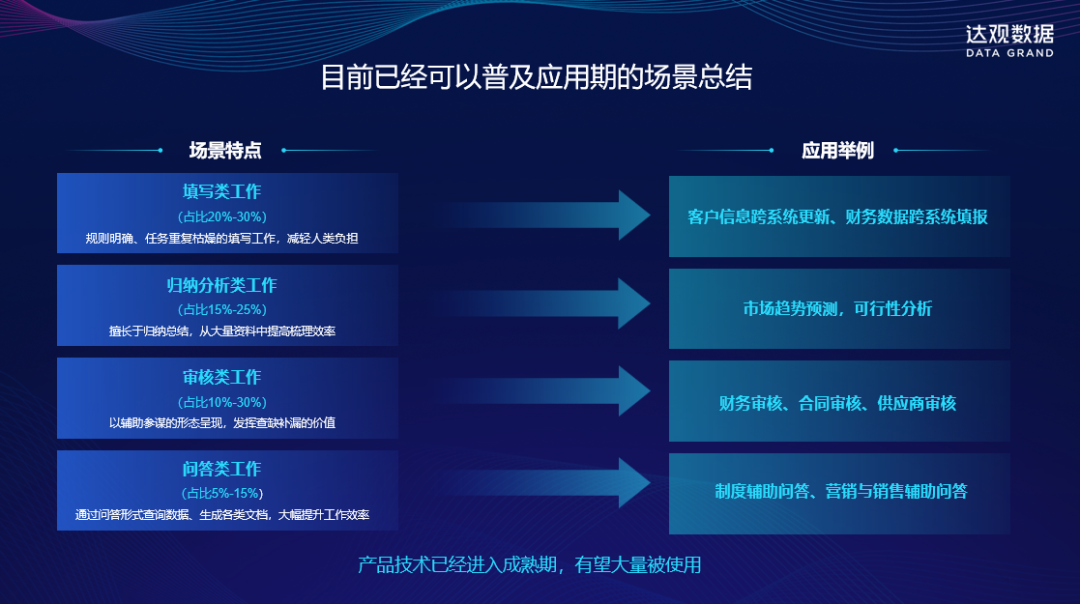
Currently, Agents have entered the popular application period, with high maturity and clear ROI in four types of scenarios: form-filling tasks, summarization and analysis tasks, review tasks, and Q&A tasks.
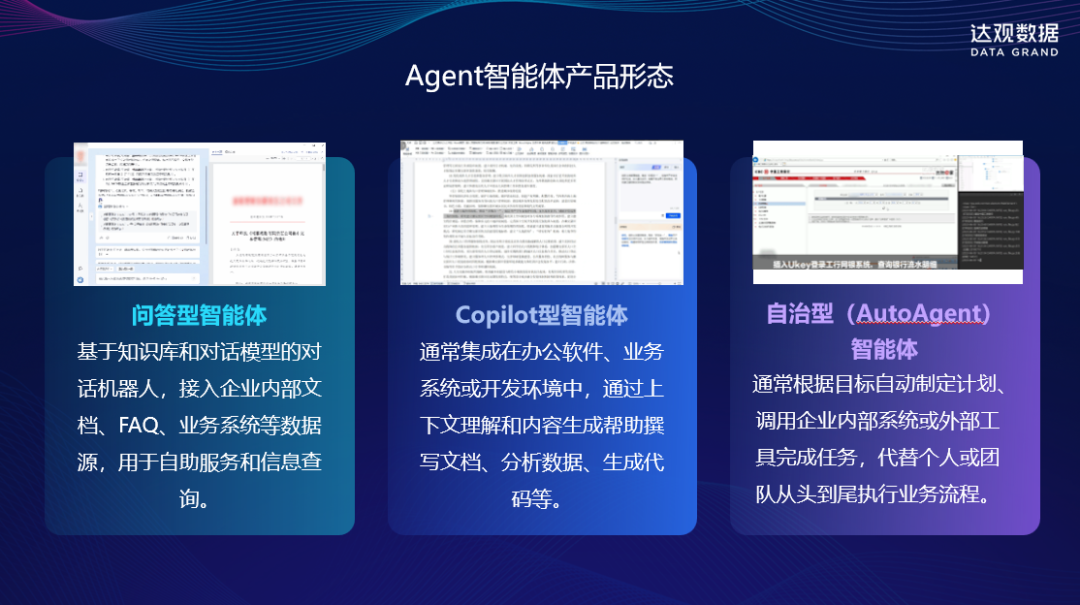
In the current enterprise application scenarios, intelligent Agents can be mainly divided into Q&A Agents, Copilot Agents, and Autonomous (AutoAgent) Agents, which differ in definition, characteristics, applicable scenarios, and interaction methods, meeting the diverse needs of enterprises in different business contexts.
The Daguan Data AI Agent platform provides a one-stop solution for enterprise Agent construction.
1. Powerful Natural Language Processing Technology
The Daguan AI Agent platform is based on advanced natural language processing algorithms, capable of accurately understanding user intentions and needs, achieving efficient dialogue interaction and text processing. Whether answering customer inquiries or assisting in document writing and data analysis, it can provide accurate and professional results, helping enterprises improve work efficiency and quality.
2. Rich Industry Experience and Expertise
Daguan Data has rich project experience and accumulated expertise in multiple industry fields, enabling a deep understanding of the business characteristics and needs of different enterprises. The Daguan AI Agent platform has been optimized and customized for various industry characteristics, providing solutions suitable for different industry application scenarios, such as finance, government, manufacturing, energy, etc., ensuring that Agent applications can quickly adapt to the business environment of enterprises and maximize value.
3. Efficient Agent Training and Optimization Capabilities
The platform provides a complete set of Agent training and optimization tools, allowing enterprises to quickly train and customize Agents based on their business data and needs, improving performance in specific business scenarios. Additionally, the platform supports continuous learning and online optimization functions, automatically adjusting Agent strategies and models based on business changes and user feedback, maintaining high efficiency and adaptability in business processes.
4. Good System Integration and Compatibility
The Daguan AI Agent platform can seamlessly integrate with various existing business systems, office software, and data sources of enterprises, enabling data sharing and interaction. For example, it can connect with the enterprise’s CRM system, ERP system, OA system, etc., embedding Agent applications into the daily business processes of enterprises, providing comprehensive intelligent support and improving overall operational efficiency.
5. Professional Service Team and Technical Support
Daguan Data has a professional service team that can provide comprehensive service support for enterprises from demand analysis, solution design, implementation deployment to after-sales maintenance. During project implementation, the service team will work closely with enterprises to ensure that Agent applications can be successfully launched and operate stably. Additionally, for any issues and technical difficulties encountered by enterprises during use, Daguan Data’s technical support team can respond promptly and provide solutions, ensuring that business operations are not affected.
References
https://mp.weixin.qq.com/s/C2BSvmeSNybtFTOsWoRbkA
https://mp.weixin.qq.com/s/8TsyFKLZvc5TGwJeqqrTQQ
https://mp.weixin.qq.com/s/2MHPbxYTJaE7Zp8JT1VDXw
https://mp.weixin.qq.com/s/hnO-5tlW0Y32on96GITrmQ
END
Related Reading
Variable Robot Wang Qian: Embodied models are not an extension of language models; Robot ChatGPT still needs 3-5 years | Star Technology • Robotics/Intelligent Machines
AI Chips Unlock New Scenarios for AI Accessibility | Star Technology • Chips and Semiconductors
Technology Empowers Intelligent Upgrades in Government Affairs | Star Technology • Specialized and Innovative “Little Giants”
The “Simplification” Technique of Robots | Star Technology • Robotics/Intelligent Machines
Breaking Through 3D Sensing Chip Technology, How Can “Chinese Chips” Break Out? | Star Technology • Specialized and Innovative “Little Giants”
Quantum Technology Harvests Industrial Fruits from Technological “Seeds” | Star Technology • Chips and Semiconductors