Click the blue textFollow us
As we enter 2025, tech leaders like Jensen Huang from NVIDIA, Sam Altman from OpenAI, and Andrew Ng, a prominent figure in machine learning, frequently mention a hot term: AI Agent. Companies such as Microsoft, Google, Tencent, ByteDance, and Alibaba have repeatedly stated that AI Agents are the most noteworthy artificial intelligence technology to watch in 2025.2025 marks the beginning of the AI Agent era. So the question arises: many AI enthusiasts and followers may ask: What is an AI Agent? What are the key technologies behind AI Agents? How do we develop and implement AI Agents? How can we apply AI Agents?
– Article Information –This article is originally published by Wu Jie from e-works.01What is an AI Agent?
With the rapid evolution of artificial intelligence technology, AI Agents (artificial intelligence agents, commonly referred to as agents) are quietly infiltrating various aspects of enterprise operations and daily life, from familiar virtual assistants (such as Siri, Xiao Ai, Doubao), to enterprise IT infrastructure operations, digital management collaboration, and intelligent R&D processes, AI Agents are widely permeating.
Unlike large models that interact with users through prompts, AI Agents possess environmental awareness, autonomous planning, decision-making, and execution of actions to achieve goals, making them intelligent systems. The powerful capabilities of AI Agents stem from their sophisticated architectural design. Typically, AI Agents are driven by large language models (LLMs) at their core, combined with four key modules: memory storage, task planning, tool usage, and task execution, forming the golden combination of AI Agent = LLM (large language model) + Memory + Planning + Tools + Action.
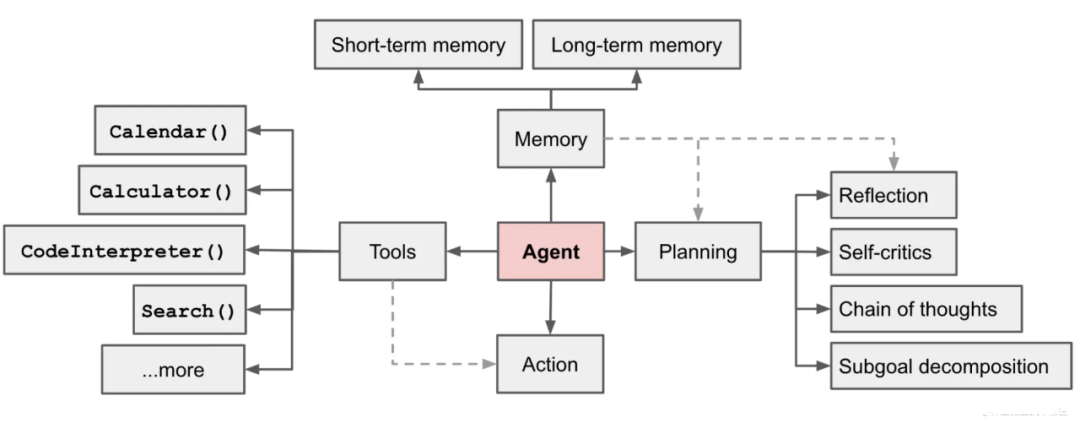
Figure 1 Core components of AI Agents (Source: Open AI)
Among them, large language models (LLMs) are the “intelligent brain” of AI Agents, responsible for understanding user intentions, processing information, and generating reasoning logic, supporting the agent’s ability to “think and understand”;
Memory is the “information warehouse” of AI Agents, encompassing short-term memory (such as dialogue context windows) and long-term memory (such as external knowledge bases and historical data storage), helping AI Agents continuously accumulate experience in specific domains and optimize service experiences;
Planning acts as the “command center” of AI Agents, capable of breaking down large tasks into sub-tasks and planning the execution process, while also being able to reflect on the task execution process to decide whether to continue executing the task or determine if the task is complete and terminate the operation;
Tools are the “external capabilities” of AI Agents, equipping the agent with tools APIs, such as calculators, search tools, code executors, database query tools, etc., enabling interaction with the physical world to solve real problems;
Action is the “executor” of AI Agents, responsible for integrating the outputs from the tool modules, organizing and optimizing them, and ultimately presenting them to the user in a clear and understandable format.
02What are the key technologies and tools?
Based on the core components of AI Agents, AI Agents can work in a human-like manner, “perceiving” user needs through large models, proactively “planning” to achieve goals, using various “tools” to complete tasks, and ultimately “acting” to execute these tasks.
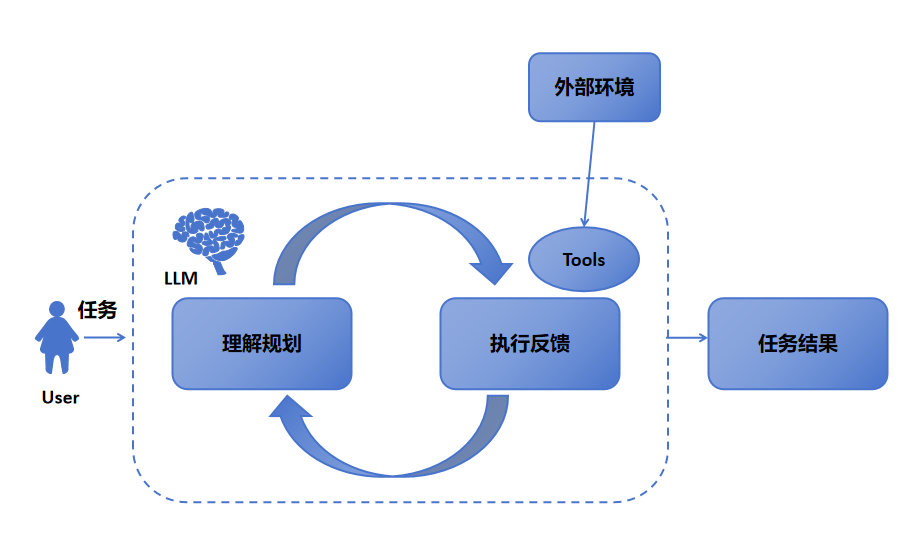
Figure 2 AI Agent Working Principle
1Protocol Tools: Ensuring Standardized Interaction and Collaboration
AI Agents have spurred the emergence of related protocols, which are used to define the interaction rules between AI Agents and external resources (databases, APIs, etc.) and among other AI Agents, ensuring cross-platform collaboration in a standardized manner to solve system integration challenges. Based on the interaction objects, they can be divided into Context-Oriented (context-oriented) and Inter-Agent (agent-to-agent) types.
Among them, context-oriented protocols are represented by MCP (Model Context Protocol), which addresses the issue of AI Agents obtaining the contextual information required for tasks from external environments (prompts, tools, resources). Based on MCP, AI Agents can break through language and framework limitations, integrate high-quality community MCP Servers, and achieve capabilities such as automated office work, data scraping, and cross-system integration, flexibly calling external APIs and various resources;
The agent-to-agent protocols are represented by A2A (Agent to Agent), which is suitable for scenarios requiring multiple AI Agents to collaborate complexly, engage in conversational interactions, and complete tasks together.
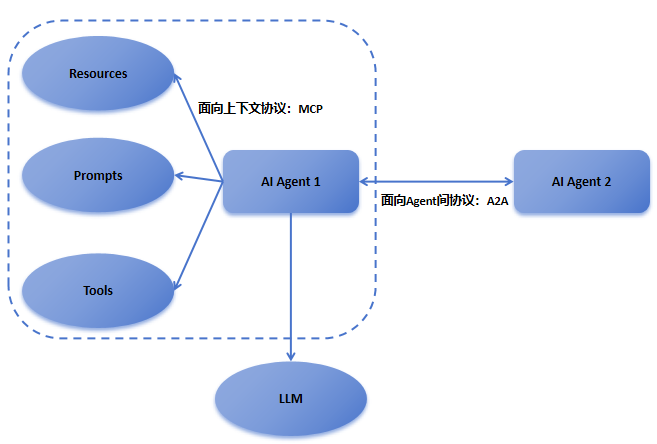
Figure 3 Relationship between MCP and A2A
2Thinking Framework: Endowing Agents with Structured Reasoning and Decision-Making Capabilities
Building agents capable of autonomous planning, execution, and adaptation to complex tasks hinges on their “thinking” ability. The AI Agent thinking framework is designed to endow AI Agents with this structured reasoning and decision-making capability. These frameworks provide a methodology guiding AI Agents on how to understand goals, decompose tasks, utilize tools, process information, and adjust behaviors based on environmental feedback.
Chain of Thought (CoT) is a key technology that enhances LLM capabilities in handling complex reasoning tasks, focusing on guiding the model to generate a series of structured intermediate reasoning steps before arriving at a final answer—simulating the gradual thought process humans use to solve problems. Through this approach, LLMs can gain a deeper understanding of problem structures, effectively decompose complex tasks, and gradually derive solutions.
Although CoT enhances the model’s reasoning capabilities, its reasoning process is primarily limited to the model’s internal knowledge, lacking real-time interaction with the external world, which may lead to outdated knowledge, hallucinations, or error propagation. ReAct (Reasoning and Action) integrates “reasoning” and “action,” allowing the model to interact with external tools or environments during reasoning, obtain real-time information, execute operations, and adjust based on feedback, constructing a “thinking-action-feedback-optimization” closed loop, adapting to dynamic task scenarios.
3Development Framework/Platform: A Standardized Support System Covering the Entire Process
Development frameworks/ platforms provide standardized architectures, components, and interfaces for AI Agent development, covering the entire process from prototype design to complex system implementation, reducing development barriers through modular design, enhancing code reusability and system maintainability. Currently, AI Agent development frameworks are mainly divided into two categories: platform-building types and general framework types.
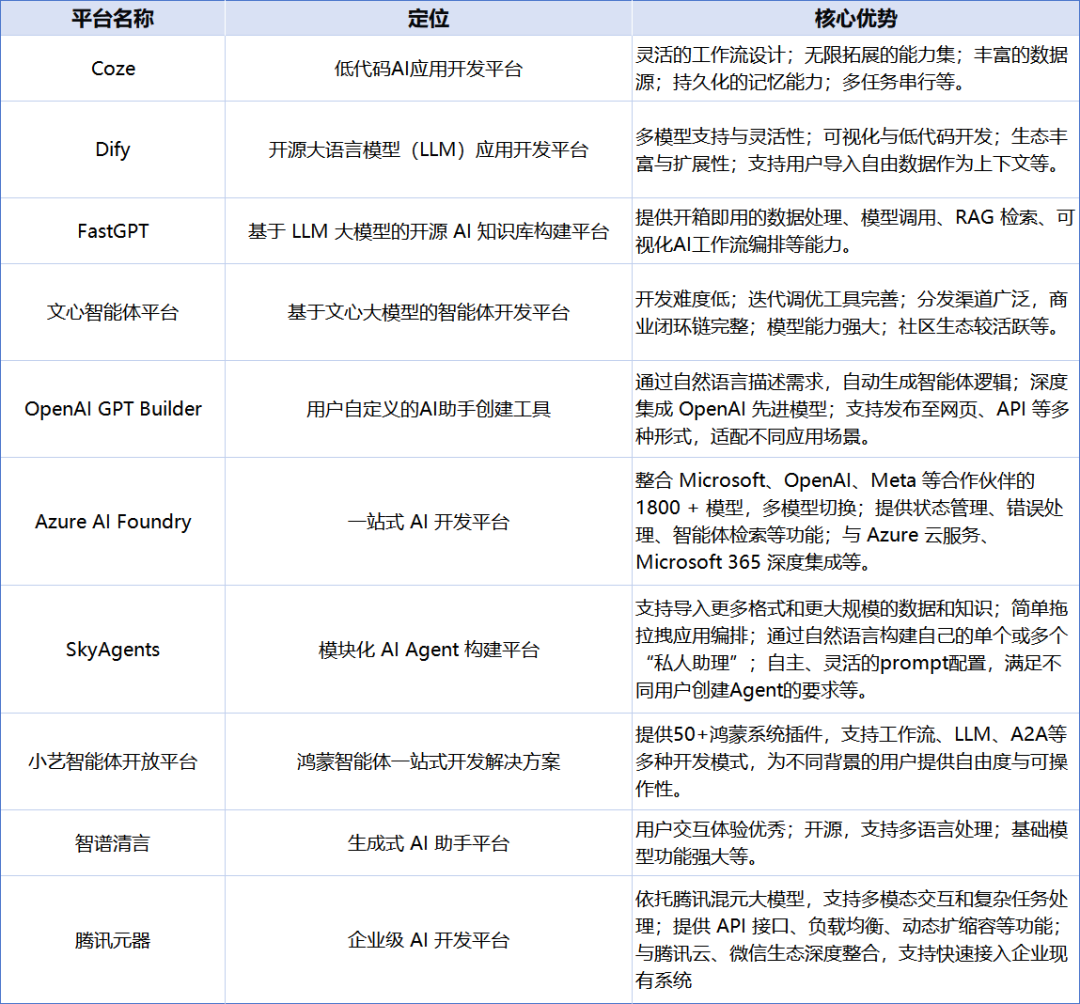
Platform-building types reduce technical barriers through low-code methods such as visual configuration, drag-and-drop plugins, and workflow visualization, helping non-technical personnel quickly build AI Agents, adapting to lightweight scenarios and rapid trial-and-error needs (as shown in Table 1).
For example, Coze provides rich templates and components, allowing users to create agents through simple graphical operations; Dify supports custom workflows, enabling quick integration with various models; FastGPT focuses on knowledge base construction, helping users efficiently build Q&A agents.
Table 1 Current mainstream AI Agent development platforms
General framework types provide Python interfaces and tool integration, Memory management, and other underlying capabilities, targeting technical developers (as shown in Table 2). For example, LangGraph has high versatility and ecological richness, supporting Agent expansion and workflow customization; AutoGen focuses on dialogue-driven and role-playing collaboration, adapting to “human + multiple AI” cooperation; CrewAI focuses on multi-agent collaborative division of labor, suitable for simulating complex project processes, etc.
Table 2 Current mainstream AI Agent development frameworks
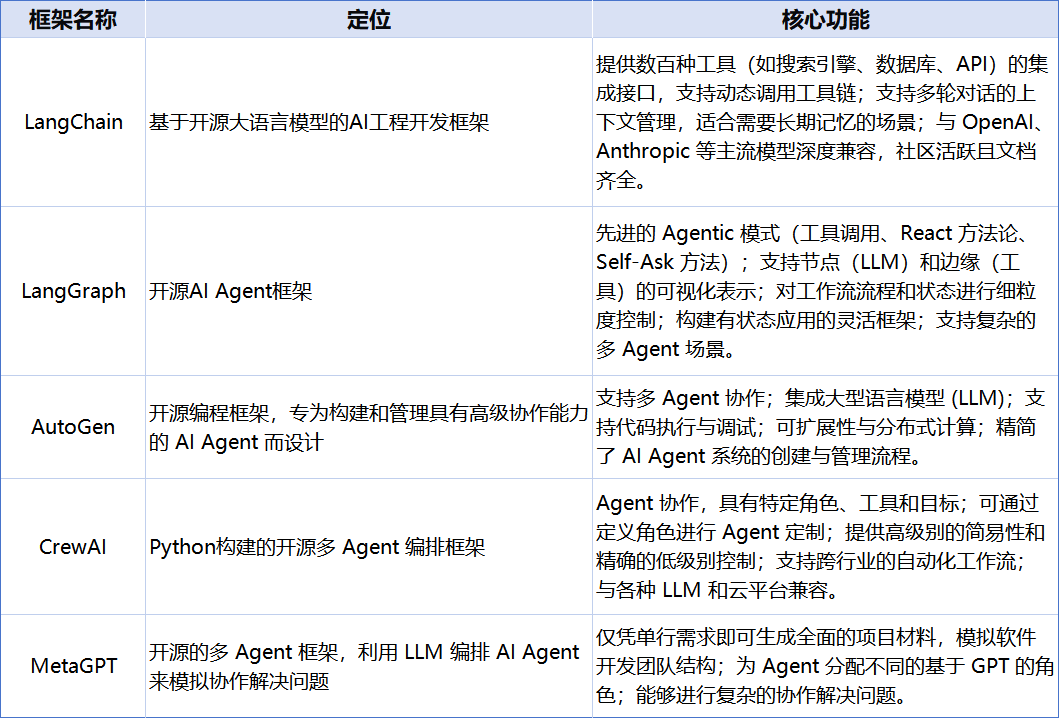
It should be noted that the above classifications are more for providing analytical perspectives, and there are no strict boundaries between them; the two types of tools often have technical connections. For example, a final deployed “AI Agent application” may be based on a combination of a “development framework” and a “development platform.”
4Other Tools: Auxiliary Support Covering All Development Phases
Prompt engineering tools: used to design and optimize prompts, accurately guiding AI Agents to understand task intentions and improve execution effectiveness, serving as a key means to enhance LLM interaction quality. For example, Prompt Optimizer, PromptWizard, etc.;
Data processing tools: responsible for data cleaning, analysis, transformation, etc., providing AI Agents with high-quality input data to ensure task execution accuracy. For example, Pandas, NumPy, etc.;
Model training tools: support AI model training, fine-tuning, and optimization, helping to enhance AI Agent performance, adapting to vertical domain task requirements, and solidifying the “brain” capabilities of the agent. For example, TensorFlow, PyTorch, etc.
Additionally, there are technologies and tools such as natural language processing, multimodal perception, reinforcement learning, and vector databases, which collaboratively construct a complete technical system for AI Agent development and operation, promoting the efficient application of AI Agents in various scenarios.
03How to Develop and Implement AI Agents?
Having understood the definition, architecture, and key technologies of AI Agents, the development and implementation process is equally worth exploring. Developing AI Agents is a complex systemic engineering task that requires following a scientific process and integrating multiple key technologies to create efficient and intelligent applications.
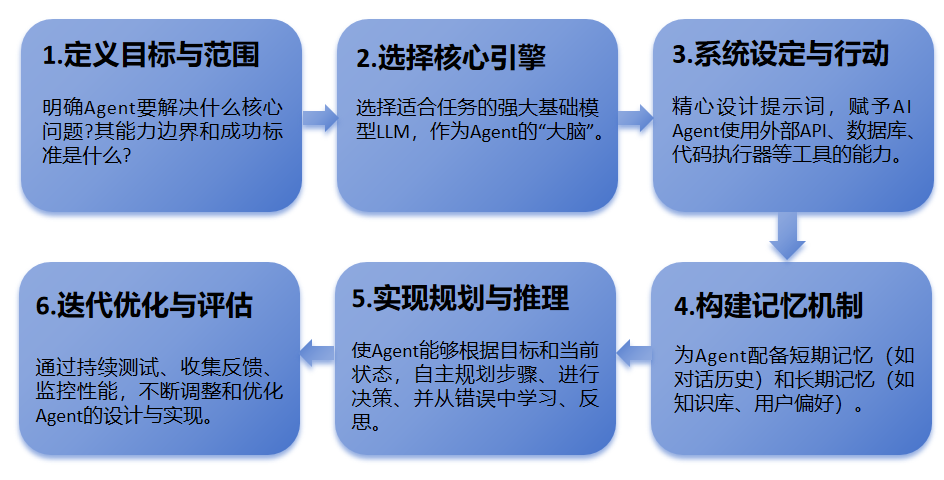
Figure 4 Core Steps in Developing and Implementing AI Agents
1Define Goals and Scope
The first step in developing AI Agents is to define goals and scope. Developers need to accurately anchor the core mission of AI Agents, clarify the problem domain to be solved, capability boundaries (task types, effective scenarios, etc.), and quantifiable success criteria. Identify potential issues from actual business processes and demand scenarios, using task decomposition methods to break complex problems into executable sub-tasks, and set KPIs such as accuracy and response time based on sub-tasks. For example, in a smart customer service scenario, define the scope of inquiries and response thresholds; in an enterprise data analysis scenario, clarify the data range and analysis dimensions.
2Select Core Engine
Choose an appropriate LLM for the AI Agent as the “intelligent core” and complete model integration. Developers need to conduct in-depth research on mainstream LLMs such as GPT, Claude, and Gemini, evaluating them based on task relevance (the model’s adaptability to the target task), performance (inference speed, generation quality), and cost input (training costs, invocation costs); based on the task requirements of AI Agents (e.g., text generation focusing on creativity, logical reasoning emphasizing rigor), complete the selection, and also complete API integration to ensure the model can stably support AI Agents.
3System Settings and Actions
System settings and actions encompass two major modules: prompt engineering and tool invocation. Prompt engineering clearly tells the model which tools need to be called and how to call them, while tool invocation helps the model obtain external information not included in the prompts, thus completing tasks more accurately. In the prompt engineering dimension, carefully design the instruction set for interacting with the LLM, including role anchoring, context constraints, and output format definitions, using techniques such as Chain of Thought (CoT) and Tree of Thought (ToT) to optimize interaction logic and ensure output accuracy. In the tool invocation dimension, empower the AI Agent to use external APIs, databases, code executors, and other tools, expanding its action boundaries.
4Build Memory Mechanisms
Equip the AI Agent with short-term memory (such as dialogue history) and long-term memory (such as knowledge bases, user preferences). Short-term memory relies on context windows to store real-time interaction information (such as dialogue history), providing situational support for real-time decision-making; long-term memory is structured storage of industry knowledge, user long-term preferences, etc., through vector databases and knowledge graphs, supporting AI Agents in knowledge retrieval and invocation. For example, knowledge graphs can associate product knowledge and user behavior trajectories, assisting AI Agents in making reasonable decisions in complex tasks.
5Implement Planning and Reasoning
Enable AI Agents to have autonomous planning, decision-making, and self-optimization capabilities based on goals and current states. Use task decomposition strategies (such as recursive decomposition, modular decomposition) to break complex goals into ordered sub-task sequences; introduce the ReAct (Reasoning + Acting) framework, integrating a self-reflection mechanism, allowing AI Agents to dynamically perceive state changes during task execution and adjust decision paths in real-time. For instance, if a task execution fails, the AI Agent can trigger the reflection module to analyze the causes of errors (such as unreasonable task decomposition, tool invocation failure), optimize subsequent execution steps, and improve the decision-making logic loop, constructing an intelligent decision-making system of “planning-execution-reflection-optimization.”
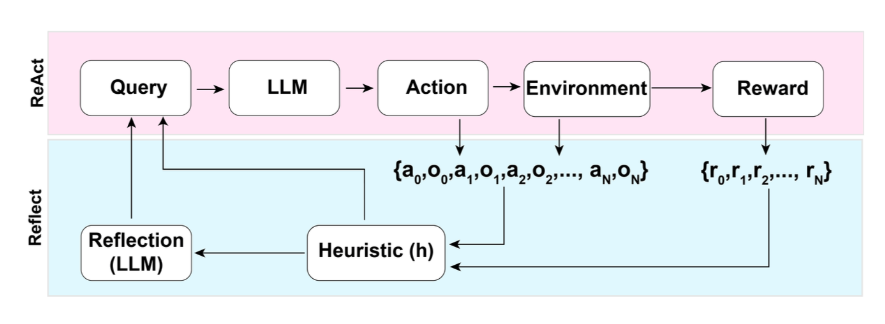
Figure 5 Reflexion Framework Diagram (Image Source: Open AI)
6Iterative Optimization and Evaluation
Through continuous testing, feedback collection, and performance monitoring, optimize AI Agent design and implementation. Design test cases covering various task scenarios; collect user feedback to understand actual usage experiences and issues; monitor performance metrics (such as response time, accuracy), conduct A/B testing to compare different solutions, and iterate optimization based on results to enhance AI Agent performance.
04How to Apply AI Agents?
From a technical perspective, AI Agents break the limitations of traditional AI being passively executed tasks, thanks to their autonomous perception, decision-making, and action capabilities. However, only by integrating into practical scenarios can the technical advantages be transformed into real productivity and social value.
1. Presentation Forms of AI Agents
Applications (App): These AI Agents exist in the form of mobile or desktop applications, allowing users to download and use them via smartphones, tablets, or computers. For example, voice assistants like Siri and Google Assistant have their own application forms.
Mini Programs/Quick Applications: This form allows users to quickly access AI functionalities without installing additional applications. For example, many lightweight AI services are provided to users in the form of mini-programs on platforms like WeChat and Alipay.
Hardware Integration: These AI Agents are typically integrated into specific hardware devices to enhance functionality or provide a more convenient service experience, such as smart speakers (Amazon Echo, Google Home), smart home systems, smart wearable devices (like smartwatches), and autonomous vehicles.
Web Services: These AI Agents provide services through web interfaces, allowing users to interact with AI via specific URLs without downloading or installing any software. For example, enterprise intelligent data analysis platforms and research literature retrieval AI tools can complete data processing or information queries online.
Embedded Systems: AI Agents may be directly embedded into other electronic devices or mechanical systems to perform specialized tasks. For instance, in industrial automation, they can control robots, or in smart appliances, they can manage path planning.
The choice of presentation form largely depends on the needs of the target user group, ease of use, and cost-effectiveness. With technological advancements, more innovative forms of AI Agents may emerge in the future.
2. Application Scenarios of AI Agents
Currently, AI Agents show broad application prospects in fields such as healthcare, education, industry, and financial services. For example, in healthcare, AI Agents can be used for intelligent consultations, medical image analysis, personalized health management, and medical knowledge base queries, improving diagnostic accuracy and optimizing medical resources; in education, AI Agents can provide intelligent tutoring, automatic grading, generate educational content, and assist in language learning; in the industrial sector, AI Agents can be applied to predictive maintenance of equipment, robot control, and supply chain optimization; in finance, AI Agents can be used for intelligent investment advisory, quantitative trading, risk management, fraud detection, credit scoring, and personalized financial services.
05What Challenges Do AI Agents Face in Application?
Despite the widespread application of AI Agents, their development path still faces numerous challenges:
1. Security and Privacy Risks
Security and privacy risks are paramount. AI Agents can easily trigger personal information leakage risks when collecting and processing massive amounts of data. If protective mechanisms are weak, they may be vulnerable to hacking attacks that steal data. Additionally, AI Agents may be used to execute malicious acts such as fraud and misinformation dissemination, for example, scammers customizing agents to simulate customer service voices to induce users to transfer money; fake news-generating agents may produce rumors in bulk, disrupting public opinion.
2. Doubts About Technical Reliability
Currently, the “autonomy” of intelligent agents largely relies on preset rules and large model reasoning, lacking true logical understanding capabilities, which may lead to erroneous decisions in complex scenarios; moreover, when multiple intelligent agents work together, confusion may arise due to conflicting goals, data desynchronization, or communication delays; additionally, when faced with abnormal inputs (such as vague instructions or erroneous data), intelligent agents are prone to produce “hallucination outputs” or crash.
3. Ethical and Compliance Issues
Some decision-making processes of AI Agents are “black boxes,” making it difficult to trace logic. When AI Agents make decisions that lead to adverse consequences, it is challenging to clarify responsibility; furthermore, different regions have different regulations regarding AI applications (such as the EU’s AI Act and China’s Interim Measures for the Management of Generative Artificial Intelligence Services). If agents are used across regions, they may violate local laws due to cross-border data and algorithm compliance issues.
4. Challenges in Commercialization
Based on the above factors, some users doubt the reliability of AI Agents, especially in high-risk areas (such as healthcare and law), preferring human decision-making, making it difficult for AI Agents to be deeply implemented; at the same time, developing and maintaining high-performance AI Agents requires substantial computational power, data, and human resources, but in many scenarios, the actual utility is limited, leading to low ROI (return on investment) for enterprises.
06What are the Development Trends of AI Agents?
From technological evolution to scenario implementation, AI Agents are accelerating breakthroughs along multiple paths, and their future development will exhibit distinct characteristics of multidimensional deepening:
1. Deepening Industry Applications
AI Agents will no longer be limited to general assistant roles, but will be deeply embedded in healthcare, education, industry, finance, and other sectors, becoming domain-specific experts. Specialized AI Agents trained on domain data will continue to emerge, gradually forming powerful industry-level intelligent decision-making capabilities while multi-agent systems will further enhance the efficiency of solving complex problems through cross-domain collaboration. For example, in supply chain scenarios, the collaboration of procurement, production, and logistics AI Agents can achieve end-to-end optimization.
2. Enhancing Technical Capabilities
In the future, AI Agents will evolve from relying on a single language model to integrating multimodal capabilities involving vision, speech, and actions, while combining with physical entities to form embodied intelligence, achieving more natural human-machine interactions. At the same time, AI Agents will possess proactive perception and decision-making capabilities, able to monitor environmental changes in real-time, anticipate potential risks, and intervene proactively. Additionally, dynamic learning and self-optimization mechanisms will become standard, allowing AI Agents to continuously iterate and optimize workflows based on user feedback and behavior data, improving service quality.
3. Lowering Development Barriers
As technology matures and tools improve, the development barriers for AI Agents will gradually decrease, enabling more enterprises and developers to participate. Moreover, more open-source frameworks and low-code/no-code development platforms will emerge, accelerating the popularization of AI Agents in small and medium-sized enterprises, startups, and other organizations, fostering continuous innovation and forming a rich and diverse application ecosystem.
4. Scalable Commercialization
Three key factors—technological maturity, cost control, and industry acceptance—will reach a turning point: the continuous improvement of large model reasoning capabilities; breakthroughs in edge deployment and edge computing technologies will significantly reduce usage costs; at the same time, enterprises’ recognition of the value of AI Agents will significantly increase, enhancing their willingness to apply them. In the future, “Agent as a Service (AaaS)” will become the mainstream service model, allowing enterprises to subscribe to intelligent capabilities such as customer service and data analysis based on usage; simultaneously, regulations regarding AI Agent responsibility and data privacy will gradually be implemented, and regulatory frameworks will continue to improve, laying a solid foundation for large-scale commercialization.
07Conclusion
AI Agents represent the evolution of artificial intelligence from “tools” to “assistants” and then to “agents.” In the early “tool stage,” AI only executed preset rule tasks; the large models propelled it into the “assistant stage,” where it could understand natural language commands to complete complex tasks; now, in the “agent stage,” AI Agents can autonomously perceive environments, plan tasks, and execute actions. With continuous technological development, AI Agents will play a role in more fields, providing humans with smarter and more efficient services.
For developers, grasping the technical context and tool ecosystem of AI Agents is key to seizing opportunities; for enterprises and users, understanding their application scenarios and value logic is essential to better embrace this intelligent revolution. It is foreseeable that AI Agents will not only be an inevitable product of technological evolution but will also become an important link connecting the digital world and the physical world, profoundly changing our ways of life and work.
References
1. LLM Powered Autonomous Agents
https://lilianweng.github.io/posts/2023-06-23-agent/
2. Google AI Agent White Paper: The Era of AI Agents Arrives in 2025
https://mp.weixin.qq.com/s/n0v_wrYd4GI_cKnU1FyTLA
3. A Comprehensive Guide to Elegantly Developing Complex AI Agents
https://mp.weixin.qq.com/s/DJG2FABiUEFl1uxpL2DAiA