As the complexity of embedded systems continues to increase, embedded development is no longer just about writing software/firmware; it also involves coordinating the software and hardware ecosystem. The interdependence of hardware and software, along with system complexity, can actually slow down product adoption and delay profitability. Therefore, the industry urgently needs a unified path from exploration and development to deployment.
The AMD Embedded Development Framework (EDF) aims to simplify this process by providing a modular, scalable, and open-source system-level development environment, thereby optimizing and accelerating the deployment path. So, what is the AMD Embedded Development Framework?
EDF is not just a toolkit; it is a comprehensive methodology that enables rapid development and distribution of embedded software components. This embedded development framework offers:
Software Development Kit (SDK): Open-source build tools for generating robust, industry-standard Linux® images.
Out-of-the-box experience: Provides scalable pre-built images for evaluation boards, enabling quick startup and exploration.
Complete embedded software stack: Includes toolchains, boot firmware, EDF Linux images, example designs, etc., to alleviate development burdens.
Next, let’s delve into the three pillars of the AMD Embedded Development Framework, which bring disruptive changes to embedded developers.
Open
Source
EDF adheres to the open-source principles, allowing developers to confidently build, customize, and extend embedded systems. It also helps developers break free from vendor lock-in, which can slow down development progress.
Supported by the industry-standard Yocto Project
EDF utilizes the Yocto Project, a widely used open-source framework for building custom embedded Linux operating systems. Yocto Project is not a Linux distribution but a build system that allows you to tailor the operating system based on hardware, use cases, and performance requirements. It provides various libraries, templates, tools, and methodologies for easy integration and regular maintenance.
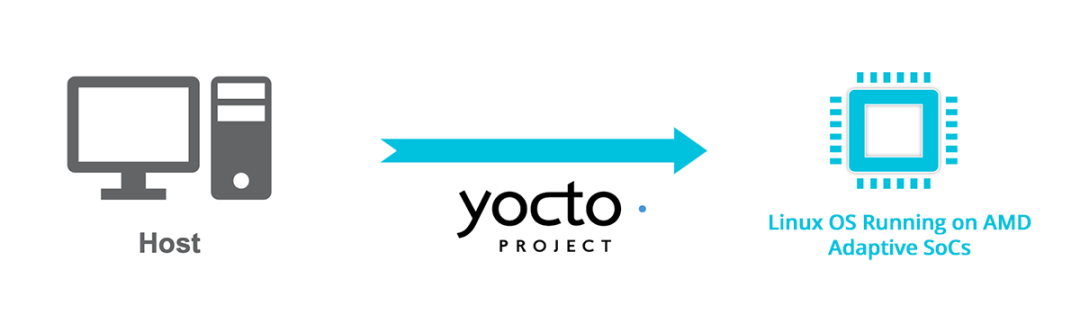
EDF supports multiple architectures and reproducible builds, ensuring:
-
Seamless customization of your operating system based on specific needs
-
Vendor-neutral tools for long-term flexibility
-
Easier integration and handover with third-party OS vendors
-
Complete ecosystem support and long-term maintainability
Given that this is an open-source ecosystem, you will benefit from a thriving community, rapid bug fixes, feature enhancements, faster innovation, and a transparent development process.
Full-stack solution
EDF is a complete software stack that bridges the gap between hardware and software development. From pre-built Linux disk images and boot firmware to trusted environments, real-time operating systems (RTOS), and reference designs and processes, the embedded development framework provides everything needed for developing and deploying embedded systems.
-
Instant board enablement with AMD EDF Linux and platform BSP
-
Feature-rich, ready-to-use pre-built images for a smoother out-of-the-box experience
-
Boot firmware to ensure reliable system startup
-
Modular reference example designs for scalable deployment
-
Support for advanced boot processes and multi-domain architectures
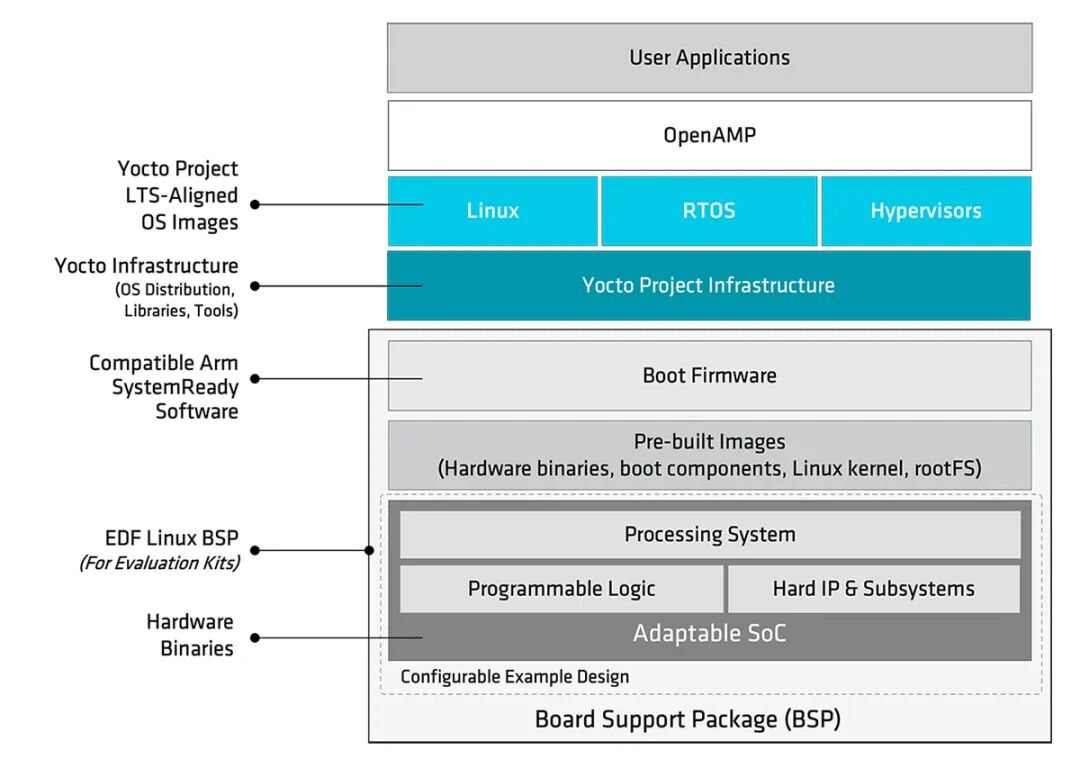
Whether you are building a minimal system or a complex multi-domain architecture, it provides tools for effectively managing hardware-software interdependencies, while supporting both single-stage and multi-stage boot processes, ensuring compatibility with various embedded software development solutions from AMD and partners.
This software stack ensures that developers can start with a known good baseline and modify and extend their embedded solutions to meet mass production requirements.
Accelerate Development
EDF is designed to shorten development cycles and accelerate time-to-market through pre-built images, automated processes, and different design entry points for various roles, helping teams transition from development to deployment faster. This also allows teams to focus on application development and system integration.
Different Design Entry Points

Evaluation
-
Out-of-the-box evaluation – Flash and boot using pre-built images to run and experience a fully operational chip immediately.

Development
-
Software Development – Use SDKs, containers, or package sources to write and deploy software for AMD Adaptive SoCs.
-
Custom Hardware Development – Use AMD Vivado/Vitis tool flows and Configurable Example Designs (CED) to integrate programmable logic (PL) loads.
-
Operating System Integration and Development – Leverage the Yocto Project to build and customize the EDF Linux operating system.

Deployment
-
Flexible Deployment – Deploy on target AMD Adaptive SoCs via package sources, containers, OTA updates, etc.
EDF maximizes setup time, reduces integration overhead, and accelerates time-to-market, allowing you to focus on innovation rather than infrastructure.
Ready to start building?

Whether you are evaluating AMD Adaptive SoCs, building custom platforms, or scaling deployments, the AMD Embedded Development Framework (EDF) provides you with an integrated framework, a consistent experience, and a fast path to deployment.
Share + Like + Follow, let’s arrange it.This article is authorized for reprint from: Xilinx official WeChat account. If there is any infringement, please contact for deletion.