New Solana Network Upgrade
Introduction
The economic design of Solana aims to balance network security with long-term monetary sustainability. The initial inflation curve starts with an 8% rate that gradually decreases to a final rate of 1.5%.
SIMD-0411, known as doubled deflation rate, proposes a targeted adjustment:doubling the rate of inflation decay, which reduces emissions more quickly while maintaining the final rate of 1.5% that the ecosystem has already centered around. By modifying a single parameter rather than redesigning the entire inflation system, SIMD-0411 provides a minimal, predictable, and low-risk way to strengthen Solana’s monetary policy without increasing the complexity of the protocol.
This upgrade stands in stark contrast to SIMD-0228, which was an earlier attempt to reduce emissions using a dynamic, stake-responsive formula. While SIMD-0228 aimed to make inflation adaptive, it introduced uncertainty, implementation overhead, and governance friction, ultimately leading to stagnation in its adoption. SIMD-0411 achieves the same high-level goals of reducing inflation and improving capital efficiency through a simpler, more manageable approach.
What SIMD-0411 Actually Does
Solana’s inflation plan is defined by three parameters:
- Initial inflation rate: 8%
- Deflation rate: -15% per year
- Final inflation rate: 1.5%
Currently, Solana’s annual inflation rate is approximately 4.18%.
Under the current curve, it will take an additional 6.2 years to reach the 1.5% lower limit.
SIMD-0411 proposes a simple change:
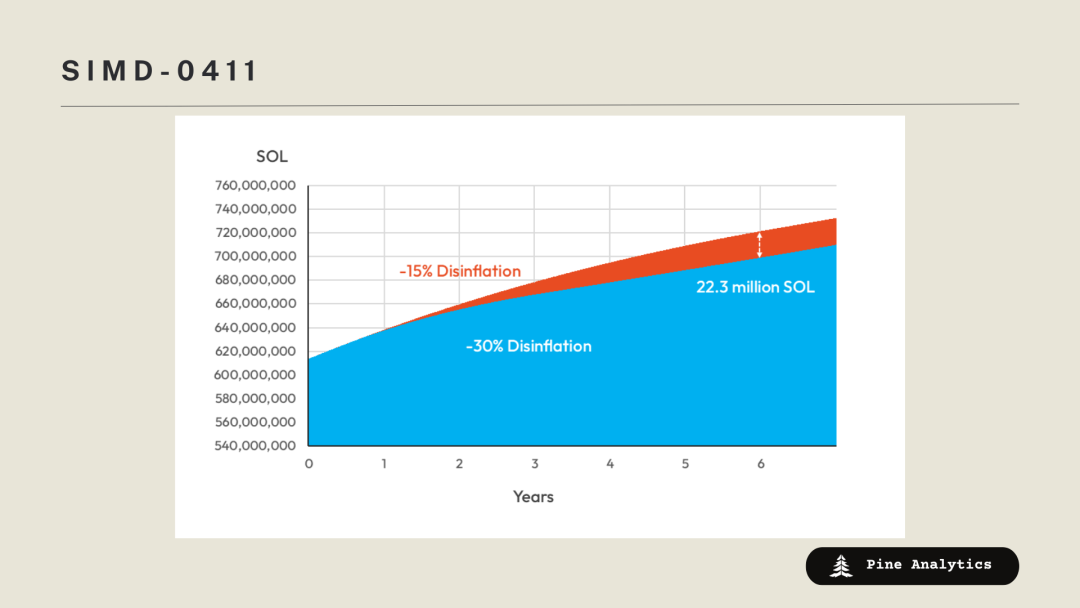
Doubling the deflation rate from -15% to -30%.
This accelerates the rate of inflation decay, without changing the final rate itself.
Results of the Change
- Reaching the final inflation rate in 3.1 years instead of 6.2 years
- Reducing emissions by 22.3 million SOL over six years (approximately $2.9 billion at current prices)
- Nominal stake yield steadily declines:
- Year 1: ~5.04%
- Year 2: ~3.48%
- Year 3: ~2.42%
- About 10 validators become unprofitable in the first year.
Differences Between SIMD-0411 and SIMD-0228
SIMD-0228 attempted to do something more ambitious:
SIMD-0228: Dynamic, Market-Driven Emissions
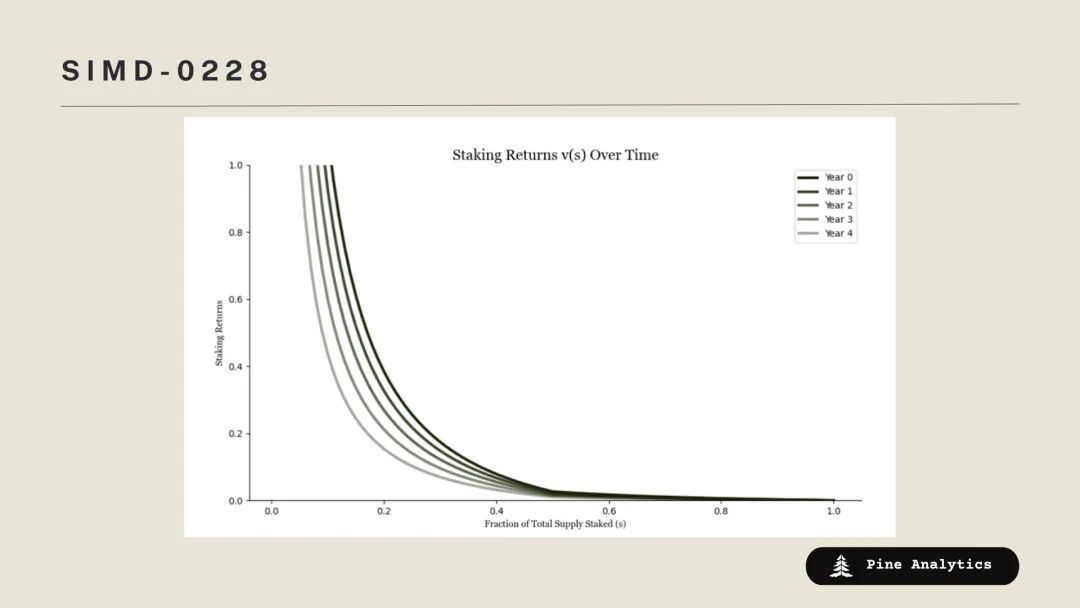
It used an exponential function to link inflation to the percentage of SOL staked.
This design would increase emissions when stake participation was too low and decrease emissions when stake health was good.
Its goals were:
- Stabilizing network security
- Optimizing inflation
- Creating a responsive, incentive-aligned system
How SIMD-0411 Improves on SIMD-0228
SIMD-0411 pursues the same core goal as SIMD-0228—significantly reducing SOL emissions—but it does so in a simpler, lower-risk manner. SIMD-0228 introduced a dynamic, stake-responsive formula that raised concerns about complexity, parameter tuning, and unpredictable outcomes, while SIMD-0411 only changes a single, well-known lever: it doubles the deflation rate from -15% to -30%. This makes the effects deterministic and easy to model, avoiding new edge cases or implementation risks, and making it easier to communicate with validators, stakers, and institutions. In short, it achieves a similar reduction in emissions while avoiding the governance friction and uncertainty that led to the stagnation of SIMD-0228, all without changing Solana’s ultimate inflation target.
Impact on the Network
Doubling the deflation rate will immediately reduce the number of new SOL entering circulation each year, thereby lowering the overall stake rewards of the network. As nominal yields decline, the APY received by stakers also decreases, which reduces the profitability of validators and drives a small number of lower-stake validators to become unprofitable in the coming years. The economic trade-off is clear: by reducing emissions, Solana will issue 22 million fewer SOL over the next six years, significantly reducing dilution for holders and decreasing forced sales from stakers. The slowed supply growth enhances the long-term value of SOL, improves monetary efficiency, and makes the token more attractive to retail and institutional holders who benefit from reduced inflationary pressure.
- Original link: pineanalytics.substack.c…
- Upchain Community AI Assistant, translating excellent English articles for everyone. Please forgive any translation inaccuracies.

Upchain Community started in 2017, helping developers become better Web3 Builders by building a high-quality technical content platform and offline spaces.

- Upchain Community Website: learnblockchain.cn
- Developer Skill Certification: decert.me
- Bilibili: space.bilibili.com/581611011
- YouTube: www.youtube.com/@upchain