On the global technology stage today, humanoid robots are undoubtedly one of the most prominent and popular fields. With the advancement of technology, the need for robots to interact with humans has become increasingly evident. Capacitive tactile sensors, as an important member of human-computer interaction technology, have always maintained a place in the long river of technological development and have never been abandoned by the market. From smartphones, tablets, and home appliances in our daily lives to smart door locks, automotive multimedia screens, control panels, and even automotive HOD steering wheels, the application of capacitive tactile sensors is ubiquitous. Capacitive sensing technology not only remains relevant but is also continuously evolving and iterating. In the field of humanoid robots, the market potential for electronic skin is enormous. According to brokerage statistics, the market size for electronic skin is expected to reach trillions, and capacitive tactile sensors, as a technological route for electronic skin, will also benefit from the booming development of the electronic skin market. However, I have observed that most people are not fully aware of the vast market prospects of capacitive tactile sensors. Currently, many companies involved in the electronic skin field, both domestically and internationally, have crossed over from the automotive industry to the humanoid robot field, such as foreign companies like Interlink Electronics and Tekscan, and domestic companies like Hanwei Technology, Fule New Materials, and Pasini.
In the field of humanoid robots, capacitive tactile sensors are currently mainly applied in dexterous hands. However, as humanoid robot technology continues to advance, electronic skin will gradually cover the entire body of the robot. Future humanoid robots should not be cold and insensitive machines; they need to be able to sensitively perceive changes in the external environment to meet the needs of human emotional interaction. With the continuous development of humanoid robot technology, the demand for human-computer interaction will continue to increase, and capacitive sensors, as one of the human-computer interaction technologies, will inevitably occupy a key position in this market.
I’m sure everyone has seen the boxing match videos of Yushu robots, where the performance of those robots seems to lack perceptual ability, appearing quite comical. For example, when a person kicks the robot from behind, the robot cannot perceive that it has been attacked from behind and will only retaliate from the front. This is a typical manifestation of a robot’s lack of perceptual ability. One of the applications of electronic skin in humanoid robots is to enable robots to perceive the external environment as accurately as humans and make reasonable decisions based on the environment.
Tactile sensors can be divided into layered tactile sensors and magnetoelectric tactile sensors. Layered tactile sensors include resistive, piezoelectric, and capacitive sensors, with structures consisting of a sensitive layer, electrode layer, base layer, encapsulation layer, and adhesive layer. The sensitive layer is located at the top and is made of functional materials with sensitive response characteristics, such as PDMS and carbon nanotubes; the base layer uses elastomer materials like PI or Ecoflex to provide mechanical support and recoverable deformation capability for the overall structure; the encapsulation layer uses PDMS films to protect the internal circuits from humidity, temperature, and contamination. Additionally, there are visual tactile and magnetoelectric tactile sensors.
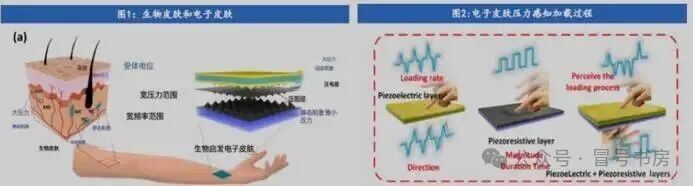
The following are several performance comparison charts of tactile sensors extracted from the Pasini official website. Since Pasini uses magnetoelectric tactile sensors, the parameters in the charts may lean towards the magnetoelectric technology route, but we can still roughly understand the advantages and disadvantages of different tactile technologies from them.
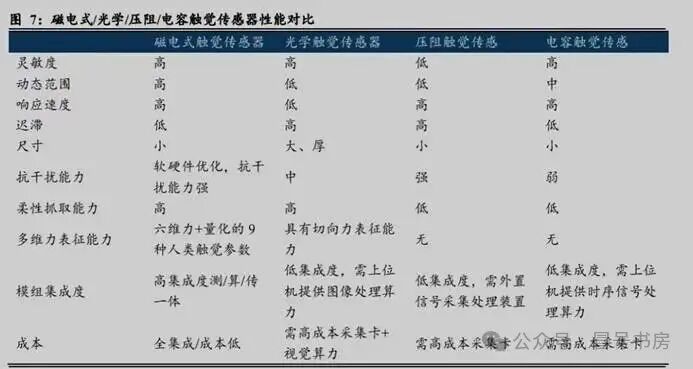
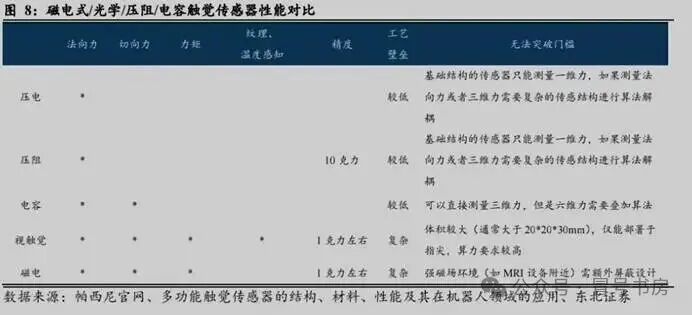
As a researcher focused on capacitive technology in the automotive field, I firmly believe that in the future of tactile sensors for humanoid robots, capacitive sensing technology will occupy an important position. Below, I will focus on analyzing the application of capacitive tactile sensors in humanoid robot electronic skin.
Comparing the parameters of the aforementioned tactile sensor technology routes:
First is “sensitivity”. Capacitive sensors have a relatively high sensitivity level among all technology routes. Taking Infineon’s PSOC4HV series MCU as an example, its minimum self-capacitance detection unit is 15fF, and the minimum mutual capacitance detection unit is 10fF, indicating that within the capacitance range detectable by PSOC4HV, the minimum capacitance change unit can reach the fF level, which is an order of magnitude smaller than pF capacitance, demonstrating that the sensitivity of capacitance detection is quite high.
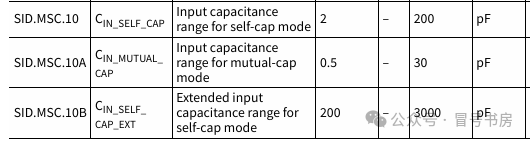
Secondly is “dynamic range”. Again, taking Infineon’s PSOC4HV series MCU as an example, its self-capacitance detection range is 2pF – 3nF. Although related lists consider the “dynamic range” of capacitive tactile sensors to be moderate, from the perspective of the automotive industry, the capacitance detection range of 2pF – 3nF is already sufficiently large to meet the capacitance range required for applications such as touch door handles, touch switches, HOD steering wheels, and kick sensors for rear tailgates. Even for the capacitive values on dexterous hands (due to the limited area and plate spacing of dexterous hands, the capacitance value is at the pF level), the detection range of the PSOC series MCU is also sufficient.
Third is “response speed”. Taking Infineon’s PSOC4HV series MCU as an example, its SENSOR frequency range is 45KHZ – 6MHZ, and it integrates a CORTEX – M0 + CPU with a main frequency of 48MHZ, allowing a complete capacitance acquisition cycle to reach the μS level, resulting in very rapid response speed.

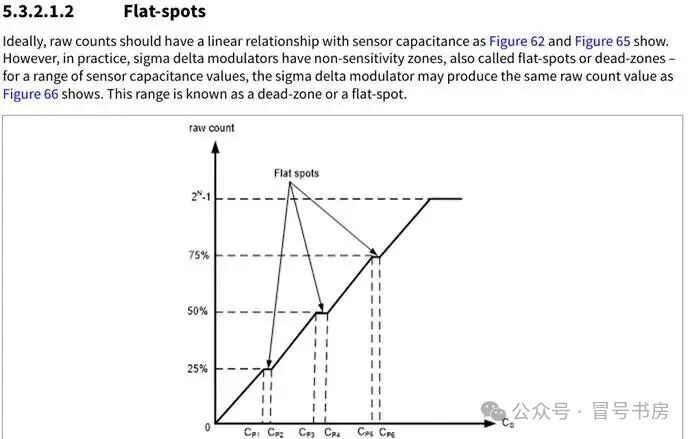
Fourth is “hysteresis”. Due to its fast response speed, the capacitance has a linear relationship with RAWDATA, and the chip integrates a jitter function, reducing the flat point or dead zone of the capacitance, so the hysteresis of the capacitance is theoretically very small.
Fifth is “size”. The detection range of capacitive touch sensors can be made very small, and the area of self-capacitance or mutual capacitance SENSOR can be designed to be very small. For example, under the small area of a dexterous fingertip, multiple capacitive touch sensors can theoretically be set.
Sixth is “anti-interference capability”. Related lists indicate that capacitive technology routes have weak anti-interference capabilities, while magnetoelectric technology can enhance anti-interference capabilities through software and hardware optimization. However, as an engineer with extensive experience in the capacitive field and multiple EMC rectifications of products, I believe that capacitive sensor routes can also enhance anti-interference capabilities through software and hardware optimization. In fact, if the PCBLAYOUT and product system structure design are unreasonable, the anti-interference capability of any technology route will be affected.
Seventh is “multi-dimensional force characterization capability”. The capacitive technology route can theoretically achieve six-dimensional force measurement. The measurement of six-dimensional force depends on the structural design of the electronic skin capacitive touch sensor. For example, in the conventional design of a multi-touch panel, within a limited area, the capacitive structure can collect forces along the XYZ axes in three-dimensional space, and software algorithms can calculate the torque along the XYZ axes. Six-dimensional force measurement is a challenge that requires converting capacitance calibration into force magnitude, and the durability, robustness, and calibration of capacitive sensors are crucial, which is also one of the challenges faced by most tactile sensors.
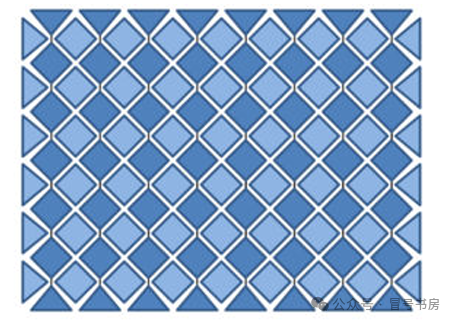
Multi-point mutual capacitance sensor structure
Eighth is “flexible grasping capability”. The above list considers the flexible grasping capability of capacitive routes to be weak. However, in my view, capacitive sensors primarily rely on the deformation of the dexterous hand’s touch area to cause capacitance changes to collect force changes. Although the deformation of the touch area is small when grasping flexible objects, due to the high sensitivity of the capacitive route, the capacitance changes caused by small deformations can be detected, so the conclusion that capacitive flexible grasping capability is weak is debatable.
Ninth is “integration level”. Infineon’s PSOC4HV series MCU has high integration characteristics, with built-in LIN communication modules, LDO power management units, capacitive sensing functions, and M0 + cores, allowing for multi-dimensional functional integration on a single chip. Its packaging form minimally supports 32Pin QFN, occupying very little physical space, effectively simplifying hardware design and reducing board area. However, the related list mentions that this technology route “requires control signals from the host computer”, which I have doubts about—given the current technical status, capacitive sensing integrated chips like PSOC4HV are already quite mature, and perhaps Pasini did not fully consider the current advancements in capacitive sensors that have achieved “sensing + control” integration?
Tenth is “cost”. The related list points out the need for high-cost acquisition cards, but if we only focus on the signal processing of capacitive sensors, using integrated COTEX – M0 + MCU chips is sufficient, and the cost of such chips is only a few dollars, which is not high.
In summary, the capacitive tactile sensor technology route is one of the most promising technological routes in humanoid robot electronic skin. The evolution from early resistive touch screens in mobile phones to the capacitive touch screens commonly used in today’s smartphones demonstrates the unique advantages of capacitive technology as a human-computer interaction route, and from the development history of capacitive technology, it can achieve low cost and large-scale production. Recently, Musk mentioned that the difficulty of producing humanoid robots lies between automotive autonomous driving and spacecraft development, primarily because a complete and perfect industrial chain has not yet formed globally. Taking the tactile sensor track as an example, the technology routes for tactile sensors in the market have not yet been finalized, and most participants in this industrial chain have expanded from the automotive industry to the humanoid robot industry, such as domestic companies like Hanwei Technology and Fule New Materials. Currently, resistive tactile sensors are relatively mature, with simple processes, low costs, and low technical difficulty. Tesla’s humanoid robot dexterous hand tactile sensors use the resistive technology route, similar to how early smartphones commonly used resistive touch screens. However, with technological advancements, almost all touch screens now use capacitive technology, as capacitive touch technology excels in performance, cost, and robustness, while resistive touch screens have gradually been phased out. Currently, companies involved in the development of humanoid robot electronic skin are still in the early stages, and this track has a vast scale and is in its early development phase, with many technical challenges yet to be overcome, undoubtedly presenting a once-in-a-lifetime opportunity.
The electronic skin for humanoid robots is an industry with vast market space, capable of accommodating numerous companies, much like the new energy vehicle industry a decade ago, requiring long-term commitment to technological investment. For the electronic skin hardware solution of dexterous hands, I have an idea: if chip companies could design an MCU that integrates motor drive and capacitive touch functions, treating the entire hardware circuit of the dexterous hand as an actuator, the dexterous hand actuator would only need to control the motors of the dexterous hand and collect feedback tactile signals, transmitting the signals to the humanoid robot’s “brain”, then the BOM cost of the dexterous hand hardware would be significantly reduced. As the number of dexterous hands increases, the overall structural cost will also be greatly reduced, and in the future, the cost of dexterous hands may very well drop to the thousand-yuan level.
Infineon’s PSOC series MCU is a chip that integrates motor drive, capacitive sensing, resistive sensing, and inductive sensing. If it can be appropriately optimized and improved by adding integrated operational amplifiers and comparators, it can utilize Infineon’s PSOC to achieve a single-chip integration solution for dexterous hands, making it a design platform for dexterous hands. Whether resistive, capacitive, or inductive tactile sensors applied to metal surfaces can be used, regardless of how future technologies evolve, the PSOC platform will be compatible with existing technology routes, significantly reducing the electronic material costs of dexterous hands.
If given the opportunity to enter the field of humanoid robot electronic skin, I will definitely give my all. Through the automotive HOD steering wheel project and workplace training, my mindset and psychological endurance have greatly improved. Throughout this journey, I have had to rely on myself, and my former naivety is no longer present. Unfortunately, I currently do not have the conditions to develop humanoid robot electronic skin, but if given the chance, with my in-depth understanding of capacitive technology, I am confident in achieving outstanding results in the capacitive technology route for electronic skin.