Follow our official account to keep the embedded knowledge flowing!
1. Communication in Embedded Systems
In embedded Linux projects, there are various options for inter-process communication:
- Message Queues (POSIX MQ): Complicated API, message size is limited (usually 8KB), and cross-machine communication requires rewriting.
- Shared Memory + Semaphores: Best performance, but requires manual synchronization, which can lead to deadlocks if not handled carefully.
- Socket Programming: Flexible but requires a lot of code; error handling and reconnection logic can take hundreds of lines.
- D-Bus: Powerful but too heavy; a single daemon can consume several MB of memory.
All these options require: attention to too many low-level details.
In projects like smart gateways and edge computing devices, the system is often divided into multiple processes: a collection process reads sensor data, a processing process performs algorithms, and a reporting process handles cloud communication.
Looking for a unified interface that can handle both inter-process and cross-network communication? Want automatic reconnection and load balancing? The cost of implementing it yourself is too high; consider using nanomsg.
https://github.com/nanomsg/nanomsg
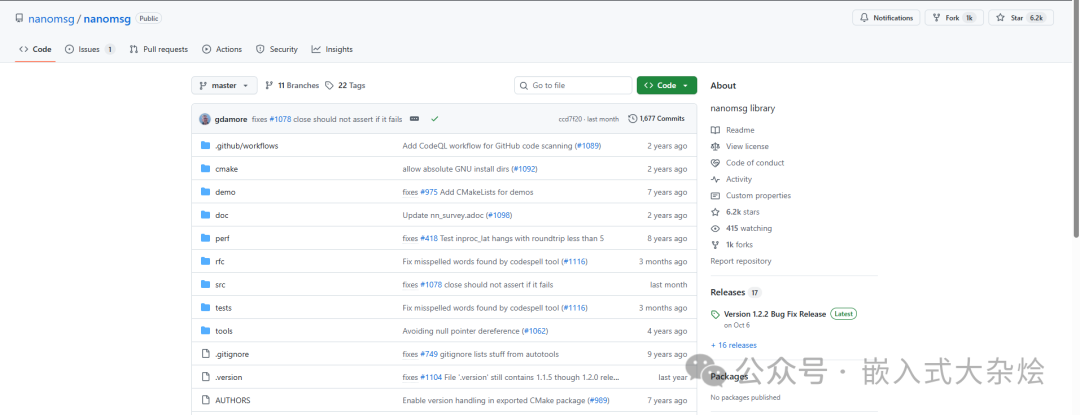
nanomsg is a high-performance communication library that implements several <span>scalable protocols</span>; the task of scalable protocols is to define how multiple application systems communicate, forming a large distributed system.
Positioning of nanomsg
nanomsg is not a simplified version of ZeroMQ; it is a redesign by Martin Sustrik, the author of ZeroMQ. The core idea is simple: to provide high-level messaging patterns while hiding low-level transport details.
In one sentence: it elevates socket programming to an abstract layer of “message communication patterns”.
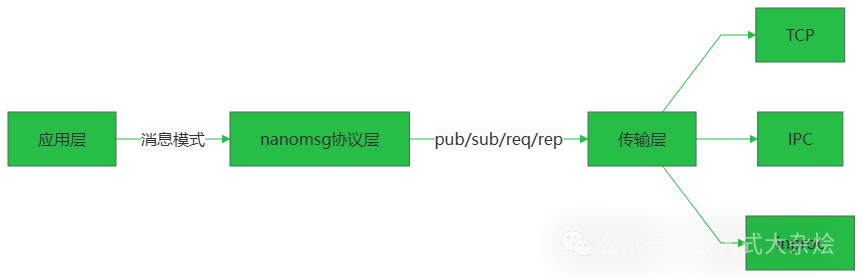
Key Data:
- Binary size: approximately 300KB when statically linked
- Runtime overhead: about 4KB of memory per socket
2. Usage Example
Assuming you have a temperature and humidity collector that needs to send data to a local display process, a logging process, and a network reporting process simultaneously.
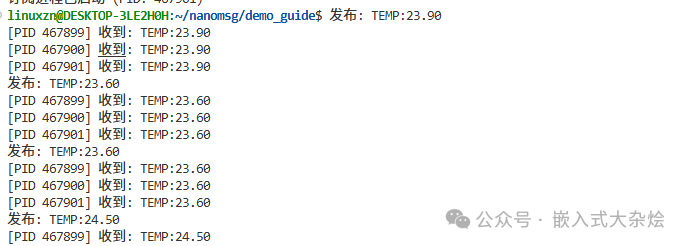
Publisher (Collection Process): publisher.c
#include <stdio.h>
#include <string.h>
#include <unistd.h>
#include <nn.h>
#include <pubsub.h>

// Simulate sensor reading
float read_temperature() {
    static float temp = 25.0;
    temp += (rand() % 20 - 10) / 10.0;
    return temp;
}

int main() {
    int pub = nn_socket(AF_SP, NN_PUB);
    if (pub < 0) {
        perror("nn_socket");
        return 1;
    }

    if (nn_bind(pub, "ipc:///tmp/sensor.ipc") < 0) {
        perror("nn_bind");
        return 1;
    }

    printf("Temperature collector started, publishing to ipc:///tmp/sensor.ipc\n");

    while (1) {
        char msg[32];
        float temp = read_temperature();
        int len = snprintf(msg, sizeof(msg), "TEMP:%.2f", temp);

        if (nn_send(pub, msg, len, 0) < 0) {
            perror("nn_send");
        } else {
            printf("Published: %s\n", msg);
        }
        sleep(1);
    }

    nn_close(pub);
    return 0;
}
Subscriber (Any Subscription Process): subscriber.c
#include <stdio.h>
#include <string.h>
#include <nn.h>
#include <pubsub.h>

int main() {
    int sub = nn_socket(AF_SP, NN_SUB);
    if (sub < 0) {
        perror("nn_socket");
        return 1;
    }

    // Subscribe to all messages (empty string means no filter)
    if (nn_setsockopt(sub, NN_SUB, NN_SUB_SUBSCRIBE, "", 0) < 0) {
        perror("nn_setsockopt");
        return 1;
    }

    if (nn_connect(sub, "ipc:///tmp/sensor.ipc") < 0) {
        perror("nn_connect");
        return 1;
    }

    printf("Subscriber process started (PID: %d)\n", getpid());

    char buf[64];
    int bytes;
    while ((bytes = nn_recv(sub, buf, sizeof(buf), 0)) >= 0) {
        buf[bytes] = '\0';
        printf("[PID %d] Received: %s\n", getpid(), buf);
    }

    perror("nn_recv");
    nn_close(sub);
    return 1;
}
Compilation:
gcc publisher.c -o publisher -lnanomsg
gcc subscriber.c -o subscriber -lnanomsg
Execution:
# Start the publisher
./publisher &

# Start multiple subscribers
./subscriber &
./subscriber &
./subscriber &
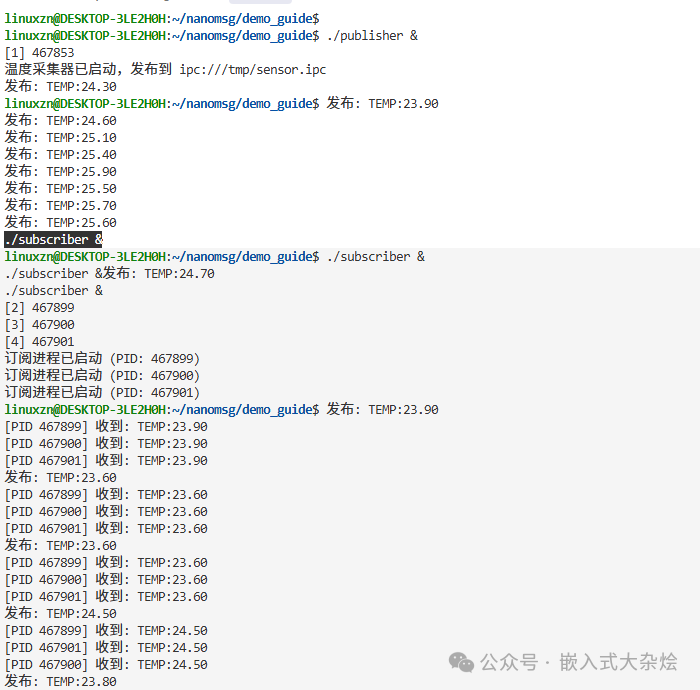
Notes:
- The publisher does not need to know how many subscribers there are: The sender and receiver are completely decoupled.
- Transport layer can be switched: Changing
<span>ipc://</span>to<span>tcp://192.168.1.100:5555</span>allows cross-machine communication. - Automatic connection management: Subscriber reconnection is automatic, no code required.
Comparison with traditional Socket code:
If implemented with raw sockets, the same functionality might require:
- Listening on a port →
<span>socket() + bind() + listen()</span> - Managing multiple client connections →
<span>accept()</span>+ connection list - Looping to send to all clients → Iterating through connections, handling
<span>EPIPE</span>errors - Handling client disconnections → Cleaning up the connection list
3. Introduction to nanomsg
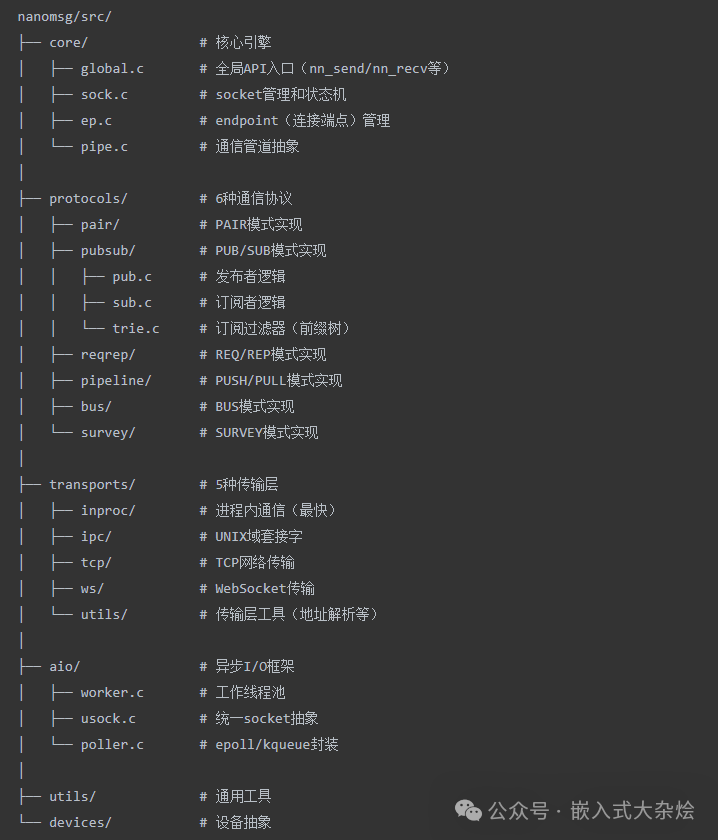
3.1 Directory Structure
Core Directory Structure:
Module Dependency Relationships:
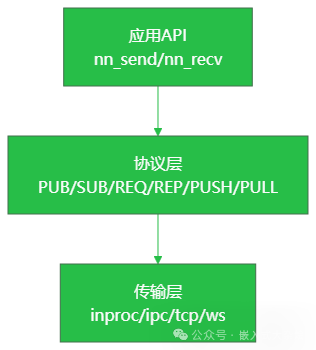
3.2 Layered Architecture
nanomsg adopts a “protocol stack” design, but unlike TCP/IP, the “protocols” here refer to message communication patterns.
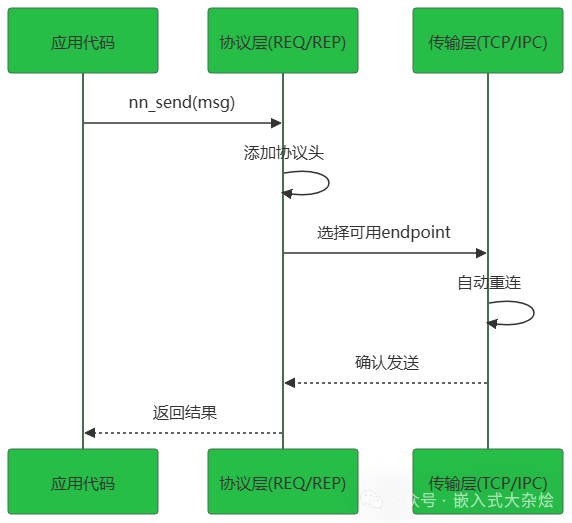
What does the protocol layer do?
Taking the REQ/REP (request-reply) pattern as an example, the protocol layer ensures:
- Strict message pairing: A REQ must wait for a REP before sending the next one.
- Automatic retries: If the peer crashes, requests will automatically route to other available servers.
- Load balancing: When a REQ connects to multiple REPs, it automatically distributes requests in a round-robin manner.
3.3 Zero-Copy
For large messages (like image data), nanomsg provides <span>nn_allocmsg</span> to reduce intermediate copies:
Method 1: Using nn_allocmsg (recommended):

Method 2: Regular send

Two internal paths of nn_sendmsg:
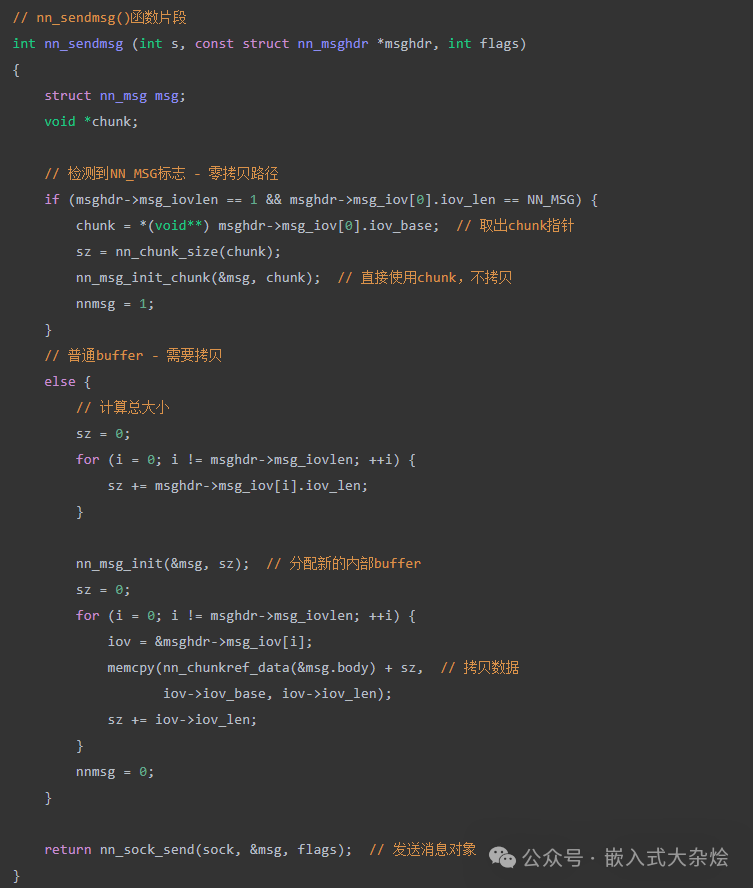
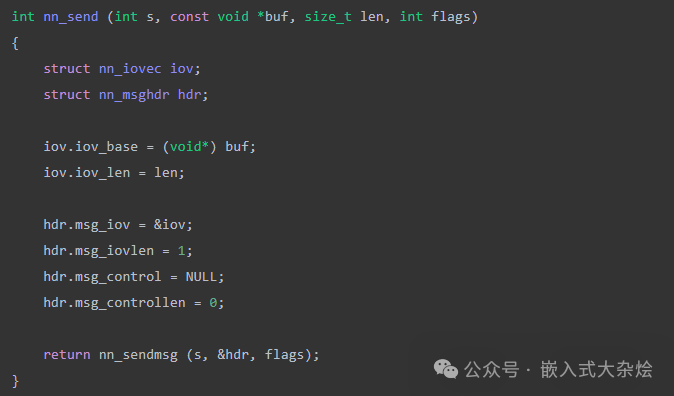
Comparison of copy counts between the two methods (using inproc transport as an example):
| Stage | Regular send | nn_allocmsg |
|---|---|---|
| Filling data | 1 copy | 1 copy |
| Sending to queue | 1 copy | 0 copies (passing pointer) |
| Receiving from queue | 1 copy | 0 copies (passing pointer) |
4. Choosing Protocol Patterns
nanomsg provides six basic patterns; how to choose?
| Requirement Scenario | Recommended Pattern | Reason |
|---|---|---|
| Multiple processes need the same data | PUB/SUB | Automatic broadcasting, subscribers are independent |
| Remote calls need to return results | REQ/REP | Strict request-response pairing |
| Tasks need to be processed in parallel | PUSH/PULL | Automatic load balancing |
| Need a bidirectional dedicated channel | PAIR | Simple and efficient |
| Multi-node mutual notification | BUS | Fully interconnected broadcasting |
| Need to collect responses from multiple nodes | SURVEY | Time-limited response collection |
90% of actual projects only need:
- PUB/SUB – Sensor data, event notifications
- REQ/REP – Configuration management, RPC calls
- PUSH/PULL – Task queues, pipeline processing
5. Important Experiences
5.1 Three Tips for Performance Optimization
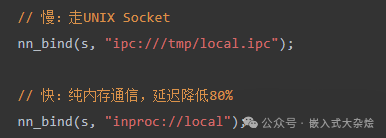
1. Prefer inproc
For processes on the same machine, prefer using <span>inproc://</span> instead of <span>ipc://</span>:
2. Set buffer sizes appropriately

The default is 128KB; for high-throughput scenarios, it can be adjusted to 1MB, but be mindful of memory usage.
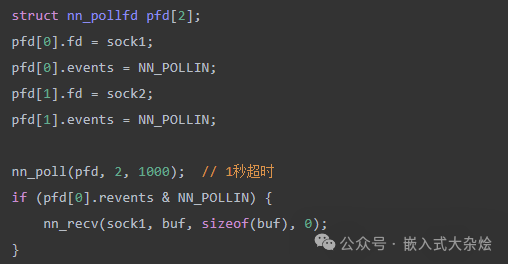
3. Use nn_poll for multiplexing
When a process needs to handle multiple sockets:
5.2 Comparison with Other Projects
| Project | Binary Size | Dependencies | Maturity | Applicable Scenarios |
|---|---|---|---|---|
| nanomsg | ~300KB | None | Stable (1.x) | Embedded, inter-process communication |
| nng | ~400KB | None | Active development | nanomsg upgrade |
| ZeroMQ | ~2MB | libsodium | Very mature | General distributed systems |
| Mosquitto | ~500KB | OpenSSL | Mature | MQTT specific |
- Resource-constrained (<16MB memory): choose nanomsg
- Need MQTT protocol: choose Mosquitto
- New project with moderate stability requirements: choose nng (new work by nanomsg author, API compatible)
Conclusion
The core problem solved by nanomsg is standardizing communication patterns. No longer needing to repeatedly implement “publish-subscribe” or “request-reply” for each project, just like you don’t need to implement TCP yourself. 90% of scenarios use PUB/SUB and REQ/REP, with a preference for inproc transport.
You might also like:
A lightweight ring buffer management library suitable for embedded systems!
Git interactive rebase to modify commit descriptions
Singleton pattern: The guardian of global state consistency in embedded systems
Embedded field: The ultimate showdown between Linux and RTOS!
Embedded software advancement guide, let’s level up together!
Clickto read the original text and get popular embedded books