 Click the blue text above to subscribe

Due to the soft and lightweight characteristics, soft machines are inherently safe and friendly to humans, and intelligent interactive soft machines are expected to integrate into human society. The intelligence of soft machines relies on the perception of the environment and their own state, making flexible sensors with simple structures but diverse functions extremely important. In recent years, ion-conducting hydrogels have provided new methods for large deformation/contact sensing, but the body resistance sensing mechanism (Ohm’s law) limits their sensitivity to 1, and current flexible sensors still cannot balance high sensitivity and large measurement range.
To address this contradiction, recently, Associate Professor Jia Kun’s research group from Xi’an Jiaotong University collaborated with Professor Yang Qingsheng’s group from Beijing University of Technology and Associate Professor Tao Ran’s group from Beijing Institute of Technology to develop a multifunctional hydrogel (HCHG) sensor based on high-density cracks. In the undeformed state, the crack parts of the sensor are closed, and under the action of an alternating electric field, anions and cations can pass through the closed cracks. When the hydrogel is deformed, the cracks gradually open/close at appropriate deformations, causing the cross-sectional area through which the ionic current flows to change continuously, resulting in a sharp change in resistance (Figure 1). Once the cracks are fully opened, the resistance continues to increase according to the same law as the unstretched hydrogel without cracks. The sensitivity of this flexible sensor reaches up to 80 at a 20% stretching strain, with tactile force sensitivity up to 0.45 kPa-1, and a detection range of up to 215%, while also offering multiple sensing configurations to meet various application needs. This flexible sensor can be widely used for measuring deformations on the surfaces of flexible objects.
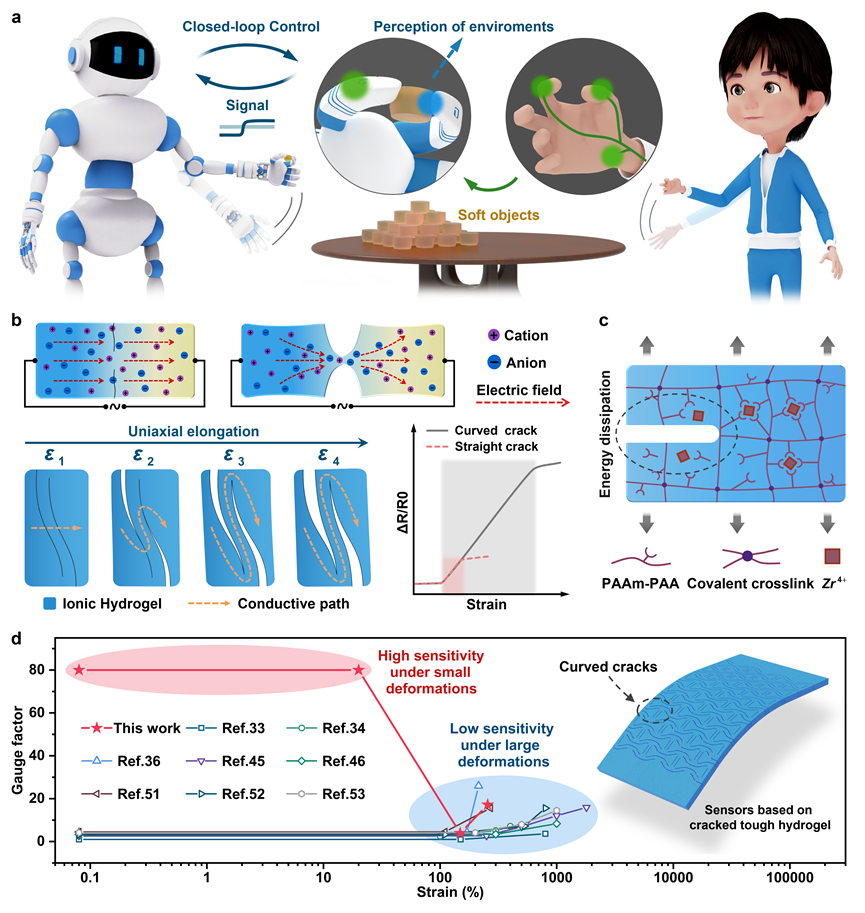
Figure 1 Working PrincipleAccording to the different geometric parameters and arrangement methods of the crack unit cells, the sensor can be designed into various configurations. By comparison, they chose a periodic crack pattern with optimal sensing performance and processability. First, they used P(AAm-co-AAc)/Zr4+ hydrogel containing lithium chloride as the sensor matrix and modified polyurethane (TPU) material as the testing substrate, systematically studying the basic principles and characteristics of sensing (Figure 2). The study found that when uniaxial elongation is applied, the relative resistance of various layouts exhibits similar responses, especially when the strain is less than 20%. Since the resistance response is insensitive to the component layout, the shape of the HCHG sensor can adapt to different application scenarios. The sensor has a long service life; after 10,000 loading-unloading tests with a maximum strain of 50%, the cracks do not propagate.
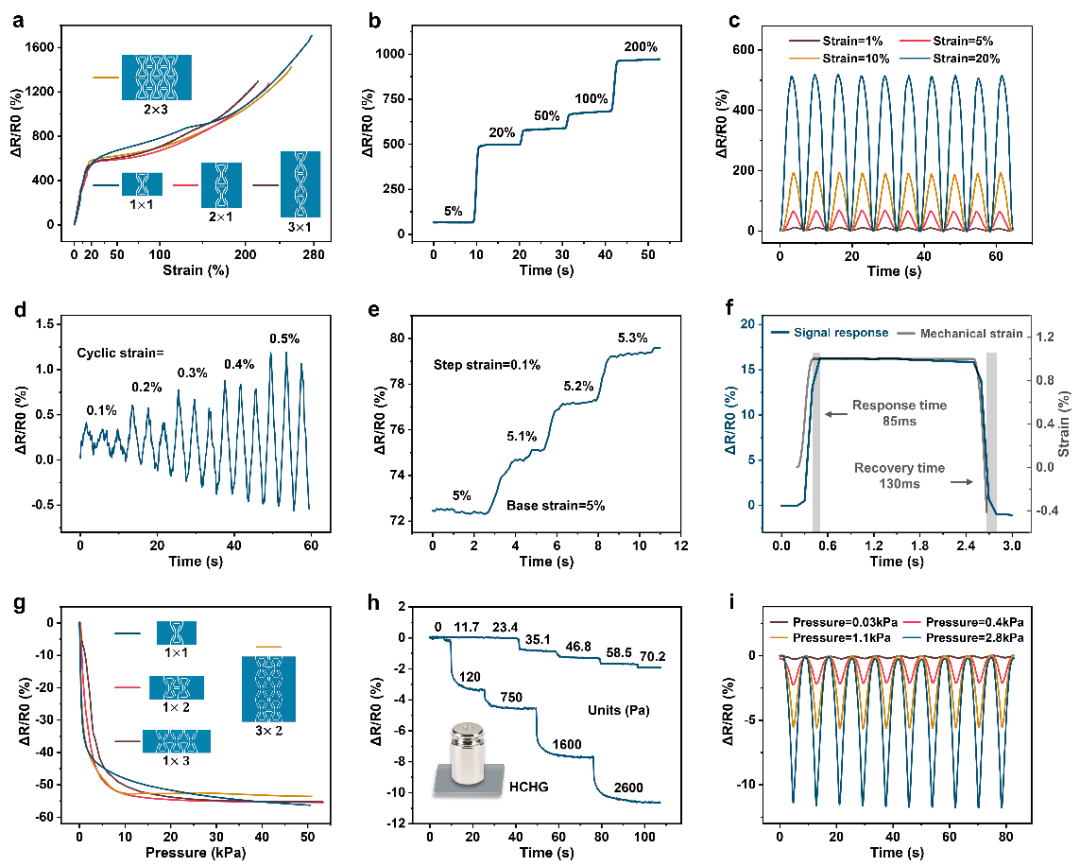
Figure 2 Basic Performance of the SensorNext, to distinguish between in-plane and out-of-plane deformations in the complex motion of soft machines, they proposed a sandwich structure (Figure 3). By decoupling the resistance responses of two sensors, they achieved the identification of stretching, compression, and bending states. Humans are the most vulnerable “soft machines”. The human skin undergoes slight deformations during fine movements, while larger deformations occur with joint movements during motion. Therefore, based on the sensor’s stretchability, high sensitivity, and large detection range, they applied body motion detection to the manipulation of robotic arms. The four joints of the robotic arm are mapped to the joints of the upper limb, and when the resistance changes of the four sensors mounted on the thumb, index finger, wrist, and elbow occur, they send drive signals to the corresponding servo motors, thus driving the robotic arm (Figure 4).
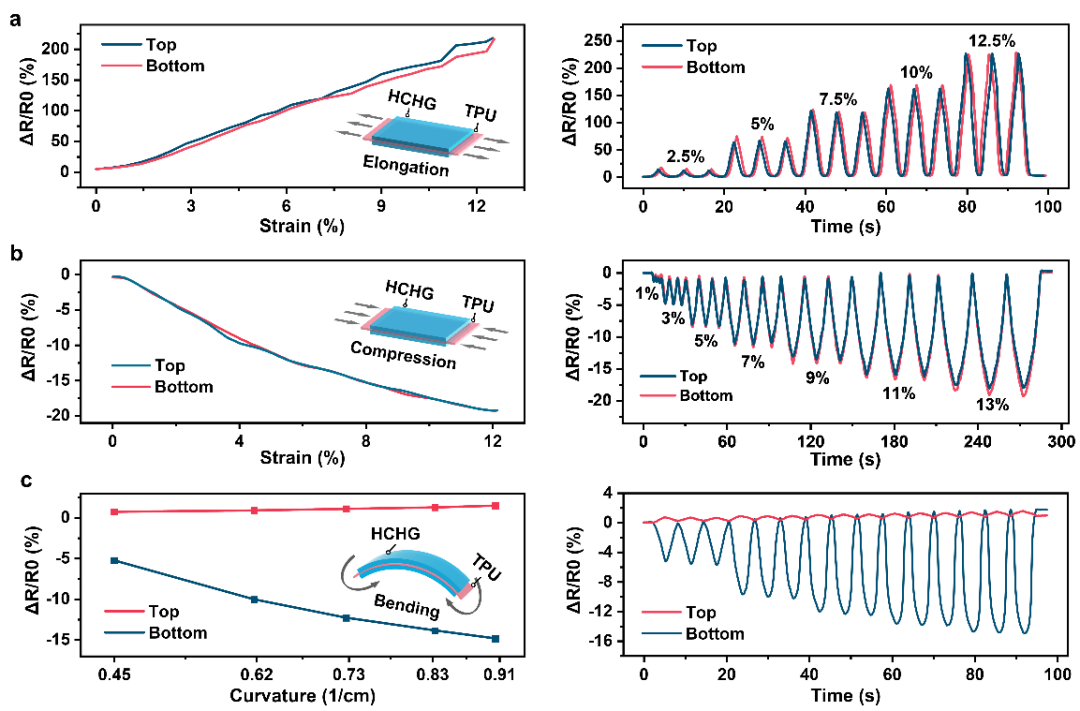
Figure 3 Multiple Sensing Signal Recognition
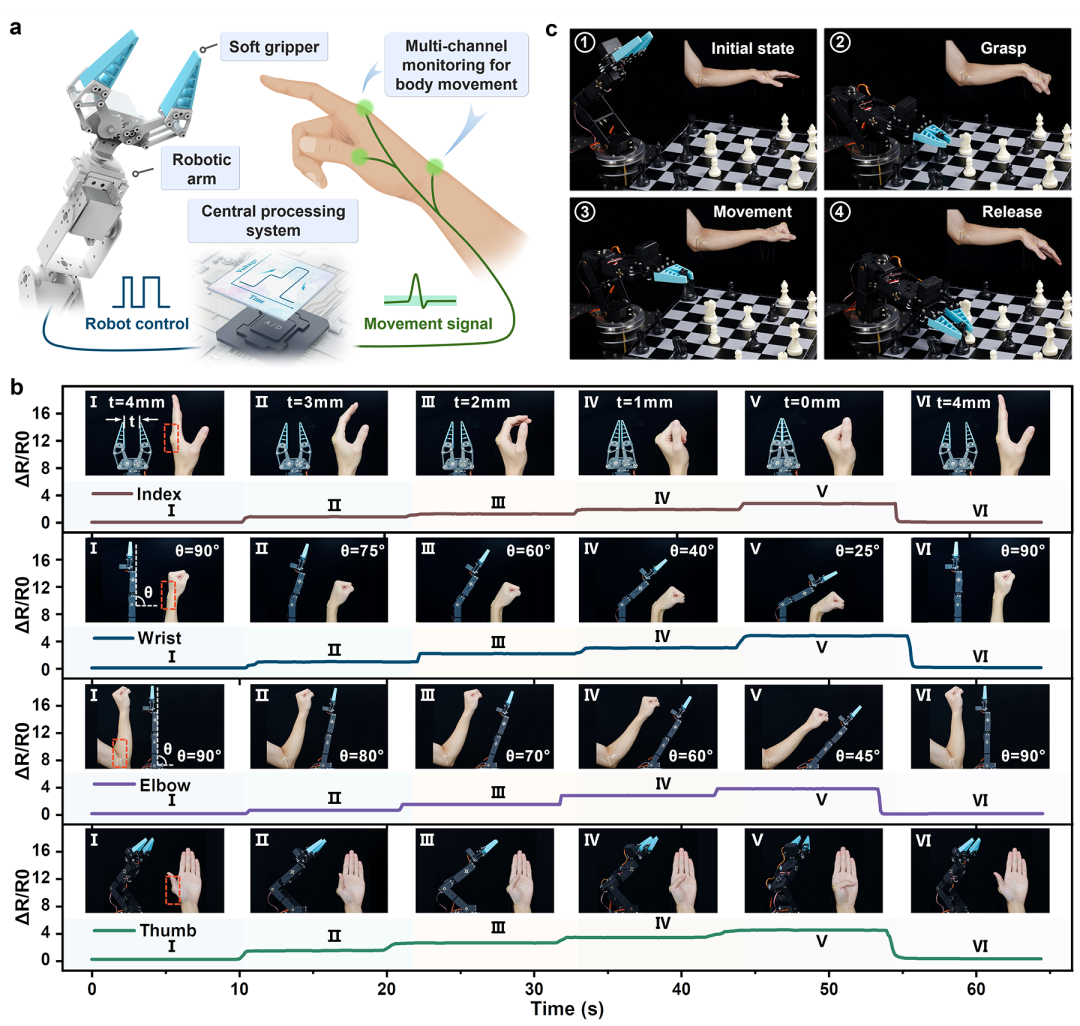
Figure 4 Human Motion Controlled Robotic Arm.To demonstrate the application prospects of this sensor in fields such as soft robotics, they installed the sensor on a soft robotic hand, endowing it with the ability to perceive during the process of grasping objects, achieving the protection of soft objects from damage during the grasping of soft materials such as sponges, tofu, and Dixie cups. (Figure 5).
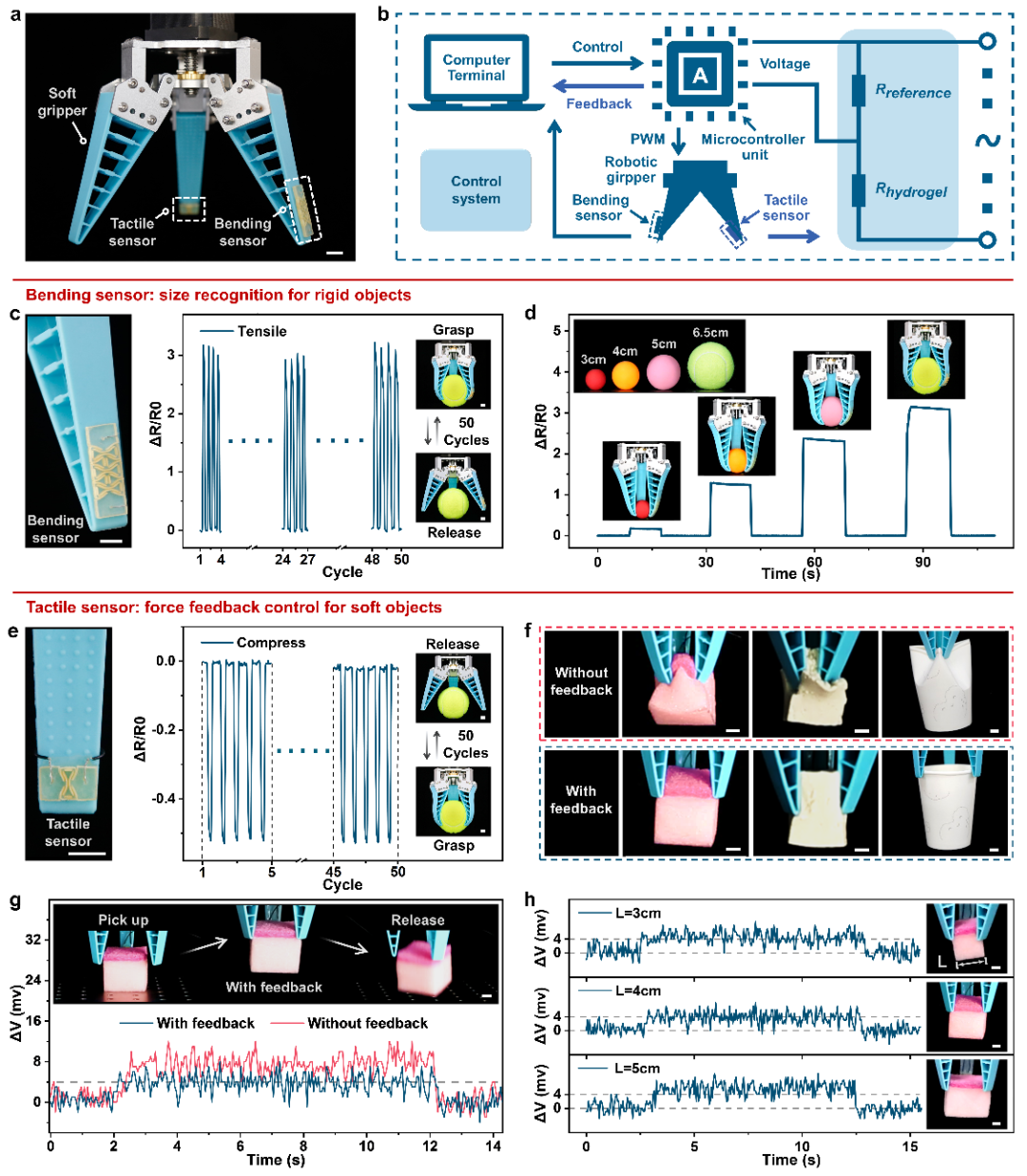
Figure 5 Grasping Soft ObjectsAssociate Professor Jia Kun’s team, in collaboration with Professor Yang Qingsheng’s team and Associate Professor Tao Ran’s team, reported a novel high-sensitivity, wide-detection range flexible stretchable sensor based on high-density cracks, systematically studying its working principle and basic characteristics, and demonstrating its broad application prospects. This research provides guidance for the design of flexible sensors and lays the foundation for the development of next-generation wearable devices and soft robots.This research work was published in Advanced Functional Materials under the title “Multifunctional Hydrogel Sensor with Curved Macro Cracks: A Strategy for High Sensitivity and Wide Detection Range.” Guo Yuhan (Graduate student at Beijing University of Technology), Guo Haoyu (PhD student at Xi’an Jiaotong University), and Han Yuwei (Graduate student at Xi’an Jiaotong University) are the co-first authors of this article. Associate Professor Jia Kun from Xi’an Jiaotong University, Professor Yang Qingsheng from Beijing University of Technology, and Associate Professor Tao Ran from Beijing Institute of Technology are the corresponding authors of the paper.
Original link:
https://doi.org/10.1002/adfm.202306820
Related Progress
Professor Suo Zhigang from Harvard University and Associate Professor Jia Kun from Xi’an Jiaotong University “Cell Rep. Phys. Sci.”: Chemical Sensors Based on Ion-Electron Interfaces
Professor Suo Zhigang’s research group at Harvard University and Associate Professor Jia Kun’s research group at Xi’an Jiaotong University collaborated: Magnetic Induction Assists Signal Transmission Between Electrons and Ions

Original article from Polymer Science. Personal forwarding and sharing are welcome. For publications or media wishing to reprint, please contact: [email protected]

Call for Papers
Experts and scholars are welcome to submit manuscripts (papers, project introductions, new technologies, academic exchanges, unit news, conference information, recruitment and enrollment, etc.) to [email protected], and please specify detailed contact information. Polymer Science® will promptly push and also publish on the China Polymer website.
Welcome to Join WeChat Group To meet the needs of colleagues from various sectors in polymer industry-academia-research, we have successively opened dozens of special discussion groups, including a group for polymer experts and scholars, as well as groups for polymer industry technology, entrepreneurs, PhD students, graduate students, media, journal, exhibition associations, etc., covering the entire polymer industry or field. Currently, it gathers over ten thousand top experts, scholars, technical personnel, and entrepreneurs from domestic and foreign universities, research institutes, and corporate R&D centers.
To apply to join the group, please first add the review WeChat account PolymerChina (or press and hold the QR code below), and please be sure to specify: Polymer + Name + Institution + Title (or Degree) + Field (or Industry), otherwise it will not be processed. Qualification will be reviewed before entering the relevant professional group.

Click here “Read the original text” for more.