

Week 34, 2025
One Sentence a Week: May you learn something
The doubts held by humanity are the seeds of science.
1
Triboelectric Charge Density
Pub Date: 2025-08-14
DOI:10.1002/adma.202510157
A Universal Orientation-Engineering Strategy for Enhancing Mechano-Electric Conversion Performance in Semi-Crystalline Biopolymers
Enhancing Mechano-Electric Conversion Performance in Semi-Crystalline Biopolymers through a Universal Orientation Control Strategy
Advanced Materials (IF 26.8)
Chinese Academy of Sciences
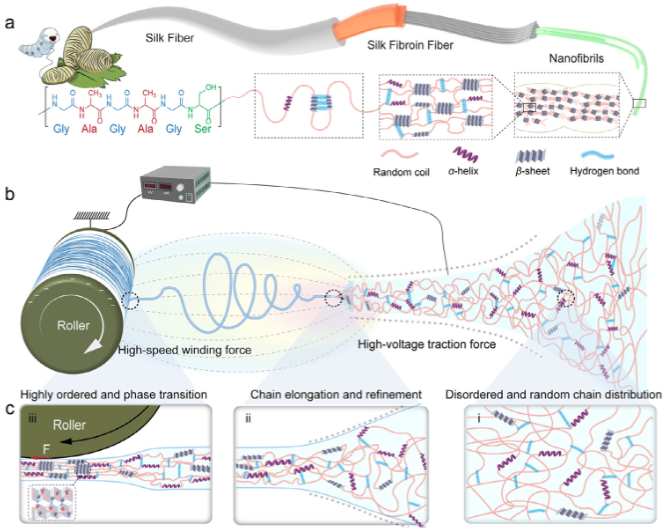
High charge density triboelectric materials are key to developing high-performance triboelectric nanogenerators. However, most semi-crystalline biopolymers exhibit low triboelectric output performance due to their inherent structural and physicochemical limitations. This paper develops oriented silk fibroin nanofibers (SFNs) with phase change polarization and enhanced carrier mobility through high-pressure, high-speed synergistic electrospinning technology. To analyze the molecular and aggregate structural changes of SFNs during the orientation process induced by high electric fields and stress, a multi-scale structural evolution model was constructed, ranging from microscopic molecular chains to mesoscopic aggregate structures and macroscopic fiber arrangements. The study found that as the orientation coefficient increased, the molecular conformation transitioned from disordered α-helices to ordered stacked β-sheets. The aggregated molecular chains gradually slid, reorganized, and aligned along the stress field direction, which helps regulate charge capture and carrier mobility characteristics. The orientation-adjusted SFN significantly enhanced interfacial charge transfer and bulk charge transport capabilities, thereby greatly improving triboelectric performance. This work not only provides new insights into the mechano-electric conversion mechanisms of semi-crystalline biopolymers but also offers guidance for the design of high charge density triboelectric materials.
Original link:
https://doi.org/10.1002/adma.202510157
Editor: Shen Xingxing
2
Increased Output Current
Pub Date: 2025-08-14
DOI:10.1002/adma.202508689
Linking Electron Cloud Potential Wells to Achieve Ultrahigh Output Current in a Triboelectric Nanogenerator
Connecting Electron Cloud Potential Wells to Achieve Ultrahigh Output Current in Triboelectric Nanogenerators
Advanced Materials (IF 26.8)
Northwestern Polytechnical University
With the rapid development of the Internet of Things and intelligent robotics technology, the demand for distributed flexible sensing networks and portable power supply devices is increasing. As a self-powered sensor and micro-nano energy supply device, triboelectric nanogenerators (TENGs) can convert irregular and ubiquitous mechanical energy from the environment into electrical energy, showing broad application prospects in human-machine interaction, soft robotics, and wearable medical devices. However, TENGs still face significant challenges in achieving ultrahigh current density and water resistance due to the insufficient utilization of electrons within the triboelectric layer. This paper proposes that connecting the electron cloud potential wells (ECPWs) of triboelectric materials can significantly enhance the output current of TENGs. This hypothesis is validated through experimental designs embedding reduced graphene oxide (rGO) conductive networks into ethyl cellulose (EC) and polydimethylsiloxane (PDMS) triboelectric layers. The TENG constructed based on this model achieved a current density of approximately 3533 mA·m-2 in the contact-separation working mode, setting a record for similar devices. Furthermore, this TENG maintained excellent operational stability even in high humidity and rainy environments. This research provides an innovative and promising strategy for fabricating TENGs with ultrahigh output current and water resistance, greatly expanding their practical application space in various fields.
Original link:
https://doi.org/10.1002/adma.202508689
Editor: Shen Xingxing
3
Piezoelectric Sensors
Pub Date: 2025-08-14
DOI:10.1016/j.matt.2025.102280
Polarizing-Free Triboelectric Dipoles Achieving High Piezoelectric-Like Sensors
Non-Polarized Triboelectric Dipoles: Achieving High-Performance Piezoelectric-Like Sensors
Advanced Functional Materials (IF 19)
China University of Geosciences
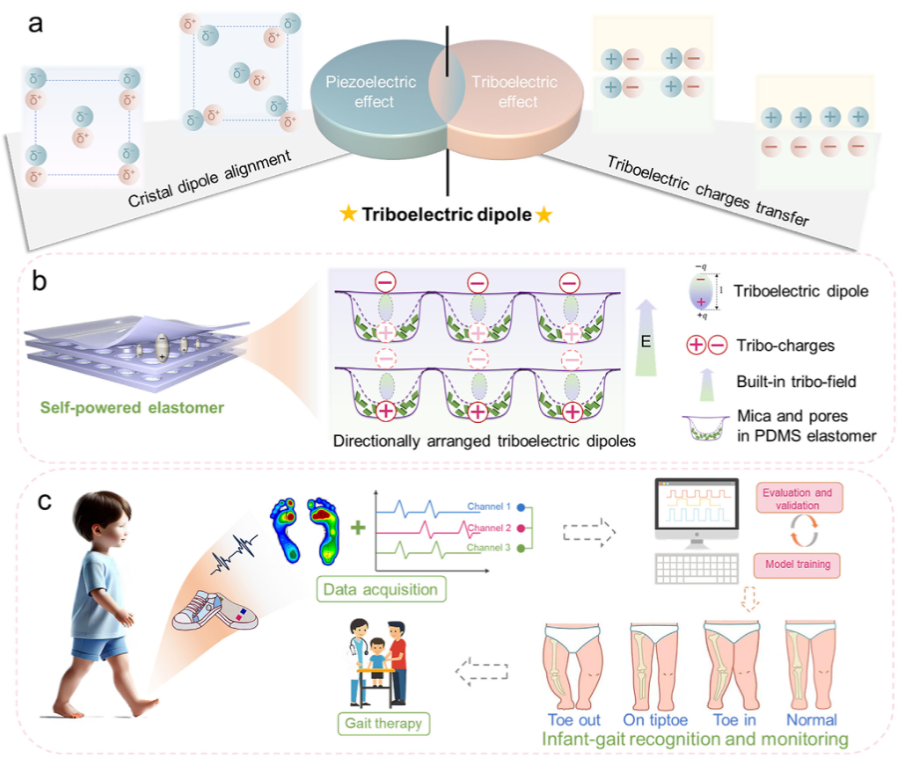
The fundamental limitation of traditional piezoelectric technology lies in its inherent dipole dependence, with conventional materials (such as ceramics, polymers, and piezoelectric elastomer composites) facing issues of mechanical rigidity, low polarization process efficiency, and compromised electromechanical conversion performance. This study proposes a paradigm-shifting triboelectric dipole architecture that simulates piezoelectric behavior through the contact electrification effect. By embedding rationally designed charge transfer pairs into an elastomer matrix, non-polarized triboelectric dipoles with controllable dipole moments are achieved through directional arrangement. This self-driven elastomer exhibits a high piezoelectric-like coefficient of 385 pC/N, a low Young’s modulus of 0.304 MPa, and intrinsic electrical output (10 V, 90 nA). Subsequent packaging processes ensure the material’s voltage retention capability after spray and immersion tests. Based on vertically arranged triboelectric dipole arrays, we developed self-driven piezoelectric-like sensor insoles for monitoring foot pressure. By integrating three-channel sensing data with a one-dimensional convolutional neural network, the system achieved a 97.92% accuracy rate in recognizing four gait types (O-shaped legs, X-shaped legs, toe walking, and normal walking), providing a reliable solution for early diagnosis. This research establishes a universal elastomer design strategy that simultaneously achieves low Young’s modulus and enhanced electromechanical conversion, opening new avenues for flexible self-driven systems in next-generation wearable medical technologies.
Original link:
https://doi.org/10.1002/adfm.202509310
Editor: Shen Xingxing
4
Cellulose Hydrogels
Pub Date: 2025-08-07
DOI:10.1016/j.jobab.2025.08.003
Surface Amination Modification of Cellulose Hydrogels for Enhancing Triboelectric Performance of Extreme Environment-Resistant Triboelectric Sensors
Surface Amination Modification of Cellulose Hydrogels Enhances the Performance of Extreme Environment-Resistant Triboelectric Sensors
Journal of Bioresources and Bioproducts ( IF 13 )
Fujian Agriculture and Forestry University
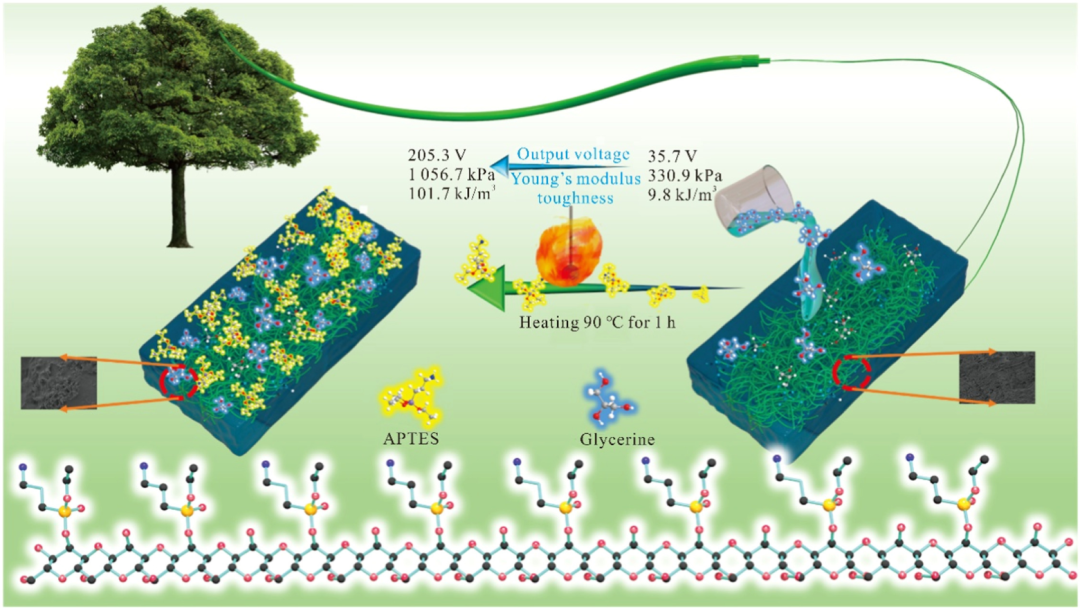
In recent years, multifunctional wearable flexible electronic devices based on hydrogels have been widely studied. Despite their broad application prospects, significant challenges remain in effectively powering these devices. Triboelectric nanogenerators (TENGs) assembled from surface-modified hydrogels may be one promising strategy to address this challenge. This study proposes the development of a multifunctional composite hydrogel synthesized through the amination surface modification of glycerol-cellulose hydrogel (3-aminopropyltriethoxysilane-glycerol-cellulose, A-GC). The resulting composite hydrogel is used to manufacture TENG electrodes, effectively harvesting mechanical energy to power flexible sensors. The composite hydrogel, primarily composed of cellulose and glycerol, with 3-aminopropyltriethoxysilane as the surface modification component, exhibits excellent mechanical properties and good conductivity (2.83 S/m). More importantly, it demonstrates a high triboelectric output performance of 205.3 V, maintaining long-term stable triboelectric output and achieving a maximum triboelectric power density of 732.1 mW/m2. Furthermore, even under extreme environmental conditions (–24 and 60 °C), the introduction of glycerol into the cellulose hydrogel enhances its mechanical properties and triboelectric output performance. The A-GC-TENG shows great potential in various applications, including mechanical energy harvesting and conversion, writing recognition, wireless signal transmission, and human-machine interaction, demonstrating significant application prospects in flexible wearable sensors and self-powered electronic devices. The development of composite cellulose hydrogels provides a new method for manufacturing high-performance flexible wearable electronic devices capable of operating effectively in harsh environments.
Original link:
https://doi.org/10.1016/j.jobab.2025.08.003
Editor: Shen Xingxing
5
Intelligent Soft Robotics
Pub Date: 2025-08-19
DOI:10.1002/adfm.202517158
Intelligent Soft Robotic System for Sensing and Recognition via Triboelectric-Based Multi-Sensor Fusion
Intelligent Soft Robotic System for Sensing and Recognition via Triboelectric-Based Multi-Sensor Fusion
Advanced Functional Materials ( IF 19 )
Hebei University of Technology
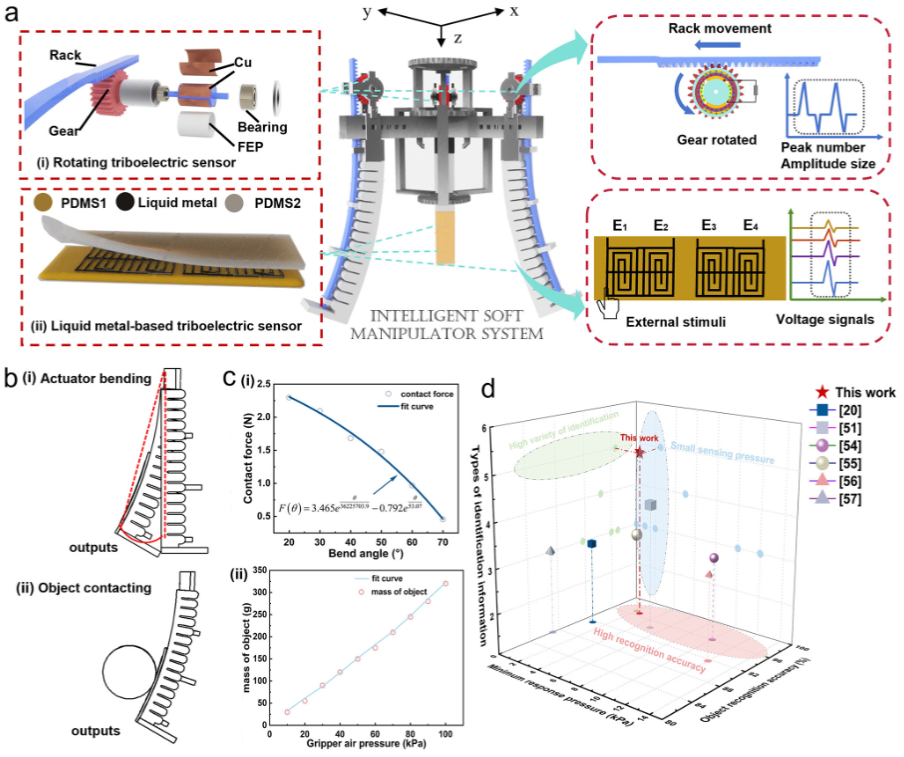
Triboelectric nanogenerators (TENGs) are key technologies for flexible electronic devices, especially tactile sensors, enabling flexible robotic hands to effectively interact with the external environment. Ongoing challenges include insufficient system flexibility, limited recognition datasets, and poor recognition accuracy. This paper proposes an intelligent soft robotic system that integrates triboelectric sensors for accurately capturing object grasping information. The liquid metal triboelectric sensor employs liquid metal fingerprint electrodes, demonstrating excellent performance retention under real-world conditions, whether in bent or stretched states, and can recognize four types of sensory information. Additionally, a rotating triboelectric sensor with a gear-rack structure enhances the measurement of the size and shape of the grasped objects. Compared to traditional robotic hands, this innovative multi-sensor fusion design allows the entire system to acquire more sensory information using fewer channels. Finally, by combining convolutional neural networks with deep learning techniques, the system achieved a 96.67% target recognition accuracy across 15 different objects. This easy-to-manufacture and efficient self-powered sensing system, equipped with a soft robotic hand, endows it with intelligent sensing capabilities and demonstrates significant potential for digital real-time recognition.
Original link:
https://doi.org/10.1002/adfm.202517158
Editor: Shen Xingxing
6
Droplet Triboelectric Nanogenerator
Pub Date: 2025-08-19
DOI:10.1002/adfm.202514116
Dynamic Real-Time Monitoring of Microalgal Photosynthesis Using Droplet Triboelectric Nanogenerators
Dynamic Real-Time Monitoring of Microalgal Photosynthesis Using Droplet Triboelectric Nanogenerators
Advanced Functional Materials ( IF 19 )
Dalian Polytechnic University
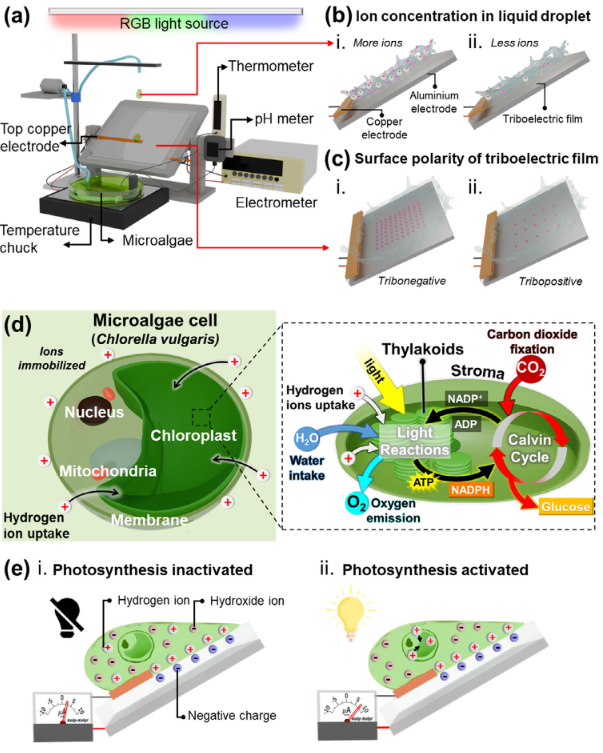
Understanding microalgal photosynthesis is crucial for improving cultivation efficiency and maximizing carbon fixation. However, traditional monitoring technologies often suffer from low temporal resolution or accuracy, hindering real-time optimization of photometric parameters and leading to suboptimal system performance. Here, a new technology is developed using droplet triboelectric nanogenerators (D-TENGs) to monitor the photosynthetic dynamics of Chlorella, enabling real-time understanding of its response to various light stimuli through different degrees of solid-liquid interface charge interactions. Exposure to red and blue light increases the short-circuit charge (Qsc) from 15 nC to 20 and 18 nC, respectively, indicating enhanced microalgal photosynthetic activity. When photosynthesis is activated, Qsc exhibits a cyclical pattern due to the interaction between light-dependent reactions and the Calvin cycle. Temperature-related measurements support this trend, where the cycle period linearly decreases with increasing temperature, reflecting reduced enzyme efficiency of the Calvin cycle at lower temperatures. Additionally, as light intensity increases, the average short-circuit charge (Qavg) shows a trend consistent with theoretical predictions of light inhibition at high intensities. This work highlights the potential of D-TENGs as a promising real-time and non-invasive tool for monitoring microalgal photosynthesis, opening new avenues for detecting the carbon fixation capabilities of various microalgal species under different light conditions.
Original link:
https://doi.org/10.1002/adfm.202514116
Editor: Shen Xingxing

Editor: Shen Xingxing | Reviewer: Bulala