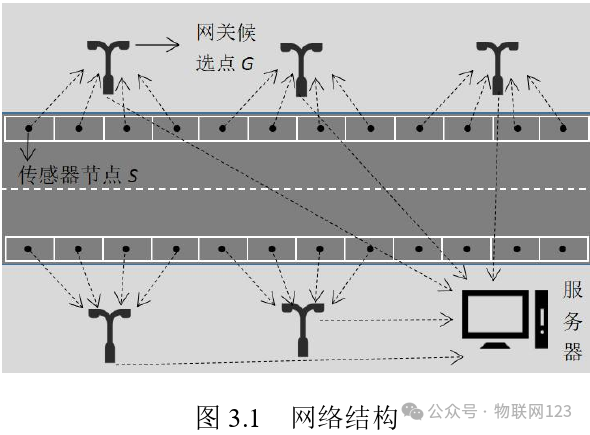
With the acceleration of urbanization, the number of vehicles is increasing year by year, and the problem of finding parking has become increasingly severe. The IoT-based smart roadside parking management system can monitor the status and duration of parking spaces in real-time, which can be used for parking guidance, parking fee calculation, reverse vehicle search, and illegal parking detection, making it one of the important ways to alleviate parking difficulties.The roadside parking detection IoT relies on gateways to achieve bidirectional connections between sensor nodes and remote servers. The reasonable deployment and scheduling of gateways are key to ensuring network connectivity. However, there are still several issues in the research on gateway deployment and scheduling: 1) In the roadside parking detection IoT, the deployment location of the gateway is limited (usually deployed on roadside lamp posts), and the coverage objects of the gateway—sensor nodes—are linearly distributed along the road with known positions. Existing deployment algorithms mostly do not consider these characteristics, making them unsuitable for roadside parking scenarios, resulting in excessive coverage redundancy in gateway deployment. 2) In the roadside parking detection IoT, changes in parking space status can affect the communication links between sensor nodes and gateways. Since the communication link between the gateway and sensor nodes can be easily interfered with by vehicles (which can be considered as large metal objects), when a parking space changes from vacant to occupied, the number of gateways that the sensor nodes can communicate with decreases, while when a parking space changes from occupied to vacant, the number of gateways that the sensor nodes can communicate with increases. Existing gateway scheduling algorithms do not consider this feature, leading to the inability to ensure that all sensor nodes are connected to a gateway when the number of gateways that sensor nodes can communicate with decreases, and high energy consumption and overload of gateways when the number of gateways that sensor nodes can communicate with increases.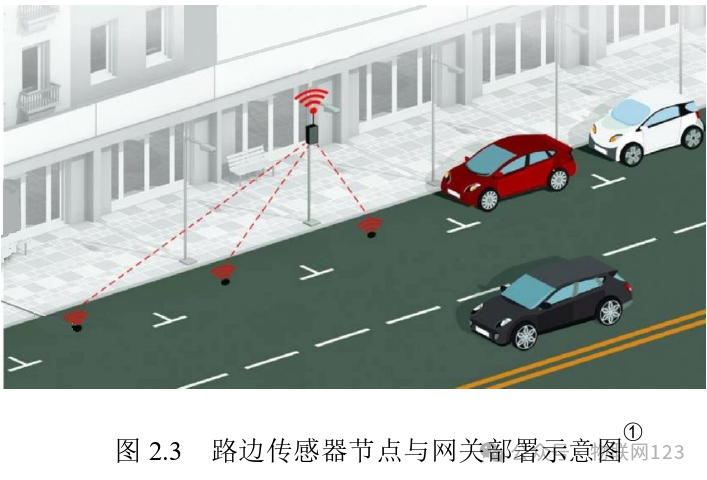
 References:[1] Guo Xiaohong. Research on Gateway Deployment and Scheduling Algorithms for IoT-Based Roadside Parking Detection Systems [D]. Dongguan University of Technology, 2023.
| Disclaimer: The images and text used in this article are all reprinted. If there are any copyright issues, please inform us immediately, and we will confirm and delete the content based on the proof materials you provide. The content of this article represents the author’s personal views and does not represent the views or positions of IoT 123. |
Special Reminder:
IoT Professional CommunicationGroup We welcome individuals related to the IoT industry to join, and we also welcome various industry experts, seniors, and influencers to join the group. In addition to not being able to post sensitive content, pornographic content, and it is not recommended to send promotional content multiple times, other content can be freely discussed~——Communication QQ Group 724511126, Friends who want to join the group, please note: Name – Organization – Research Direction (without notes, please forgive us for not passing), and will be invited to join the group after the editor reviews.!