C Language Programming Notes – Examples of Using scanf and Arithmetic Operators
C Language Programming Notes - Examples of Using scanf and Arithmetic Operators

Example 1: Input a time duration (in minutes) from the keyboard and calculate how many hours and minutes that duration corresponds to.(1) Source Code #include <stdio.h> #include <stdlib.h> int main(){ int a,b,c; printf("Please enter a time duration (in minutes):"); scanf("%d",&a); b=a/60; c=a%60; printf("%d minutes is equivalent to %d hours and %d minutes\n",a,b,c); return 0;} (2) … Read more
Introduction to C Language Basics: From the First Program to Variable Operations

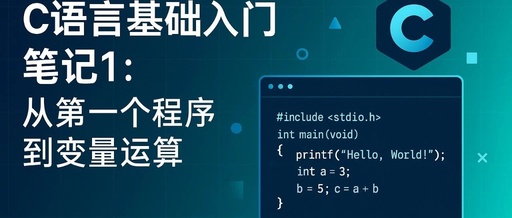
Introduction to C Language Basics: From the First Program to Variable Operations

Introduction to C Language Basics: From the First Program to Variable Operations This article records some of the most fundamental knowledge points and practical examples I encountered while learning C language, suitable for beginners who are just getting started with C as a reference. (1) The First C Program #include <stdio.h> int main() { printf("Hello … Read more

C++ Lecture 3: The ‘Secret Symbols’ that Drive Code Execution

C++ Lecture 3: The 'Secret Symbols' that Drive Code Execution

In the previous lecture, we learned how to create variables—these “little boxes” that can store numbers, text, and even boolean values (true/false). However, these “boxes” that can only store data are not very useful; the true magic of programming reveals itself when these “boxes” start to interact, accumulate, compare, and even make judgments. The core … Read more

C++ Basics: Fundamental Operations

C++ Basics: Fundamental Operations

C++ provides a rich set of operators to manipulate data, which can be broadly categorized into the following types: Arithmetic Operators Relational Operators Logical Operators Assignment Operators Increment and Decrement Operators Other Operators (bitwise operations, comma operator, <span>sizeof</span>, etc., which will be briefly mentioned in this article) 1. Arithmetic Operators Used to perform basic mathematical … Read more

Python Basics 02 — Fundamental Data Types and Input/Output

Python Basics 02 -- Fundamental Data Types and Input/Output

Python Basics 02 — Fundamental Data Types and Input/Output 1. Fundamental Data Types Data + Algorithm = Program; data is the core of a program, and data types are classifications and definitions of data. For example, the game coins you see are an integer, and the name of the game character is a string; these … Read more

Chapter 6: Operators in C Language

Chapter 6: Operators in C Language

Chapter 6: Operators in C Language In C language, operators are used to perform various operations. C language includes a rich set of operators that can process data, perform comparisons, and execute logical operations. The types of operators are numerous and are generally divided into the following categories: 1. Arithmetic Operators 2. Relational Operators 3. … Read more

Detailed Explanation of Escape Characters and Operators in Python: A Must-Have Guide for Programming Basics

Detailed Explanation of Escape Characters and Operators in Python: A Must-Have Guide for Programming Basics

In daily programming, escape characters and operators are the fundamental symbols we use to communicate with computers. They are like the syntax rules of the programming world; only by mastering these basics can we write correct and efficient code. Today, we will delve into the usage techniques of escape characters and operators in Python! ⚡ … Read more

Understanding C Language Vocabulary Elements

Understanding C Language Vocabulary Elements

In the world of C programming, mastering its vocabulary elements is fundamental for writing code smoothly. 1. The Six Major Tokens in C Language There are six key tokens in C language, which are the basic units that make up C code: keywords, punctuation, identifiers, constants, string constants, and operators. 2. Rules for Identifiers Identifiers … Read more

Getting Started with Python: Mastering print, input, and Operators in 30 Minutes

Getting Started with Python: Mastering print, input, and Operators in 30 Minutes

For beginners in Python, the first step is often to understand how to make the program “speak” (output), how to make the program “listen” (input), and how to make the program perform calculations (operators). These three fundamental concepts are like the “letters + phonetics” when learning English, forming the foundation of all Python programs. Today, … Read more

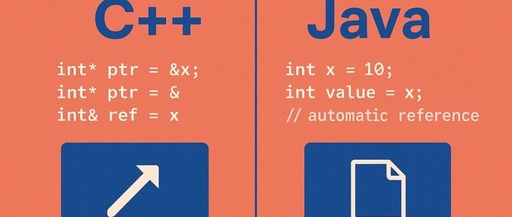
Key Differences Between Operators in Java and C++

Key Differences Between Operators in Java and C++

A summary of the main differences between operators in Java and C++ is provided. Please add any omissions. Pointer and Reference Operators Available in C++, Not in Java: // C++ – Pointer and Reference Operators int x = 10; int* ptr = &x; // Address-of operator (&) int value = *ptr; // Dereference operator (*) … Read more