Chapter 4: Introduction to Python (Part 1)

Chapter 4: Introduction to Python (Part 1)

1. String Formatting Output 1.1 Core Methods and Key Features 1. Plus (+) Concatenation Method Principle: Directly connects string literals with variables using + to form a complete string. Core Syntax: “Fixed Text” + Variable1 + “Fixed Text” + Variable2 Example: name = “Zhang San” info = “I am ” + name + “, I … Read more

Python Day 2: Escape Characters

Python Day 2: Escape Characters

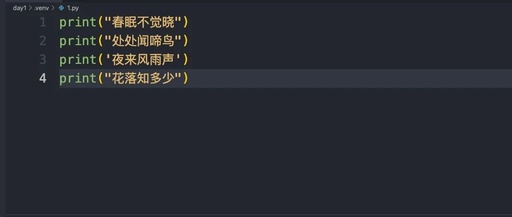
IntroductionWhen using the print statement to output variables, it can be inconvenient for certain special characters, such as newline and tab symbols, as shown in the code below.When printing this ancient poem, we often need to use four print statements. To output this content in a single line, we need to use the newline escape … Read more

Detailed Explanation of Escape Characters and Operators in Python: A Must-Have Guide for Programming Basics

Detailed Explanation of Escape Characters and Operators in Python: A Must-Have Guide for Programming Basics

In daily programming, escape characters and operators are the fundamental symbols we use to communicate with computers. They are like the syntax rules of the programming world; only by mastering these basics can we write correct and efficient code. Today, we will delve into the usage techniques of escape characters and operators in Python! ⚡ … Read more

A Quick Guide to C++ Data Types: From int/double to Escape Characters

A Quick Guide to C++ Data Types: From int/double to Escape Characters

Highlights: “Quick Guide” provides a sense of direction, covering various data types comprehensively, from basics to advanced topics like escape characters<span> </span> and <span> , etc.</span> 2 Data Types C++ requires that when creating a variable or constant, the corresponding data type must be specified; otherwise, memory cannot be allocated for the variable. 2.1 Integer … Read more

Python Notes for Unemployed Programmers

Python Notes for Unemployed Programmers

A string is a sequence composed of independent characters, typically enclosed in single quotes (”), double quotes (“”), or triple quotes (”’ ”’ or “”” “””). For example, the following representations are actually the same: s1 = ‘python’s2 = “python” s3 = “””python””” print(s1==s2==s3) D:\pyproject\venv\Scripts\python.exe D:/pyproject/py05.py True Process finished with exit code 0 Python supports … Read more