As the core operator of “China’s Silicon Valley,” Zhangjiang Hi-Tech (600895) has seen its value surge, reflecting the market’s urgent expectations for the domestic substitution of China’s semiconductor industry. The company will enjoy long-term dividends driven by the robust development of the semiconductor industry under the strong impetus of national strategy.
Diving deeper into Zhangjiang Hi-Tech may seem a bit late, as the market has already fully priced it in, but it is still worthwhile to organize the investment logic for future reference. There may still be opportunities to enter at lower prices, after all, the only constant in life is change itself.
1. Strategic Positioning: Technology Real Estate + Technology Investment Banking
1. Basic Situation
(1) The technology real estate developer is transforming into a dual-driven model of “space operation + industrial investment.” Zhangjiang Science City is one of the four comprehensive national science centers in the country, covering a planned area of 220 square kilometers. As the core developer and operator of Zhangjiang Science City, Zhangjiang Hi-Tech has now formed three leading industries: integrated circuits, biomedicine, and artificial intelligence, with evident agglomeration effects.
(2) A mature technology industry investment system. It has the capability to support equity financing from angel rounds to IPOs, covering the entire lifecycle of enterprises through a “direct investment + fund + incubation” model. As of the first quarter of 2025, it has cumulatively invested 9.5 billion yuan, leveraging nearly 60 billion yuan of social capital. By relying on “bid linkage,” it introduces high-growth enterprises, forming a closed loop of “investment, cultivation, and exit.”
2. Core Valuation Logic:
(1) Through Zhangjiang Haicheng’s 10.779% stake in Shanghai Micro Electronics (with domestic 28nm lithography machine mass production verification underway), it positions itself at a key link in the localization of semiconductor equipment.
(2) Through Zhangjiang Haicheng’s 14.1968% stake in Chip Micro-Assembly (a company spun off from Shanghai Micro Electronics, which has delivered 500 stepper lithography machines within just six months of its establishment, and has strong IPO potential in three years).
(3) The “landlord + shareholder” model forms an industrial ecological closed loop, supporting key enterprises in the park to strengthen and grow through investment and financing. If related enterprises successfully achieve IPOs, their subsequent capacity expansion, technological iteration, and industrial chain integration needs will further feed back into the park’s rental and sales income, realizing value reconstruction.
2. Business Development: Three Driving Forces in Coordination
1. Industrial Space Development
By the first half of 2025, it will hold 1.63 million square meters of rental properties, with 3.34 million square meters under construction, accounting for 53.08% of rental income. The land appreciation potential of the science city is significant, and new projects before 2027 will release performance elasticity.
2. Industrial Investment Layout
Focusing on three hot areas: integrated circuits (RISC-V architecture), biomedicine, and AI (represented by companies like SMIC, MicroPort Medical, and Qingtong Intelligent), the investment returns continue to grow. In the first half of 2025, an additional 60 million yuan was invested externally. The second phase of the VC fund Suifeng has completed fundraising, while the second phase of the angel fund Suiyue is ongoing.
It holds 8.33% of the shares in the Shanghai Financial Development Investment Fund Phase II, indirectly holding 0.026% of Ant Financial’s equity, sharing in the fintech dividends.
3. Industrial Service Empowerment
In partnership with Hualing Co., it is building a public service platform for chip testing to meet the common needs of early-stage integrated circuit companies, strengthening the stickiness of the industrial chain.
3. Performance and Valuation
1. Performance
The financial report shows that in the first half of 2025, revenue was 1.704 billion yuan (up 39.05% year-on-year), with a net profit attributable to shareholders of 369 million yuan (up 38.64% year-on-year). The rapid growth in net profit attributable to shareholders is mainly due to a net investment income of 335 million yuan achieved in the first half of the year, an increase of 422.91% compared to the same period last year.
Revenue has grown rapidly, with real estate sales amounting to 1.129 billion yuan in the first half of 2025 (up 55.43% year-on-year); and real estate rental income of 567 million yuan (up 17.01% year-on-year).
2. Valuation Assessment
Zhangjiang Hi-Tech’s transformation is a microcosm of China’s industrial upgrade, shifting from land dividends to innovation dividends, leading to a change in the company’s valuation anchor. The real estate component in the market value structure is decreasing year by year, while the industrial investment component is increasing year by year. In 2024, the average share price is expected to be around 16 yuan, corresponding to a market value of 25 billion yuan. In October 2024, after Shanghai Micro Electronics withdrew its IPO materials, the market expected the backdoor listing process to accelerate, and the market value quickly rose to 45 billion yuan. If we conservatively estimate Shanghai Micro Electronics’ market value at 200-300 billion yuan, a 10% stake corresponds to a market value of 20-30 billion yuan. The current market value is 56 billion yuan, indicating that the market price has basically absorbed the positive factors.
However, the subsequent valuation still has two main expectations: first, Shanghai Micro Electronics, as a core enterprise in the domestic lithography machine field, is expected to receive a very high valuation (possibly exceeding 600 billion yuan); second, although Chip Micro-Assembly was established for a short time, as a strong sibling of Shanghai Micro Electronics, it is not ruled out that it will go for an IPO in three years, thus there is also a certain imagination space for subsequent valuations.
Risk Warning
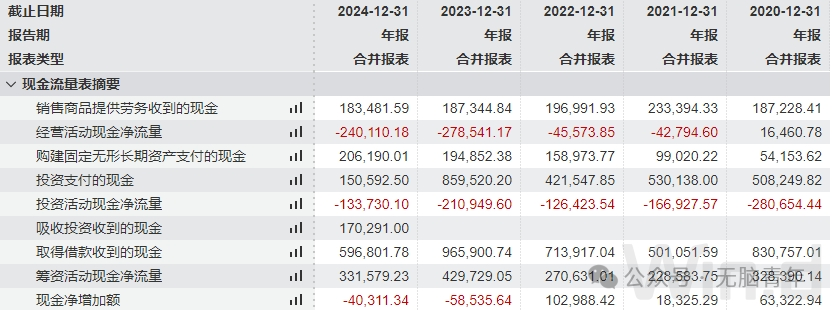
For four consecutive years, operating cash flow has been negative,and cash funds only cover 30% of current liabilities,requiring close attention to its debt repayment risks. If the domestic lithography machine technology breakthroughs do not meet expectations, combined with the impacts of real estate regulation and changes in industrial subsidies, its liquidity may raise alarms, and the market may quickly withdraw support.