During the PCB design process, before routing, we generally stack the layers of the project we are designing, calculating the impedance based on thickness, substrate, number of layers, and other information. After the calculations, we typically obtain the content shown in the figure below.
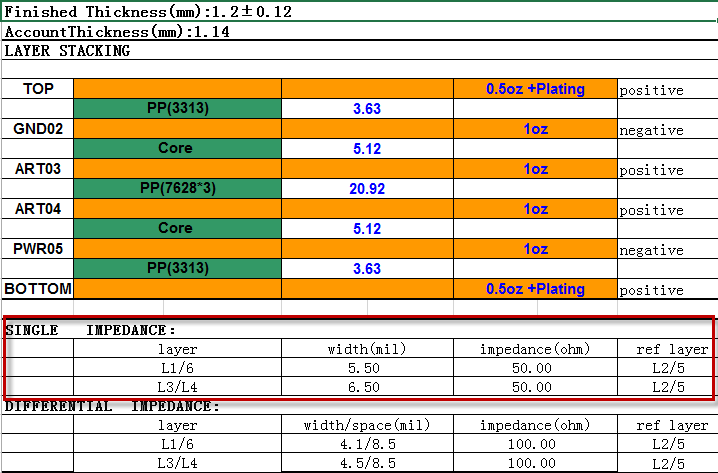 From the above figure, it can be seen that the single-ended networks designed generally control the impedance at 50 ohms. Many people may wonder why the control is set at 50 ohms instead of 25 ohms or 80 ohms.First, the default choice is to use 50 ohms, and this value is widely accepted in the industry. Generally speaking, it must be based on a standard established by a recognized organization, and everyone designs according to this standard.A significant portion of electronic technology originates from the military; initially, the technology was used for military purposes and gradually transitioned to civilian use.In the early days of microwave applications during World War II, the choice of impedance completely depended on the needs of the application, with no standard value. As technology advanced, it became necessary to establish impedance standards to achieve a balance between economy and convenience.In the United States, the most commonly used conduits are made from existing measuring rods and water pipes, with 51.5 ohms being quite common. However, the adapters and converters encountered are typically 50-51.5 ohms. To address these issues for the Army and Navy, an organization called JAN was established (later known as DESC), which was specially developed by MIL. After comprehensive consideration, 50 ohms was ultimately chosen, leading to the manufacturing of related conduits and the establishment of various cable standards.At that time, the European standard was 60 ohms. Soon after, under the influence of dominant companies in the industry like Hewlett-Packard, Europeans were also forced to change, so 50 ohms eventually became a standard that has been followed in the industry, becoming a convention. Consequently, PCBs connected to various cables are also required to adhere to the 50-ohm impedance standard for impedance matching.Secondly, the formulation of general standards is based on a comprehensive consideration of PCB manufacturing processes and design performance and feasibility.From the perspective of PCB manufacturing processes, considering the equipment of most PCB manufacturers, producing PCBs with 50-ohm impedance is relatively easy to achieve.From the impedance calculation process, it is known that too low an impedance requires wider trace widths and thinner dielectrics or larger dielectric constants, which is difficult to satisfy in high-density boards; conversely, too high an impedance requires narrower trace widths and thicker dielectrics or smaller dielectric constants, which is not conducive to EMI and crosstalk suppression. Additionally, from the perspective of multilayer boards and mass production, the reliability of processing would be poorer.Controlling the impedance at 50 ohms allows for the use of common substrates (such as FR4) and common core materials, producing standard board thicknesses (like 1mm, 1.2mm, etc.), and designing common trace widths (4~10 mil), making it very convenient for board manufacturers to process, with relatively low requirements for the equipment used.From the perspective of PCB design, 50 ohms is also chosen after comprehensive consideration. In terms of PCB routing performance, lower impedance is generally better. For a given trace width transmission line, the closer the plane distance, the corresponding EMI will decrease, and crosstalk will also be reduced.However, from the perspective of the entire signal path, it is crucial to consider one key factor: the driving capability of the chip. In the early days, most chips could not drive transmission lines with impedances less than 50 ohms, and higher impedance transmission lines were inconvenient to implement, so a compromise was made to adopt 50-ohm impedance.Therefore, 50 ohms is generally chosen as the default value for single-ended signal control impedance.