A traditional fuel vehicle requires about 500 to 600 chips, a mild hybrid vehicle requires about 1000 chips, while plug-in hybrids and pure electric vehicles require at least 2000 chips.This means that during the rapid development of smart electric vehicles, there is not only an increasing demand for advanced process chips but also a continuous increase in demand for traditional chips. MCUs are one of them, with the number mounted on vehicles constantly growing, and domain controllers bringing new demands for high safety, high reliability, and high-performance MCUs.MCU, Microcontroller Unit, refers to a microcontroller that integrates the CPU, memory, and peripheral functions on a single chip, forming a chip-level computer with control functions. It is mainly used for signal processing and control, serving as the core of intelligent control systems.MCUs are closely related to automotive electronics, industry, computers and networks, consumer electronics, home appliances, and the Internet of Things. Automotive electronics is the largest market within automotive electronics, accounting for as much as 33% globally.
MCU Structure
MCUs are mainly composed of a Central Processing Unit (CPU), memory (ROM and RAM), input/output (I/O) interfaces, serial ports, counters, and more.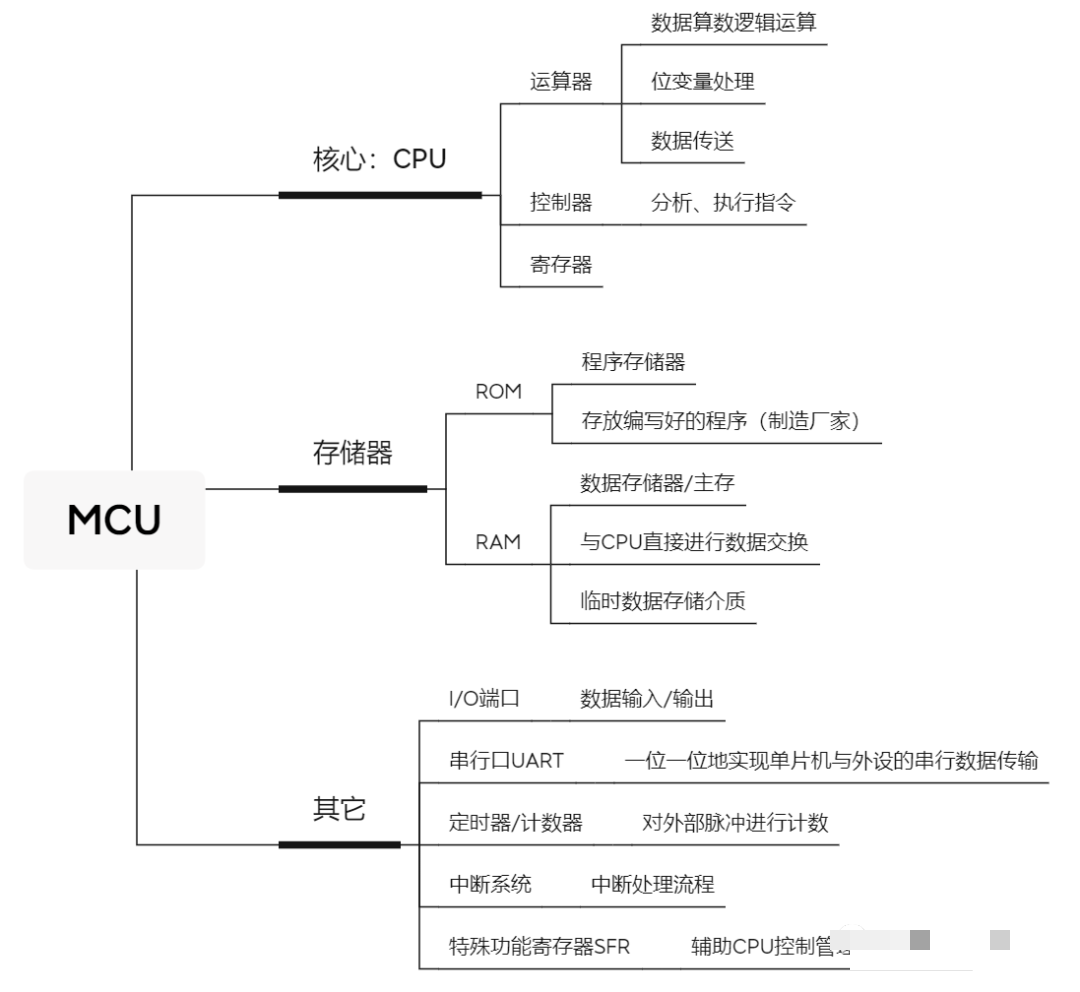 CPU: Central Processing Unit is the core component inside the MCU. The arithmetic component can perform arithmetic logic operations, bit variable processing, and data transfer operations, while the control component coordinates work according to a certain timing sequence, analyzing and executing commands.ROM: Read-Only Memory is the program storage, used to store programs written by manufacturers. Information is read in a non-destructive manner, and the data saved will not disappear when power is lost. The MCU processes according to the pre-compiled program.RAM: Random Access Memory is the data storage, which directly exchanges data with the CPU. This data cannot be retained after power loss. During program execution, data can be read and written at any time and is generally used as temporary data storage for the operating system or other running programs.Relationship Between CPU and MCU:The CPU is the core of computation and control. Besides the CPU, the MCU also includes ROM or RAM, making it a chip-level chip. A common variant is SoC (System on Chip), which is a system-level chip that can store and run system-level code, running operating systems like QNX and Linux, and includes multiple processing units (CPU + GPU + DSP + NPU + storage + interface units).
MCU Bit Width
The bit width refers to the width of data processed by the MCU at one time. A higher bit width means stronger data processing capability. Currently, the main types are 8, 16, and 32 bits, with 32 bits accounting for the largest share and growing rapidly.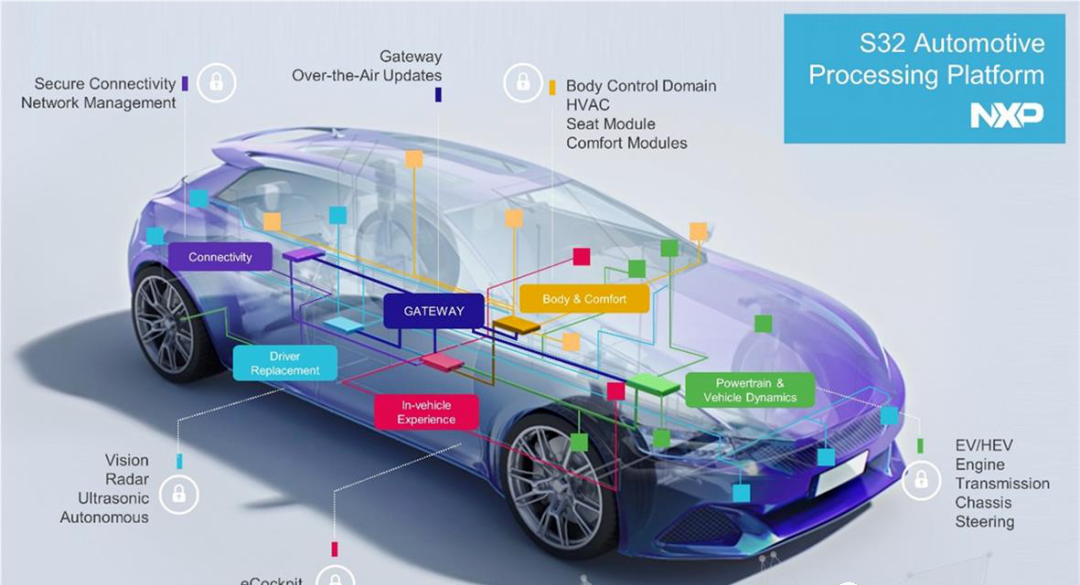 In automotive electronics applications, 8-bit MCUs are cost-effective and easy to develop, currently used for simpler control tasks such as lighting, wipers, windows, seats, and doors. However, for more complex tasks such as instrument displays, in-car entertainment systems, power control systems, chassis, and driver assistance systems, 32-bit MCUs are primarily used, and with the evolution of electric, intelligent, and connected vehicles, the computational requirements for MCUs are also increasing.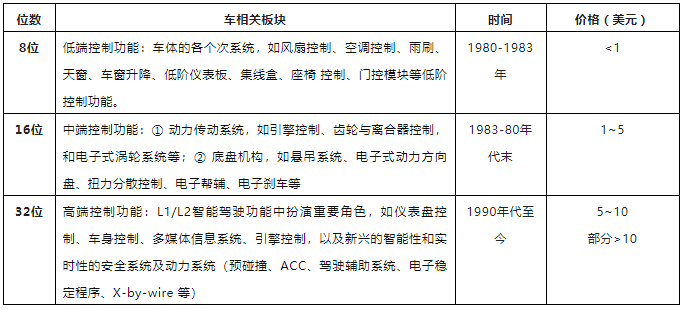
MCU Automotive Certification
Before entering the OEM supply chain system, MCU suppliers generally need to complete three major certifications: during the design phase, they must adhere to functional safety standards ISO 26262; during the wafer and packaging phases, they must follow AEC-Q001~004 and IATF16949; and during the certification testing phase, they must follow AEC-Q100/Q104.Among these, ISO 26262 defines four safety levels ASIL, from low to high: A, B, C, and D; AEC-Q100 is divided into four reliability levels, from low to high: 3, 2, 1, and 0. AEC-Q100 series certification generally takes 1-2 years, while ISO 26262 certification is more difficult and takes longer.
Application of MCU in the Smart Electric Vehicle Industry
MCUs are widely used in the automotive industry, for example, in body accessories, power systems, chassis, in-car infotainment, and intelligent driving. With the arrival of the smart electric vehicle era, demand for MCU products will become even stronger.Electrification:1. Battery Management System (BMS): BMS needs to control charging and discharging, temperature, and balancing between batteries; the main control board requires one MCU, and each slave control board also requires one MCU;2. Vehicle Control Unit (VCU): Energy management in electric vehicles requires an additional vehicle control unit, which needs to be equipped with a 32-bit high-end MCU, with the quantity varying according to each manufacturer’s solutions;3. Engine Controller/Transmission Controller: Replacement of existing systems, the inverter control MCU for electric vehicles replaces the engine controller of fuel vehicles. Due to the high speed of the motor, it needs to be slowed down through a reducer, and the MCU control chip installed for this purpose replaces the transmission controller of fuel vehicles.Intelligentization:1. Currently, the domestic automotive market is still in the L2 high penetration stage. Considering the overall cost and performance, OEMs still use a distributed architecture to add ADAS functions, and as the load rate increases, the number of MCUs for processing sensor information also increases accordingly.2. With the increasing number of cockpit functions, the role of higher-performance chips is becoming increasingly important, leading to a decline in the position of corresponding MCUs.Manufacturing ProcessMCUs primarily have high requirements for computing power and do not have high requirements for advanced processes. Additionally, the embedded storage within them limits the improvement of MCU processes. Therefore, the current automotive-grade MCU process nodes are mainly based on mature processes above 40nm, while some advanced automotive MCU products use 28nm processes. Automotive-grade chip specifications mainly use 8-inch wafers, and some manufacturers, especially IDM, have begun transitioning to 12-inch platforms.Currently, 28nm and 40nm processes are the market mainstream.
Typical Domestic and International Enterprises
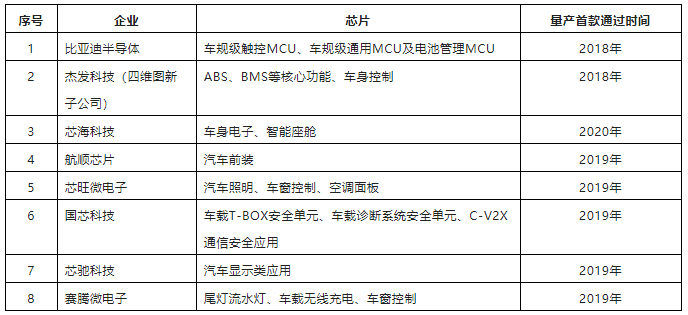
Compared to consumer and industrial-grade MCUs, automotive-grade MCUs have higher requirements for operating environments, reliability, and supply cycles. Additionally, automotive-grade MCUs have relatively higher certification thresholds, longer certification times, and difficult access, leading to a concentrated market structure. In 2021, the top five MCU companies accounted for as much as 82% of the market.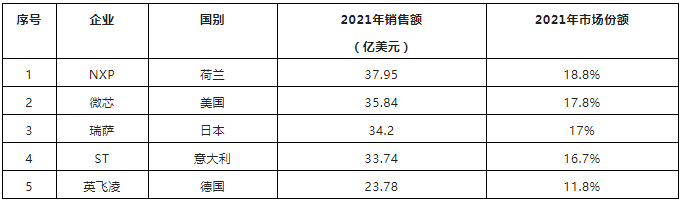 Currently, China’s automotive-grade MCUs are still in the introduction phase, and there is significant potential for localization and domestic substitution in the supply chain.
 Source:Automotive Electronics and SoftwareThis article is sourced from the internet, and the copyright belongs to the original author. If there is any infringement, please contact for deletion.END