
As “AI toys” become a buzzword in the industry, capital is flooding in, and technical solutions are emerging one after another, more and more entrepreneurs are entering this field. However, a question worth asking repeatedly is:
Is the greatest opportunity AI brings to toys really just to make them “smarter”?
If it only makes toys capable of speaking more, recognizing more commands, and connecting to more powerful computing resources, then AI is merely a facade draped over the toys. True transformation has never been about technical parameters, but about value reconstruction.
The greatest opportunity AI brings to toys is not functional upgrades, but meaning reconstruction.

The true essence of toys has never been about “play”.
Before the advent of AI, toys had already taken on roles deeper than mere “entertainment”.
They are friends of children in their childhood, the first objects of emotional projection during their growth;
They are decorations on the corners of adult desks, gentle reminders of certain times;
They are companions in solitude, gateways to imagination, and outlets for emotions.
The essence of toys has always been about “relationships”;
not the relationship between people and objects, but the relationship between people and emotions, and between people and themselves.
AI’s intervention allows toys for the first time to move from “passively carrying emotions” to “actively responding to emotions”.
This is the greatest opportunity.
AI does not make toys more like machines,
but more like “existences”.
The most dangerous trend in the current industry is “AI for the sake of AI”.
Constantly adding features: telling stories, translating, conversing, connecting to the internet, recognizing emotions… seemingly powerful, yet neglecting a fundamental question:
Do users really need these? Or are we just showing off technology?
Truly moving AI toys are not those that can say many things, but those that can say the right thing at the right time;
not those with many functions, but those that are “just there” at that moment.
The core that AI gives to toys is a sense of “presence”—
a presence that does not judge, does not disturb, but is always there to accompany.
This is not an algorithm issue, but an empathy issue.
From “smart products” to “emotional partners”.
The fundamental value of AI toys is to help users establish a stable, soft, and sustainable emotional connection.
A truly valuable AI toy may not be complex, but it understands:
-
To lower the speaking speed when a child is crying, rather than raising the volume.
-
To accompany a solitary person at night, rather than constantly pushing notifications.
-
To understand silence when there is none, rather than forcing interaction.
It cares not about “what you want me to do”, but about “are you okay right now”.
When toys begin to understand “emotional states” rather than just “voice commands”,they truly complete the leap from product to partner.
The greatest opportunity lies in “human connection”.
What AI toy entrepreneurs truly need to face is not a technical issue, but a grander proposition:
For whom are we solving what emotional problems?
Is it to alleviate loneliness for left-behind children?Is it to provide an outlet for anxious urban youth?Is it to create gentle companionship for the elderly?Or is it to create new communication bridges for parent-child relationships?
When this question is seriously considered, the product direction will naturally become clear.
AI is not the protagonist; the user’s emotions are.
Do not create “smart yet indifferent” toys anymore.
This world does not lack “talking toys”;what is truly scarce is “a presence willing to listen”.
The reasons many AI toys fail are not due to outdated technology, but a lack of emotional warmth.They act like overly enthusiastic salespeople rather than patient friends.
Entrepreneurs should be cautious:Do not use “computational power” to cover up “emotional emptiness”.
Truly successful AI toys do not make users exclaim “how amazing”,but make people unable to help but say:“It seems to understand me.”
The future of AI toys does not belong to show-offs,
but to those who empathize.
As the technological gap narrows, what truly sets apart is not the chips, but the ability to understand.
Whoever can understand the flow of human emotions more deeply,whoever can capture the real needs of loneliness, stress, joy, and companionship more delicately,will be closer to the future.
AI toys are not a technological race, but an emotional slow walk.
Three Questions for AI Toy Entrepreneurs
Before investing in each product development, entrepreneurs might ask themselves:
1. If there were no AI, would this toy still have meaning?
2. Which emotion of the user have we truly seen?
3. Does it accompany “time” or “heart”?
When the answers are clear, technology will have transformative value.
In conclusion: The real opportunity is gentleness.
The greatest opportunity AI brings to toys is not to create smarter objects, but to make companionship a reality.
In this fast-paced era, people do not lack information, but lack moments of being understood.AI toys may just be that presence that can guard our emotions.
Not to replace humans, but to gently approach them.
When we no longer ask “how smart is it”,but start asking “is it gentle”,AI toys will truly mature.
Hoomii Planet|AI Toy Industry Business Observer
【Scan to enter: AI Toy Business Observation ▪ Supply Chain】

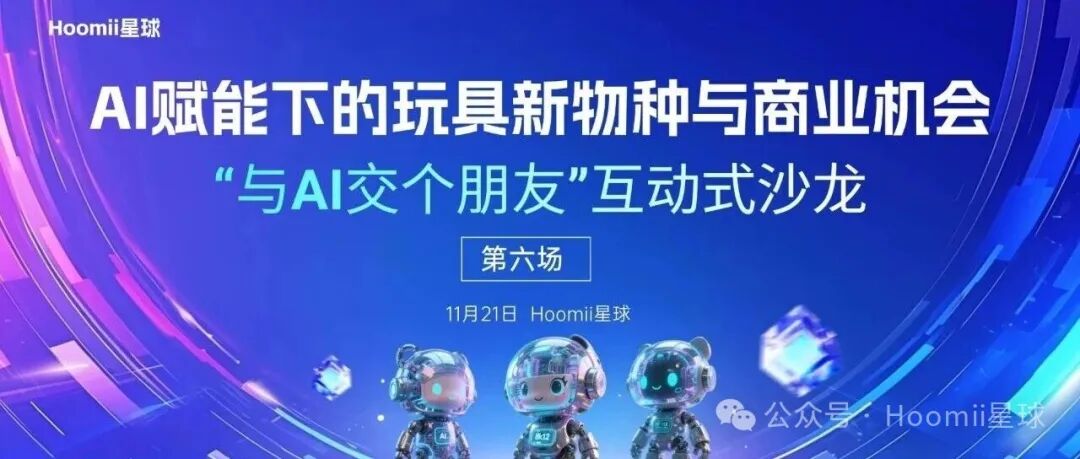
Hoomii Planet AI Toy Salon Session Six|“Roadshow × Private Domain × Channel” Three-Dimensional Growth Closed Loop
Breaking News! AI toys have been officially “incorporated into the national industrial narrative”.
In the AI era, everyone can have an intelligent entity, starting with AI toys.