IntroductionWhen we sit in a modern car and press the start button, the dashboard lights up with colorful animations, the central display mirrors the rich features of our smartphones, and the driving assistance systems silently protect our safety. Have you ever wondered what technology supports this seamless experience? The answer lies in the mysterious world of “automotive embedded systems”.This article will serve as your first map to explore this world. We will avoid obscure technical jargon and use vivid metaphors and clear logic to guide you into the electronic heart of the car, understanding how its “brain,” “nervous system,” and “senses” work together.1. From “Functional Cars” to “Software-Defined Cars”Imagine your personal computer: it has a general operating system (like Windows) that can install various software for writing documents, playing games, watching movies, and its functions are ever-changing. The systems in cars, however, are entirely different; they are mostly “dedicated computers”, also known as embedded systems.In simple terms, automotive embedded systems are computer systems designed to perform specific control tasks. They tightly integrate hardware and software, hidden in various corners of the car, quietly fulfilling their designated missions.
- Hardware is the body: including processors (CPU), memory, power supply, various chips, as well as sensors and actuators.
- Software is the soul: a series of programmed instructions that tell the hardware “what to do” under “what conditions.”
From traditional engine control and window lifting to today’s popular adaptive cruise control and automatic parking, the realization of every intelligent function relies on the support of embedded systems. Cars are evolving from purely mechanical products into highly intelligent “wheeled robots”, which is the result of the development of embedded technology.2. Understanding ECUIf we say that a car has a central “brain,” that might be an oversimplification. A more accurate description is that a modern car has a “hive mind”—a collaboration of dozens or even hundreds of micro-brains called ECUs (Electronic Control Units).ECUs are the concrete embodiments of automotive embedded systems.You can think of them as mini-computers dedicated to specific tasks.
- Engine ECU: responsible for controlling fuel injection and ignition timing, ensuring the engine runs efficiently and smoothly.
- Body Control ECU: manages wipers, windows, lights, locks, etc., enhancing convenience and comfort.
- Anti-lock Braking System ECU: performs high-frequency braking during emergency stops to prevent wheel lock-up, ensuring vehicle direction control.
- Central Entertainment System ECU: handles touchscreen operations, navigation, music playback, etc., providing infotainment functions.
These ECUs each have their own responsibilities, but they need to communicate through a “language” to achieve complex functions. This leads us to the next core concept: in-vehicle networks.3. Understanding In-Vehicle Network Protocols (CAN, LIN, Ethernet)If we compare hundreds of ECUs to various departments in a company, then their communication requires an efficient “office system.” This system is the in-vehicle network, and the rules of communication are the network protocols.
Scenario Reenactment: The Amazing “Rainy Day Auto Window Closure”
Imagine you get out of the car and it suddenly starts to rain, and the vehicle is equipped with the “rainy day auto window closure” feature. How is this function achieved? The following diagram clearly shows how signals collaborate across different bus protocols: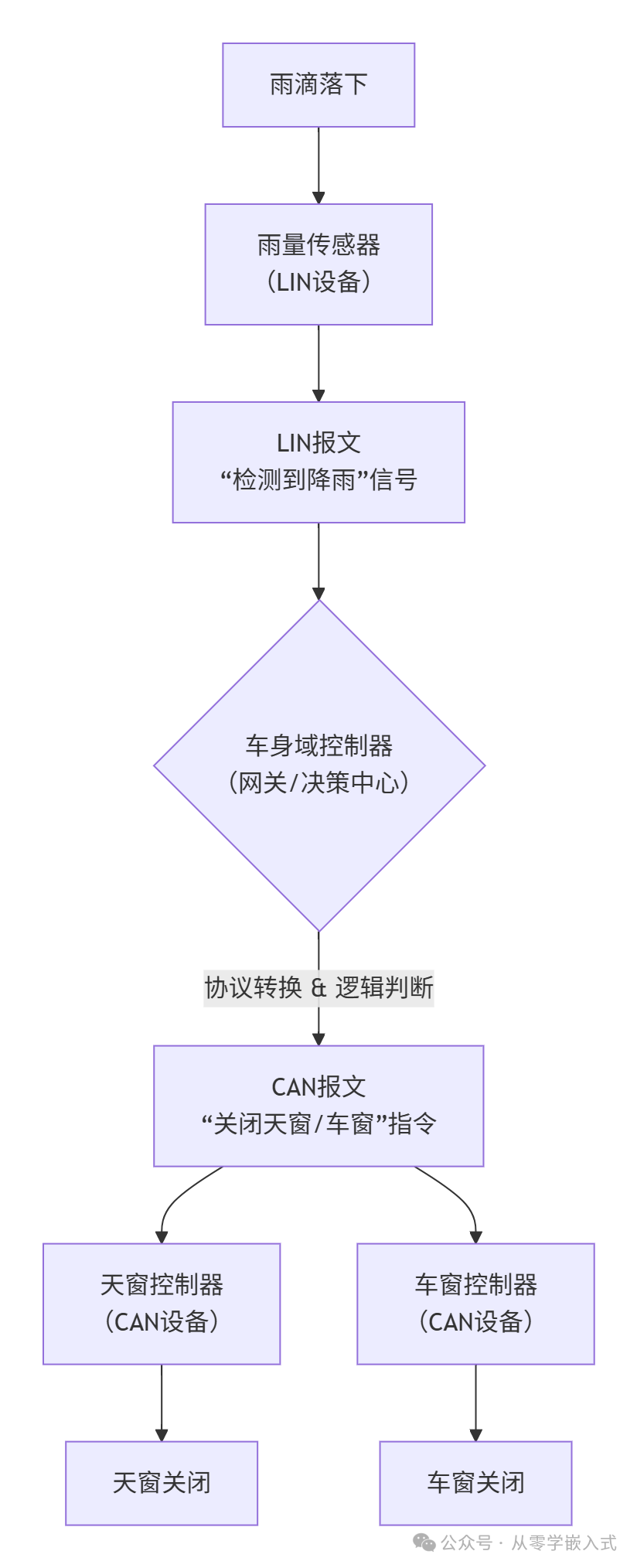 Through this example, you can intuitively see:
- LIN is like a “note” passing simple messages in a small area.
- CAN is like a “broadcast” announcing important notifications in a public area.
- Body Domain Controller is like a “manager” of a department, responsible for receiving notes, understanding information, and then issuing action instructions through broadcasts.
Why are there so many different “languages” (protocols)?The answer is the balance of cost and efficiency. Using “broadcast” (CAN bus) to transmit a simple instruction like “close the window” is too resource-intensive. Therefore, automotive engineers have designed networks with different speeds and costs, combining them like a network to form an efficient, reliable, and economical whole.4. How Do Engineers “Diagnose” Cars?With such complexity in cars, how do engineers troubleshoot when problems arise? They have a powerful “stethoscope”—professional development and diagnostic tools.Imagine a scenario where an engineer is troubleshooting an intermittent communication fault. His “workbench” looks like this:
- Hardware: A laptop connected to a USB-CAN analyzer (like a high-end USB network card, specifically designed to “listen” to automotive network data).
- Software: The computer runs professional software like CANoe.
- Diagnostic Process: The software interface displays a flurry of messages. The engineer sets filter conditions to find the problematic message. He may discover that a message that should appear every 10 milliseconds occasionally delays to 100 milliseconds, and its corresponding data curve also shows jitter or interruption. This “abnormal” message will be highlighted in red, becoming a key clue to solving the problem.
This “forensic-style” diagnosis is one of the daily tasks of embedded engineers, turning invisible network issues into tangible data evidence.
Technical Advancement: How CAN FD Achieves Speed Increase?
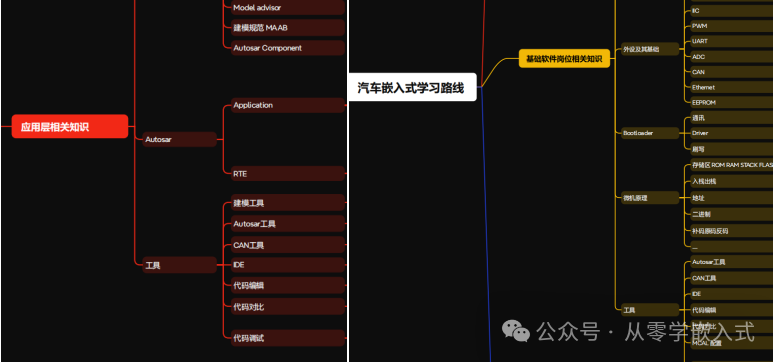
As functions become more complex and the amount of data to be transmitted increases, the traditional CAN bus (maximum 1Mbps, 8 bytes of data) becomes inadequate. Thus, CAN FD (Flexible Data Rate CAN) was born. Its innovations are illustrated in the following diagram: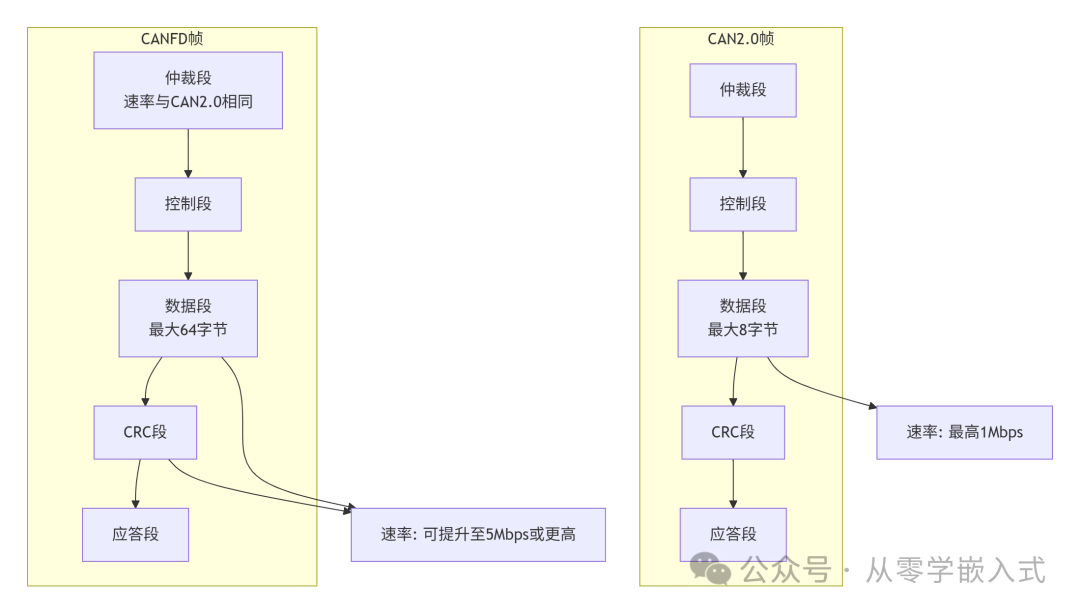 In simple terms, CAN FD is like an “intelligent highway”: when there are few vehicles and fair access to intersections (arbitration phase), everyone drives slowly to ensure safety; once the right of way is determined, they enter the wide main road (data phase), and the speed can instantly increase, allowing for rapid passage of large amounts of data. This ability for “dynamic speed increase” makes CAN FD the backbone network of current mainstream vehicles.5.How Can Beginners Enter This Field?Having read this, are you intrigued by automotive embedded systems? If you want to become a related engineer, how should you plan your learning? The following diagram outlines a clear progression path for you:
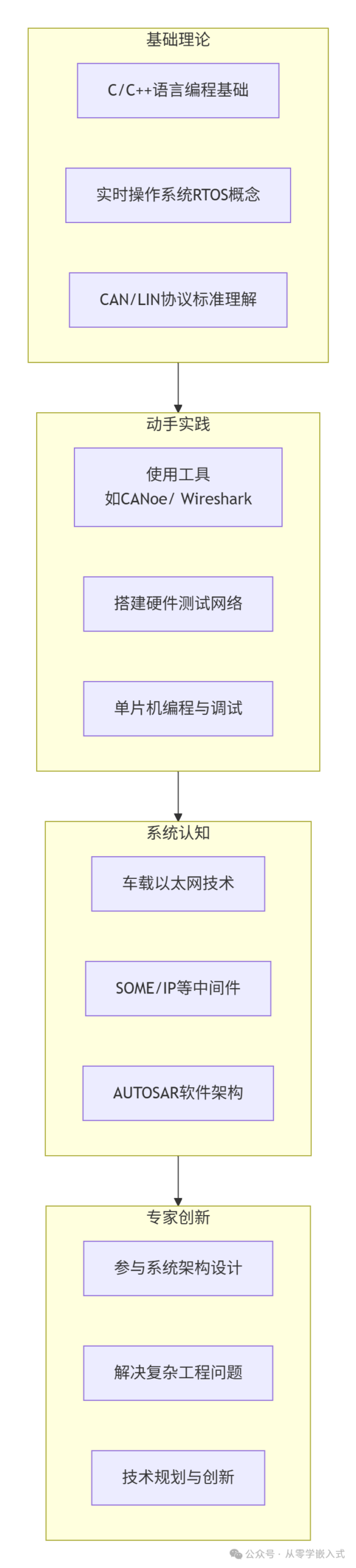 Advice for Beginners:
- Don’t be afraid of hardware. Buy an STM32 or Arduino development board and light up an LED yourself; this will leave a deeper impression than reading ten books.
- English is important. Most cutting-edge technical documents and data sheets are in English.
- Stay curious. Ask “why” about the automotive features in your daily life and try to find the answers.
6. ConclusionAutomotive embedded systems are an interdisciplinary field that integrates computer science, electronic engineering, and automotive engineering, driving unprecedented changes in the automotive industry. From simple door control to complex autonomous driving, countless engineers are building a precise collaborative system in the embedded world.I hope this guide opens a window for you, allowing you to glimpse this hardcore yet fascinating world. Perhaps the next innovation that changes the future of automobiles will stem from your curiosity at this moment.Follow usFOLLOWCLOSELY Join the group chat to get
Interview
Materials
100+ interview cases
Learning
Path
Automotive development learning path
Learning
Guidance
Multiple engineers with over 10 years of experience from major companies
Online guidance
Learning
Communication
Many developers communicate together
Helping you learn
 Like + Follow, scan the code and note (public account) to add friends, get AUTOSAR materials