|
After more than half a century of development, the robotics industry may be on the verge of a moment of looking up at the stars. |
Written by | Han FengtaoSource | Digital Time
All images in this article are sourced from the original text on Zhihu
This article is authorized for reprint by Digital Time
Introduction
Challenges in the Robotics Industry
Developing robots that can learn about the world and interact with objects within it has always been one of the most important and yet unfinished challenges in the field of robotics.
In recent years, the robotics industry has been “empowered” by countless companies claiming to use AI, but traditional AI has not been as intelligent as expected. The training costs are high, and the generalization ability is weak. Apart from its applications in the field of robot vision (which should strictly be considered as the field of computer vision rather than robotics), the implementation in areas where robots perform continuous and complex actions with significant physical interactions and operational causality has not been optimistic.
The breakthroughs in large models regarding natural language continuous dialogue, general understanding, and few-shot/zero-shot learning have finally brought a glimmer of hope for transformation at the software level for robots.
Current Limitations of Robots
Although they are called robots, current robots are still far from the all-powerful machines depicted in science fiction movies. More objectively, today’s robots are more akin to programmable specialized devices.
The penetration rate of robots in human society remains very low. For instance, in 2022, approximately 300,000 industrial robots were sold in China, with a total stock between 1.5 million and 2 million units. Given that there are about 100 million manufacturing workers in China, where typically one robot replaces 0.5 to 2 workers, the average penetration rate of industrial robots is around 2%. This means that the vast majority of production work in factories is still performed by humans.
In the commercial and service sectors, the penetration rate of robots is even lower, to the point of being negligible.
Why are robots so popular, yet their applications are so few? Why do robot sales never seem to increase?

Analysis of the reasons why robots have not achieved larger-scale applications
Setting aside price factors, the main bottleneck for the limited application and poor usability of robots lies in the software systems, specifically that existing robotic application software cannot fully leverage the capabilities of current robots. Although the performance of robotic hardware is still far from that of the “Terminator,” the overall hardware capabilities have reached a commendable level.
Robots are typical electromechanical integrated products, where software and hardware are mutually restrictive yet mutually reinforcing entities.
Enhancing robotic capabilities can lead to better performance, which in turn supports more powerful software, and stronger software enables more applications. More applications expand the market, prompting robot manufacturers to develop more capable robots, thus creating a virtuous cycle for the robotics industry.
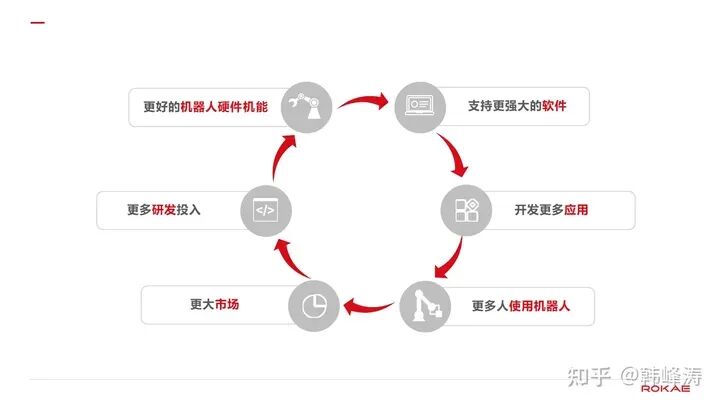 Positive cycle of industry development
The emergence of large models has completed the technological foundation for the robotics industry to leap from 1% to 10%, which is why the industry is focusing on the combination of robots and large models.
What Can Large Models Do?
This section provides an overview of the current capabilities of large models across various fields. Readers familiar with this content can skip to the next section.
When previously asked about the potential of AI in the field of robotics, I consistently expressed the view that AGI would be difficult to achieve in the short term, and that AI could only be applied in specific vertical fields of robotics. I never expected to be proven wrong so quickly.
The definition of a large model given by ChatGPT is:
A large model refers to a machine learning model with a significant number of parameters and high computational resource requirements, capable of handling complex tasks and achieving superior performance.
In other words, it is a machine learning model with a large number of parameters and high computational resource requirements, used to handle complex tasks and achieve excellent performance. Models like GPT and BERT fall into the category of large models, although there is no clear definition of how many parameters constitute a large model, it is generally considered that models with over 1 billion parameters can be classified as large models.
Large models have demonstrated impressive capabilities in various fields, such as:
In the field of natural language processing, ChatGPT, which has sparked global attention, can engage in fluent conversations with humans, write various professional articles, understand input paragraphs and provide various analyses, program various code, assist in bug finding, formulate meeting agendas, and even discuss the meaning of life with users. Additionally, ChatGPT is supporting an increasing number of plugins, and its output is no longer limited to text format; using plugins effectively can significantly enhance ChatGPT’s output efficiency. There is a wealth of information and tutorials available online about ChatGPT, which will not be elaborated on here.
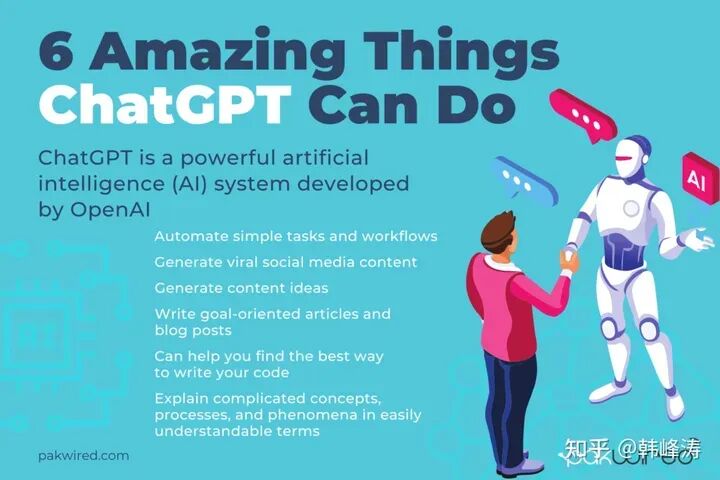 Six things ChatGPT can do
In the office sector, Microsoft’s Copilot supports Excel, Word, PPT, Outlook, Teams, and OneNote, significantly improving work efficiency. For example, in Word, you can ask Copilot to automatically generate articles based on topic requirements and refine them based on feedback. In PowerPoint, it can automatically generate a draft presentation based on a given topic, including themes, layouts, images, etc., and allows intuitive natural language communication and modifications for each slide, achieving a high level of automation. In Excel, Copilot can automatically generate specific data pivot tables and answer questions like “Analyze the data and list three key trends,” as well as analyze the reasons behind changes in certain data categories. In summary, the addition of Copilot allows computers to automatically complete many basic document tasks, greatly enhancing the efficiency of the Office suite.
Below is a video from the AI Exploration Department
In the field of image generation, large models like Midjourney and DALL-E can create illustrations, design products, and generate new business ideas based on input text. By using appropriate commands and parameter combinations, various high-quality images can be generated.
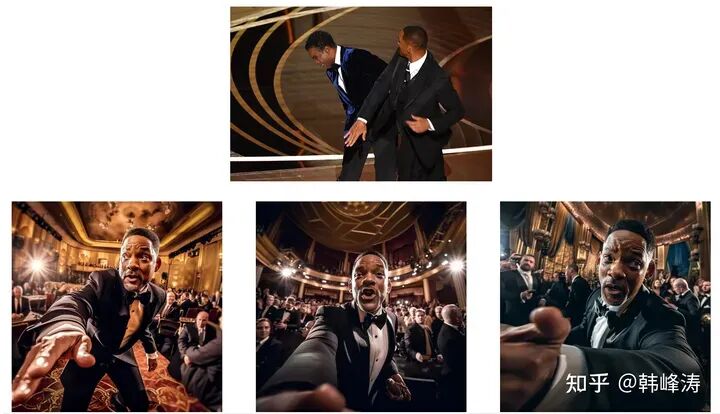 The above image shows a news photo of Will Smith slapping Chris Rock, while the three images below are GoPro perspective images generated by MidJourney, with the spell self-seeking
In the education sector, large models will have a tremendous impact on education models focused on imparting knowledge and skills, as everyone will have an intelligent assistant that stores a vast amount of knowledge, eliminating the need to memorize existing knowledge. The education model will shift towards cultivating more innovative, communicative, and reasoning abilities. On a practical level, large models can serve as one-on-one teaching assistants, making personalized education feasible in terms of cost and effectiveness. They can automatically generate suitable teaching content and question banks based on students’ historical data and complete homework grading; they can read a book and discuss its ideas and meanings with students; they can act as foreign language teachers, conversing with students and pointing out grammatical or pronunciation errors.
【【TED Talk】ChatGPT—An Amazing AI Super Tutor for Students and Teachers:https://www.bilibili.com/video/BV1AP411m77K/
From Large Model Training to Fine-Tuning Large Models
The article “On the Opportunities and Risks of Foundation Models” presents a general paradigm for using AI to solve tasks in the era of large models, which involves generating task/industry-specific large models from foundational models through fine-tuning.
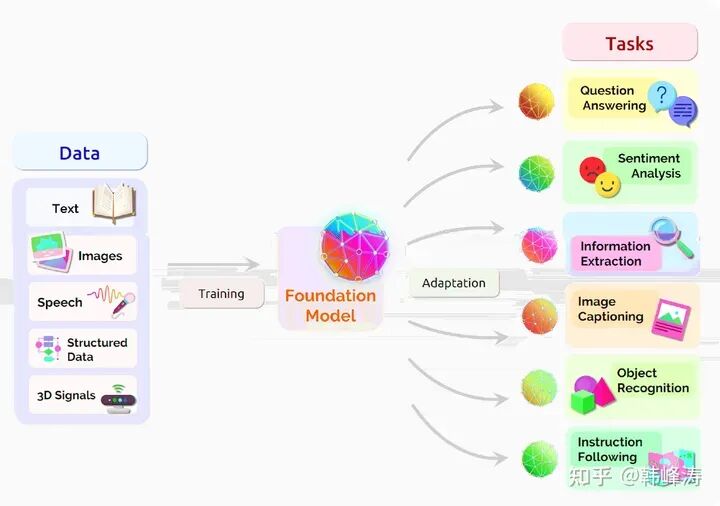 Using multiple modal data to train foundational/base models, which are then fine-tuned for various industry applications, transforming into industry-specific large models
Prior to large models, AI models were often trained separately for specific fields, and new scenarios typically required going through a series of processes such as “data collection–annotation–training (parameter tuning and optimization iteration)–deployment–application”. Even experienced AI engineers needed days or even weeks to complete this, and the models trained for field A were suitable for A, while model B was better for B, resulting in low generalizability and weak rapid deployment capabilities. This made it difficult to apply in many time-sensitive situations (such as frequently changing industrial sites or dynamically changing commercial/service scenarios).The emergence of large models has transformed the high-cost (financial & time) manual refinement model of vertical field AI development into a form of “pre-trained large models + specific task fine-tuning”. This approach can significantly enhance the generalization ability of models and improve development speed, allowing for a certain degree of general intelligence in scenarios where “precision” requirements are not high.“Are you trying to tell us that a species that communicates with each other using sound waves at an incredible rate of 1 to 10 bits per second, without any memory inheritance, can create a level 5 civilization?! And this civilization evolved without any external advanced civilization nurturing it?!” —— Commander of the Carbon-Based Fleet in the Milky Way, Liu Cixin, “Rural Teacher”In terms of information storage and transmission speed, silicon-based computers far exceed carbon-based humans.The foundational model brings “memory inheritance,” combined with the epic increase in communication speed brought by silicon, indicates that the progress in the AI industry driven by large models will be revolutionary.
When Robots Embrace Large Models
AI serves as the brain, the robot’s motion controller acts as the cerebellum, and the robot itself is the body; together they form a complete robotic system.
What Large Models Bring to Robots
The most significant progress and potential for deep integration with robots comes from large language models (LLMs), whose main characteristics and advantages include:
-
Possessing foundational knowledge across multiple domains
-
Good understanding of natural language
-
Basic capability for continuous dialogue and sustained interaction
-
Strong zero-shot/few-shot learning ability
Mapping these capabilities to the field of robotics, the applicable robotic tasks for large models include:
- Task description
- Task decomposition
- Program generation
- Task interaction
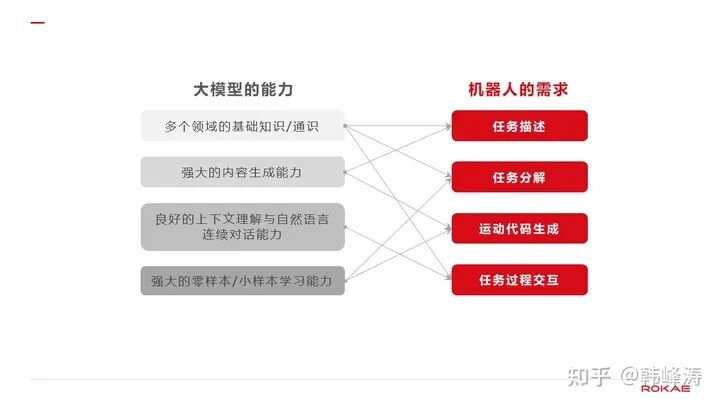 Mapping relationship between large model capabilities and new demands for robots
When these capabilities are combined, they form the dream of robotic developers: task-level programming/interactivity.Simply telling the robot what task it needs to perform allows it to understand what needs to be done, break down the task actions, generate application-level control instructions, and correct its actions based on feedback during the task process, ultimately completing the task assigned by humans. The entire process requires little to no human intervention or confirmation, essentially achieving autonomous operation of the robot without the need for robotic application engineers to master specialized operational knowledge.
Task-Level Programming for Robots
Once task-level programming or interaction is realized, the following scenarios may become a reality:

To understand the importance of task-level programming in the field of robotics, we first need to know the steps a robot goes through from receiving instructions to actual movement, and how to control the robot to complete the required actions for the task.
Currently, robotic control frameworks generally adopt a hierarchical control (Hierarchical Structure) method, where different literature divides robotic programming and control levels into multiple tiers, such as task level, action level, joint level, or in “Robotics Modelling, Planning and Control,” it is divided into task level, action level, initial level, servo level, etc.In hierarchical control methods, higher levels are responsible for task definition and action planning, while lower levels are responsible for real-time motion control, as shown in the diagram below:
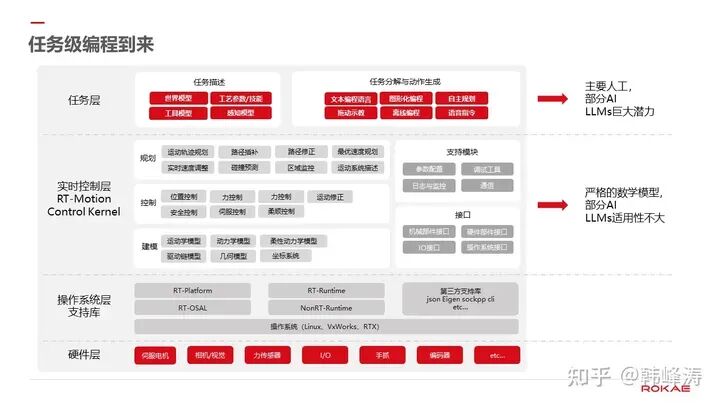 Possibility of achieving general-purpose robotic control software (robot brain) for industrial/commercial/service sectors
The future of robots will continue to test the wisdom and capabilities of many people inside and outside the industry, but in the historical flow of development, new turning points or opportunities will eventually arrive as expected.
- Task definition and description (e.g., go get a glass of water);
- Decomposing the task into actions (breaking down the process from picking up the cup to turning on the faucet to filling the cup into small actions);
- Robotic engineers program the robot based on the decomposed actions, generating code (which can be C++, Python, or a custom robotic programming language);
- Control-execute-feedback (the main function of traditional robotic control);
Before the advent of large models, generally only the fourth step of control and feedback was automatically completed by computers, while the previous steps of task definition, decomposition, and robot motion code generation were primarily completed by robotic engineers. The main work of many robotic application engineers is to understand tasks and break them down into suitable actions, using robotic programming languages to write, tune, and deploy robotic application programs.Large models are not suitable for precise low-level control but are more suited for relatively vague task-level planning. Directly generating application-level code for robots through large models appears to be the most technically feasible and likely to be quickly implemented direction.For example, if a robot is instructed to go to the kitchen and bring back a glass of water, just the sub-task of turning on the faucet presents many challenges for the robot. The faucet style varies widely, and the method of turning it on is not uniform. The robot must first understand what type of faucet it is facing, how to turn it on, and to what extent it can balance the speed of filling the cup while avoiding splashing and overflow. This task, which is simple for humans, previously required robotic application engineers to write code line by line. The general understanding ability and strong zero-shot learning capability of pre-trained large models are very suitable for generating action-level code to direct the robot’s actions to complete tasks.Of course, relying solely on AI to autonomously generate robot code may lead to incompleteness and safety issues, which would require human intervention (RLHF) for confirmation, modification, and tuning. Through the collaboration of AI and humans, the goal of low-threshold usage and rapid deployment of robots can be achieved.
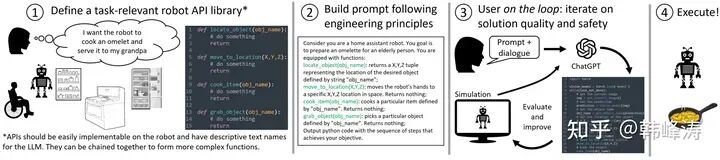 Defining task-level APIs–Designing prompts to help the model understand the API–Large model generates programs ↔ Human corrections–Execution after human confirmation
For more information on task-level programming for robots, there is a very detailed article available for reference.Link: https://www.zhihu.com/question/58830644/answer/159511581
From Engineers to Users
As task-level programming/interactivity brought by large models gradually lands in various application fields, the users of robots shift from engineers to general users.The few-shot and zero-shot capabilities of large models allow robots to quickly provide a directionally correct and basically usable overall solution for various new applications, without requiring users to possess the previously necessary specialized robotic knowledge.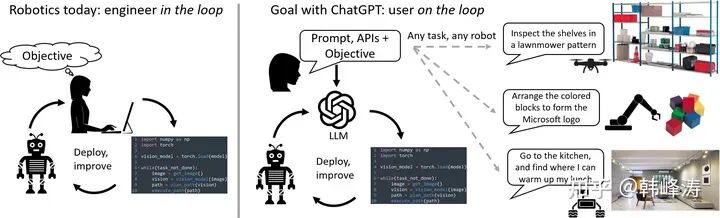 The reduction of usage thresholds is the starting point for a product or industry to achieve large-scale rapid growth.
Robots as Anchors Between AI and the Physical World
Instructions generated by AI systems that require physical interaction with the external environment must be executed by robots; robots are the best carriers for AI systems to land in the physical world.We live in a three-dimensional physical space, where almost everything that happens requires various forms of physical interaction with surrounding objects. For AI, as a computer software system, to interact with the outside world, it must rely on physical entities to accomplish this. When AlphaGo played against Lee Sedol, it still required a human to execute the moves, which could have been replaced by a robot or robotic arm.
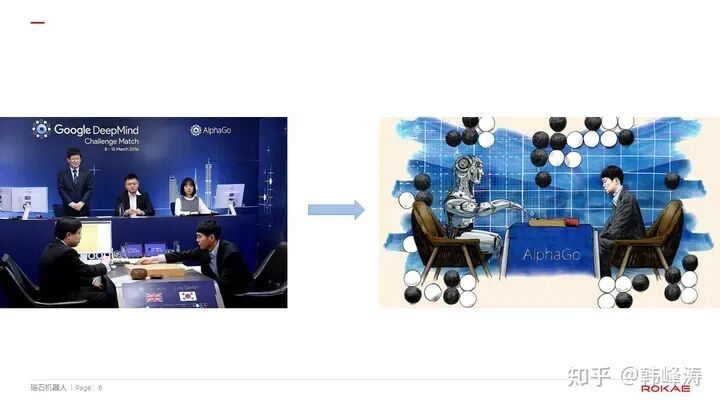 The person representing AlphaGo in the match against Lee Sedol could be replaced by a robot
The extent to which any system can influence the external world depends on its output capabilities.Computer systems produce virtual outputs that cannot physically affect the real world.In contrast, robots possess both virtual (equivalent to computers) and physical output capabilities.
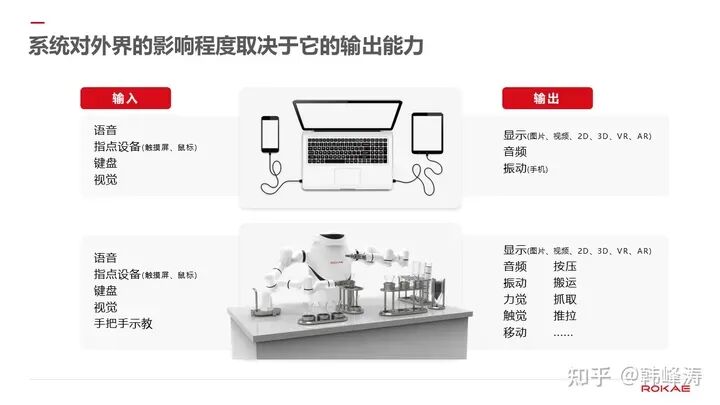 Robots have more types of output capabilities
The multi-input and multi-output capabilities are fundamental to general-purpose robotic platforms and form the hardware basis for robots to engage in a variety of tasks. This also constitutes the foundation for robots as platforms in the physical world. Typically, platform-based products have the following characteristics:
- Basic functions (facilities) are sufficiently complete
- Open architecture and rich interfaces (APIs)
- Comprehensive development tools;
Among these, having sufficiently complete basic functions is a fundamental or enabling characteristic.For example, early computers only had calculator-level capabilities and could only perform simple calculations. Even with an open architecture and rich interfaces, it was impossible to develop a video chat app. Similarly, if a robot only has simple grasping and moving capabilities, it cannot complete more complex tasks.Before the advent of multi-modal large models, even if robots had multi-modal hardware capabilities, it was still challenging to use a single model to cover all situations at the software level. For traditional NLP models, the input and output are both in text format, making it very difficult for robots that only use NLP models to “understand” what different input and output combinations can or cannot do.Now, with multi-modal large models, robots can finally begin to understand how to reasonably utilize their various output capabilities to better complete tasks.Thus, computers serve as the universal platform for the virtual world, while robots serve as the universal platform for the physical world.Of course, how knowledge between language large models, image large models, and other multi-modal large models is reflected and linked remains a challenge that has not been well resolved, but at least we now have the technological foundation to realize this vision.
Challenges Ahead
Uncertain Safety
The safety involved here includes two parts: operational safety and data safety, with operational safety further divided into task-level safety and operational-level safety.Safety of Task GenerationHere, safety refers to whether the task actions generated by large models can adapt well to new environments and situations without causing damage or triggering safety consequences. Essentially, this is a robustness issue of model outputs; one of the challenges in using robots in real-world environments is that the robot’s actions will change the environment itself, and the changes in the environment will affect the robot’s next actions. Whether the robot can update tasks and execute them smoothly in a new environment is crucial for the applicability of robots in unstructured scenarios.For example, if a robot is helping in the kitchen by using a steamer to steam buns, opening the steamer door to place the buns inside does not require much consideration, as long as there is no collision. However, when it comes time to open the steamer to take the buns out, the robot must consider whether there are people nearby, as the high-temperature steam released when opening the steamer could scald them. Whether the robot can recognize this and consider the impact of high-temperature steam on people when generating the task action “open the steamer just used” (if no one is around, it can open directly; if someone is approaching, it should wait or remind them to step back) is a basic safety requirement.Generating actions like “wait for people to move away before opening the steamer door” or “play a voice reminder to alert people about the high-temperature steam” are simple for the robot, but whether it can generate these action instructions at the right time requires the robot to possess common sense.Although large models have strong general knowledge capabilities, ensuring that every generated task complies with safety standards for the given context remains an ongoing optimization challenge.Safety of Operational ActionsIn addition to the above task generation issues that can be resolved with common sense, in many specialized fields, robots must also pay attention to whether subtle operational actions comply with safety standards. For instance, in robotic surgery, whether the robot-generated actions for grinding bones or cutting soft tissues meet surgical requirements and do not cause additional harm to patients is also a critical consideration.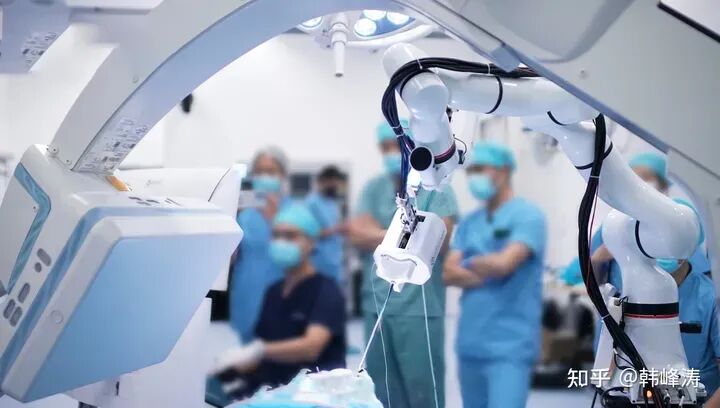 Improving the safety of AI and robotic systems is a long-term process that relies on the continuous efforts and explorations of practitioners.However, from an engineering implementation perspective, we must view safety issues correctly; safety does not equate to absolute risk-free.Another interpretation of safety is “the absence of unmanageable risks.”Imagine, is flying in an airplane safe? Is driving in a car safe?If we overly emphasize safety issues and hesitate, robots will never achieve large-scale promotion.Therefore, a reasonable division of responsibility must be established, with both the designers and users of robots sharing the risks, acknowledging that the coexistence of benefits and risks is a prerequisite for the large-scale promotion of robots.In fact, this form is ubiquitous in our lives.Globally, human drivers kill 1 million people each year due to traffic accidents; approximately 3 million deaths are caused by work-related accidents and occupational diseases; and over 2.5 million deaths result from medical errors or incorrect diagnoses.The introduction of robots + AI systems will significantly reduce casualties across various industries; robots do not need to be perfect; they just need to perform better than humans.Data Security and Information SafetyWhen training and using large models, sensitive data issues inevitably arise, such as the presence of sensitive data in the training corpus or in the inputs provided to the large model.Data and information security is an unavoidable topic, and there is currently no unified standard. How to balance the comprehensiveness of high-quality data with information security is a problem that practitioners need to gradually solve.However, from the perspective of applying large models in robotics, if we shift our development goal from general-purpose robotic AI to “skill-based robotic AI with generalization capabilities,” things become simpler.We hope to use large models to replace some of the work of robotic application engineers, or we expect robotic application large models to possess general knowledge and skills of welders, assemblers, painters, massage therapists, and surgeons, and these individuals can perform their jobs without needing to master sensitive national data or even know the sensitive data of enterprises.
 They only need general knowledge and skill data, and large models are no different.Of course, this does not mean that data security issues are unimportant in the application of large models. In the future, a country may only have a few foundation models, and from an infrastructure perspective, data security is certainly very important and requires efforts from practitioners to address.However, from the perspective of a specific application, at least for now, we do not need to overly focus on data security issues.
Lack of High-Quality Training Data
Robots need to perceive environmental states through various sensors and then execute actual actions to complete tasks. Therefore, training large models for robots requires a substantial dataset of robots interacting with the environment in the real world.Compared to the image and natural language processing fields, where training data can be obtained in large quantities from the internet or quickly and cheaply through human annotation, high-quality data for training robots to learn new tasks and skills is very scarce. The main reasons include:
- Compared to CV and NLP, robots typically require more time to execute tasks, leading to lower data collection efficiency;
- During CV and NLP training, only virtual information is processed, while robot training impacts the surrounding environment, potentially causing damage to the environment or task objects, resulting in financial losses, which are unavoidable before training is completed;
- The number of robots in use is still too low, further exacerbating the difficulty of collecting training data.
Additionally, considering that robots face more complex environments and interaction modalities when executing tasks, the scale of the datasets required is larger than in the CV and NLP fields. For example, the latest GPT-4 has just begun to understand the content shown in the image below (when a boxing glove falls, the ball will bounce), and the industry has started to describe GPT-4’s understanding level as “terrifying,” but this level of understanding is merely a basic requirement for robots that need to execute various complex physical interactions. Using simulation methods can quickly and cheaply obtain some training data for robots, but historically, due to limitations in the precision of simulation models, accuracy of physical models, and accuracy of perception data, there has been a significant gap between simulated data and real data, making it possible to train only in scenarios with low precision requirements or weak contact in simulated environments. Researchers in the field of sim-to-real have been striving to narrow the gap between simulated and real data to ultimately achieve large-scale data collection and training through virtual scenarios.Another possible direction is to leverage the achievements in visual and natural language processing to use LLMs to automatically generate datasets for training robots, significantly reducing the time and financial costs of data acquisition. However, the usability of training data generated automatically by LLMs remains an unresolved challenge.Observational learning is also a potential direction, where models learn and understand certain skills by watching human instructional videos, but this research is still in relatively early stages.In summary, in the context of lacking high-quality data, simulation data, real robot data, instructional videos, and natural language data may all play crucial roles in training foundational large models for robots.
Outlook
Impact on the Robotics Industry
Compared to industries like computers, smartphones, and automobiles, the AI and robotics industry is still in its early development stage. The capabilities of large models and robots are not yet strongly correlated; they are two independent yet closely related components of the traditional concept of a “perfect robot,” similar to the software and hardware of a computer.Therefore, in the foreseeable future, the pan-robotics industry circle, which includes AI and robotics, will differentiate into two types of companies:
- Robotics companies focused on core components and precision control, providing powerful, highly open, and cost-effective standard robotic products for the industry;
- Companies that provide robotic application products for specific scenarios/industries based on large model application technologies, leveraging foundational models provided by large companies along with their industry know-how to offer comprehensive application solutions (including software and hardware);
Under this assumption, the evaluation metrics and definitions for robotic products are about to change.Just as in the automotive sector, where cars have traditionally been viewed as transportation tools primarily for moving people from point A to point B, with the main focus on handling, passability, chassis tuning, and quality, the development of electric and intelligent vehicles has shifted the focus to sensor capabilities, autonomous driving levels, cabin intelligence, and even features like refrigerators and televisions. The car remains the same, but the parameters and metrics defining what constitutes a good car have changed.Similarly, for robots, while previous concerns were about precision, speed, and vibration suppression, future evaluations may focus more on perception capabilities (number of sensors), safety, ease of operation, environmental interaction capabilities, and openness of interfaces.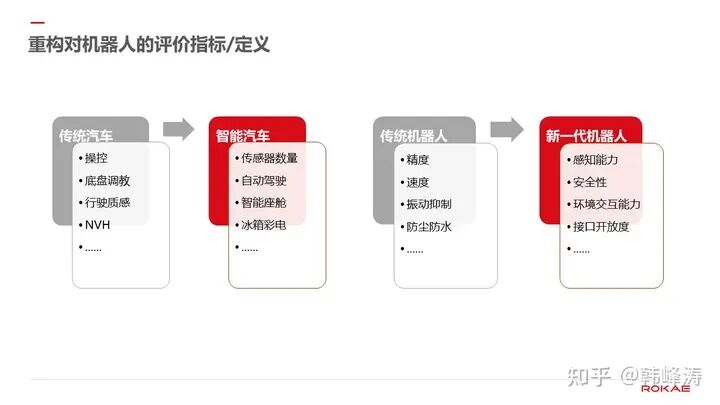 We often say that robots are software products. With the development of AI large models, the functions of robots are increasing, and the definition of robotic software will become increasingly evident. If robotic companies do not possess strong software capabilities and services, they will be unable to communicate directly with customers, unable to obtain valuable user data, and ultimately become low-margin, low-threshold assembly companies.This statement may seem alarmist, but one thing is certain: large models will bring systemic changes to robotic software systems. Robot manufacturers that do not actively embrace large models will gradually lose vitality in the new competition, just as traditional car manufacturers that failed to develop their own intelligent driving systems did.It is foreseeable that the previously fixed forms of industrial robots, collaborative robots, and mobile robots will not meet the future demand for more diverse tasks; multi-modal large models will inevitably require multi-modal (perception, movement, operation, etc.) robots.
Useful Robots ≠ Perfect Robots
The impressive performance of AI large models indicates that the AI industry has emerged from a relatively low period caused by the challenges in the implementation of advanced autonomous driving and intelligent assistant technologies, and is beginning to rise again. However, the combination of robots and large models is still in rapid development.While we cannot avoid the laws of market dynamics, maintaining reasonable expectations can help us avoid detours and accelerate the pace of implementation.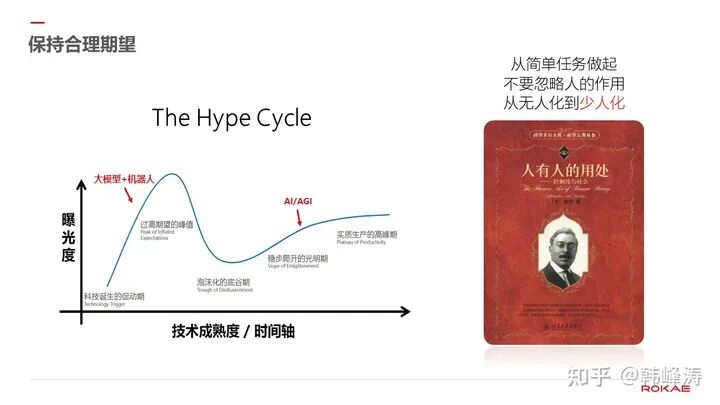 Decades of experience have shown that people often overestimate the upper limits of robotic capabilities while underestimating the market space that the lower limits of robots can bring.Some typical questions related to this include:“Your robot cannot completely replace this person’s job; why should I buy it?”“The efficiency of robots is not as good as that of humans; from the perspective of replacing humans with machines, the calculations do not add up.”In reality, when robots are less efficient than humans in certain aspects, they can balance this by increasing the duration of robot operation, such as cleaning, night operations, and low-frequency long-distance transportation. Many chemical and pharmaceutical laboratories are implementing composite robots to automate synthesis tasks previously performed by engineers. Robots with high-precision micro-manipulation capabilities that can operate 24/7 can free many highly skilled engineering technicians trapped in repetitive operational scenarios.In the foreseeable future, robots will not be able to achieve or replicate human capabilities 100% in most work scenarios. However, if we view this from the perspective of reducing personnel or improving the quality of work, robots that can only partially replace human labor still represent a significant market. A typical example is hotel delivery (takeout) robots, which, while still far from the capabilities of qualified hotel staff (in terms of answering questions, delivering items, guiding, and cleaning), currently only solve the high-frequency simple problem of delivering items to guest rooms, yet still bring cost savings and efficiency improvements to hotels, leading to widespread adoption of such products by almost all mainstream hotel chains. In fact, if a mainstream hotel does not have robots today, it would seem somewhat strange.The combination of robots and large models will make it possible for more scenarios like hotel delivery robots to emerge, and in the future, composite robots with multiple functions will provide more services and possibilities than the current simple mobile robots, ushering in the largest wave of development in the robotics industry.
Impact on Society
True progress comes from the elimination of jobs. —– Mankiw, “Principles of Economics”Undoubtedly, robots + AGI will replace a large number of entry-level and mid-level content producers and low-skill workers.While many people say that new technologies usually create more new jobs while eliminating some positions, this time it may be different. The advancement of information technology will lead to more types of jobs, but the absolute number of jobs will decline.From current information, robots + AGI largely belong to labor-saving technologies, and due to their inherent strong capabilities, most jobs related to them can be absorbed by themselves and robotic technologies (rather than requiring humans to take on numerous jobs as in previous industrial revolutions), the number of jobs created by this technological advancement will be far less than the number of jobs it eliminates.From a broader perspective, more shocking facts may emerge. Japanese author Noriko Arai, in her 2019 book “When Artificial Intelligence Enters Prestigious Universities,” introduced an AI robot developed specifically to pass the entrance exams for the University of Tokyo. From 2011 to 2016, this AI system, known as the University of Tokyo Robot, was able to meet the entrance requirements of over 70% of universities in Japan. The book also mentions that with the development of AI, half of the population may lose their jobs.However, the book “When Artificial Intelligence Enters Prestigious Universities” was published in 2019, and the author did not anticipate the emergence of large models. The descriptions of AI threats in the book mainly focus on knowledge retention, search, and matching, while the lack of common sense understanding in AI was considered the biggest flaw that would prevent AI from surpassing humans in the short term, with common sense understanding being one of the most important advantages of humans.Yet, this very aspect, which was thought to be the last hope for humans, has largely been overturned by the emergence of large models. This means that humans can no longer compete with AI in terms of rote knowledge retention, and the previously assumed advantages in common sense, understanding, and reasoning have also shown significant cracks.In a recent interview with CNBC, Elon Musk was asked, “When artificial intelligence exists and continues to improve, I don’t know how to advise my children on career development. I’m curious, when you think about providing career advice to your children, what would you tell them is valuable?” Musk paused for about 20 seconds and gave this answer:“Well, that’s a tough question to answer. I guess I would just say to follow their heart in terms of what they find interesting to do or fulfilling to do. You know, try to be as useful as possible to the rest of society.”Perhaps this is a subtle way of expressing that there is a 99% chance your children will be replaced by AI and robots in the future, but there is nothing we can do about it.A short story by Liu Cixin, “Morning Awakening,” includes a dialogue:“This primitive person has gazed at the stars for longer than the threshold of the oath, and has shown sufficient curiosity about the mysteries of the universe. Up to this point, ten such exceeding events have been observed at different locations, meeting the alarm conditions.”… The risk manager revealed that characteristic smile and said, “Is that hard to understand? When life becomes aware of the existence of the mysteries of the universe, it is only one step away from ultimately unraveling this mystery.” Seeing that people still did not understand, he continued, “For example, Earth life took over 4 billion years to first realize the existence of the mysteries of the universe, but that moment was less than 400,000 years away from your construction of Einstein’s equator, and the most critical acceleration period of this process was less than 500 years. If that primitive person’s few minutes of gazing at the universe is akin to seeing a gem, then what you call human civilization is merely bending down to pick it up.” Ding Yi nodded in realization: “That great star-gazer!”The future of robots will continue to test the wisdom and capabilities of many people inside and outside the industry, but in the historical flow of development, new turning points or opportunities will eventually arrive as expected.After more than half a century of development, the robotics industry may be on the verge of a moment of looking up at the stars.
 When “humans” look up at the stars, it signifies our extraordinary destiny
✦ Highly Recommended✦
The 20th China Manufacturing Digital Transformation Summit Forum
2023-07-19 · Xi’an
Rare opportunity, register nowLong press the QR code or clickRead the original textto register online↓